

Motivation is a good spark and a poor engine. It can get you excited for a new program, a new gym, a new pair of shoes, or the first week of a reset. But if the whole plan depends on feeling inspired, training becomes fragile. One stressful workday, one bad night of sleep, one argument, or one boring session can make the plan feel optional.
The people who train for years are not motivated every day. They have fewer decisions to make. Their workout has a place in the week, the first step is visible, the minimum version is already defined, and missing a session does not turn into a personal trial.
This article is for anyone who keeps waiting to feel ready. The practical answer is simple: stop treating motivation as the requirement. Build a system that still works when motivation is average.
- Why motivation is unreliable
- What keeps training going instead
- How to build a low-motivation plan
- How to restart without drama
Motivation is real, but it changes too easily
Motivation is not fake. It matters. It can help someone begin, choose a goal, and push through a difficult set. The problem is that it changes with sleep, stress, novelty, environment, confidence, and immediate reward. A plan that only works on high-motivation days is not really a plan for normal life.
Physical activity guidance is built around repeatable weekly behavior, not emotional peaks. The CDC adult physical activity guidance recommends regular aerobic activity and muscle-strengthening work across the week. That kind of consistency requires a structure that survives ordinary fluctuations.
For strength training, this matters because progress comes from repeated exposures. One excellent workout is satisfying. Ten ordinary workouts done across several weeks are usually more important. The goal is not to remove emotion from training. The goal is to stop letting emotion vote on every session.
The cue matters more than the mood
A cue is the thing that starts the behavior before you debate it. Shoes by the door. A gym bag packed the night before. A calendar block that says exactly what session comes next. A dumbbell where you will see it after work. These things are not magic, but they reduce friction.
Research on habit formation supports the idea that repeated behaviors in stable contexts can gradually become more automatic. In a real-world habit formation study, automaticity increased over time as people repeated a chosen behavior in a consistent context. Training is more complex than drinking water with lunch, but the principle still helps: make the first action easier to repeat.
That first action should be specific. "Train more" is weak. "At 6:15, put on shoes and start the warm-up" is stronger. Once the warm-up begins, the session has momentum. You do not need to feel heroic to take the first concrete step.
Decide the minimum before you need it
Low motivation becomes dangerous when the only available options are "full workout" or "nothing." A minimum version gives you a third option.
For example, your normal workout might include six movements and some conditioning. The minimum version could be:
- one squat or hinge movement;
- one push movement;
- one pull movement;
- one carry, walk, or core movement;
- 15 to 25 minutes total.
This is not a trick to lower standards forever. It is a bridge for the days when the full plan is unrealistic. The minimum version protects continuity without pretending that time, stress, and recovery do not exist.
The important part is to write the minimum while you are calm. If you wait until the bad day, your brain will negotiate. If the rule already exists, you only have to follow it.
Use if-then plans for predictable obstacles
Most obstacles are not surprising. Work runs late. The gym is crowded. You sleep badly. A family obligation appears. You travel. You feel flat.
Implementation intentions are simple if-then plans: if a specific obstacle happens, then you do a specific response. A meta-analysis on implementation intentions found that this kind of planning can support goal achievement across many behaviors.
For training, useful examples sound ordinary:
- If I miss the gym, then I do the home minimum after dinner.
- If I sleep less than six hours, then I reduce load and skip extra conditioning.
- If the rack is taken, then I use dumbbell split squats and continue.
- If I miss Monday, then Wednesday becomes the next session, not the beginning of a guilt spiral.
The point is not to control life. The point is to reduce the number of decisions required when life becomes inconvenient.
Make the restart boring
Motivation culture loves dramatic comebacks. Training does not need them. If you miss a week, the best restart is usually boring: return to the next planned session, reduce load if needed, and continue.
Trying to punish yourself for missed sessions often creates more fatigue, more soreness, and another missed week. A restart should lower the emotional cost of coming back. The sentence you want is not "I ruined it." It is "The next session is the restart."
This mindset is especially important for beginners. A missed session is not evidence that you lack discipline. It is information about the plan, the week, and the amount of friction around the habit. Use that information to make the next week easier to repeat.
When you do not feel like training, do the warm-up first. After ten minutes, choose normal, minimum, or recovery. Do not decide from the couch.
Do not confuse support with weakness
Some people resist cues, reminders, and minimum plans because they think discipline should feel tougher. That is backwards. Support is not weakness. Support is design.
If your training depends on a perfect emotional state, it is actually less disciplined. A repeatable system accepts that you are human. It gives you structure when mood is high, low, or neutral.
This does not mean ignoring real health signals. If you are sick, injured, unusually exhausted, or dealing with significant mental health symptoms, the answer may be rest or professional support, not a motivational speech. Fitness discipline should never require pretending that pain, depression, anxiety, or burnout are just laziness.
Build the week around the least motivated version of you
When you plan training, imagine the version of you who has already worked all day. That person does not need a complicated spreadsheet, a long debate about exercise selection, or a routine that only works when the house is quiet. They need the next step to be obvious.
Write the first five minutes of the session as clearly as the workout itself. For example: change clothes, fill water bottle, start five minutes of easy walking, then do the first warm-up set. This removes the vague space where skipping usually happens.
Also decide what counts as success before the week starts. If the goal is two full sessions and one minimum session, completing that is success. You can always do more when life allows it. You are simply refusing to make motivation responsible for the entire structure.
Continue with a related guide
For the next practical step, read The Psychology of Getting Stronger. For a second perspective from the same topic cluster, continue with Why Strength Training Teaches Patience.
Conclusion
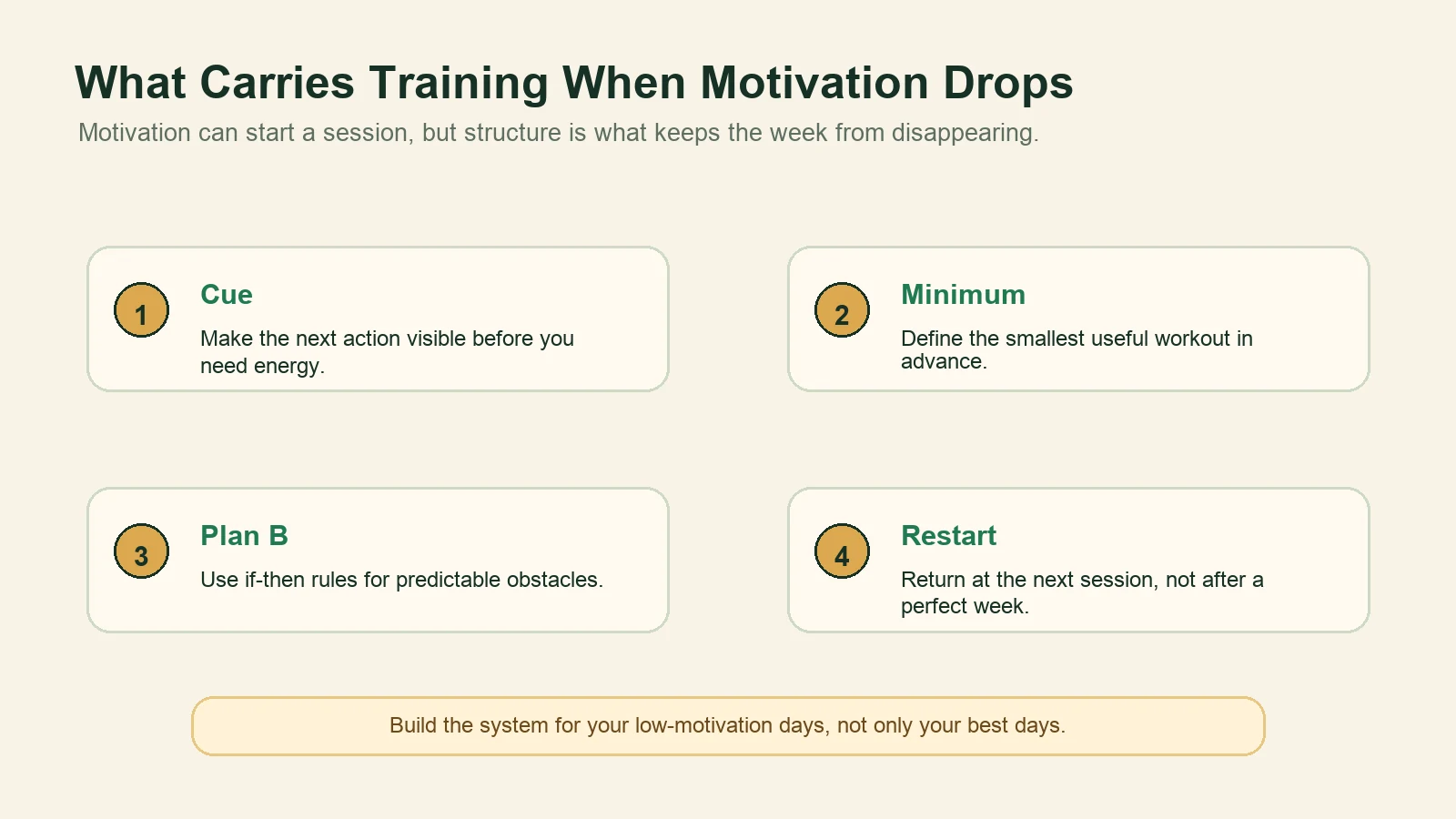
Motivation can help, but it should not be the gatekeeper. What keeps you training is a system: visible cues, a clear first step, a minimum version, if-then plans, and a restart that does not require self-punishment.
Build the plan for the days when you feel average. That is where long-term training is won. Not in the rare perfect week, but in the ordinary week that was easy enough to repeat.
FAQ
Should I wait until I feel motivated again?
Usually no. Start with the smallest safe first step, such as the warm-up. Motivation often follows action, but the plan should not depend on that happening every time.
Is a minimum workout enough for progress?
Not forever, but it can protect consistency during hard weeks. Use it as a fallback, then return to the full plan when life and recovery allow.