

Strength training teaches patience because the work and the result live on different timelines. You complete a set today, but the adaptations that support future performance accumulate through repeated sessions, recovery and practice. The delay can be frustrating. It is also one of the most useful lessons in the gym.
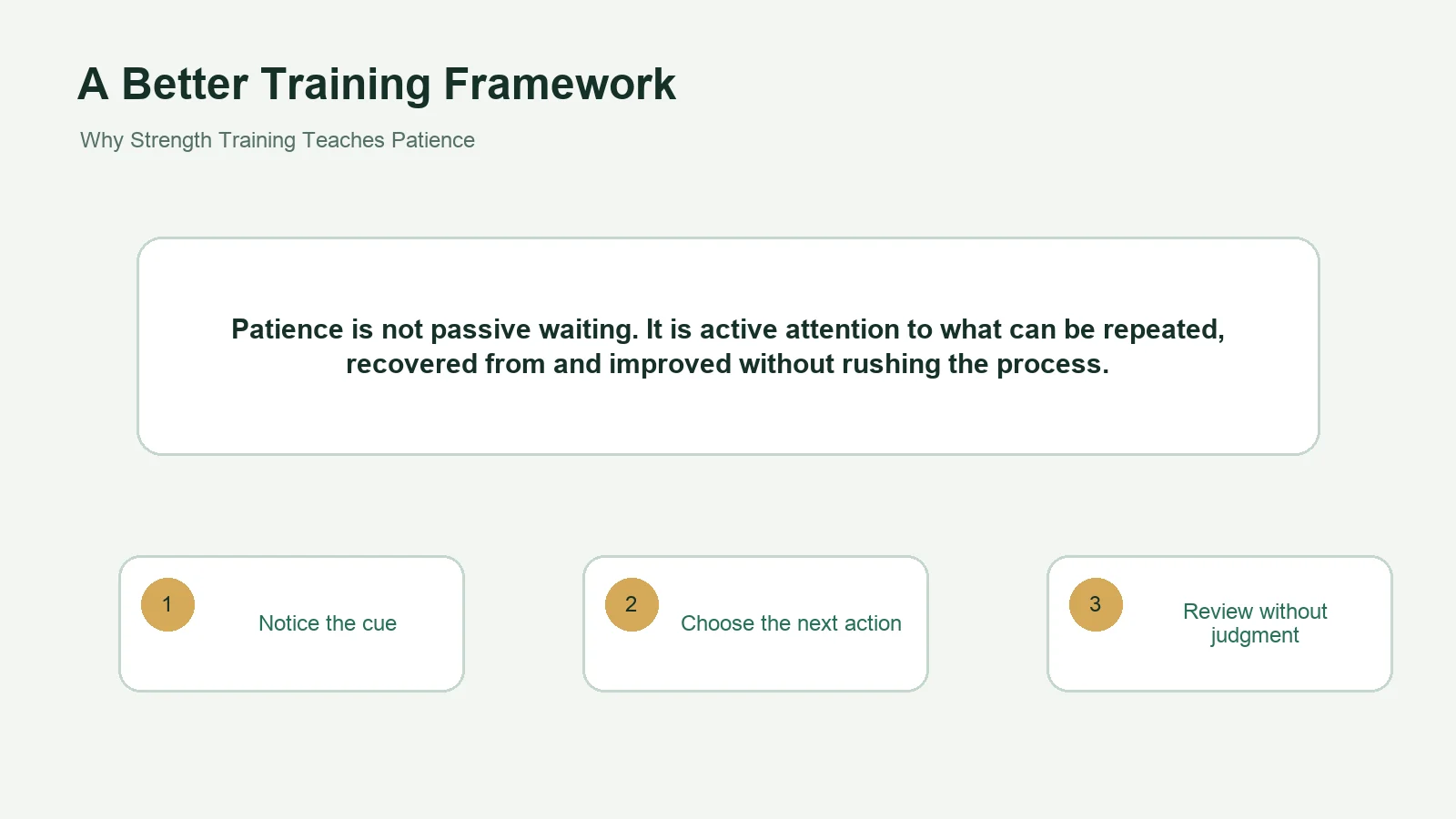
Patience is not passive. A patient lifter still trains hard, records the work and makes decisions. The difference is that those decisions are sized to the evidence instead of the emotion of one session.
- Accept the delayed result
- Use small increments
- Stay with movements long enough to learn
- Understand plateaus
- Return without rushing
- Measure longer trends
Accept the delay between work and result
A workout is a stimulus and a practice opportunity, not an instant transformation. Fatigue can temporarily hide performance. A new movement can feel awkward before it feels strong. Body composition and muscle growth are even slower to judge reliably.
This delay makes daily evaluation misleading. If you demand visible proof after every workout, normal variation begins to look like failure. Set review points at the end of several weeks and keep the days between them focused on execution.
Use increments small enough to repeat
Adding the largest possible amount feels decisive, but strength is built through loads you can practice and recover from. A small increase that preserves setup and range of motion creates better information than a jump that turns the set into improvisation.
Progression can also mean another repetition at the same load, a cleaner pause or more consistent technique. These changes are less dramatic than a plate milestone, but they often prepare the milestone. Write down the form of progression you are using so you do not change the rules whenever patience wears thin.
Stay with movements long enough to learn
Program hopping often disguises impatience as optimization. A new exercise removes the frustration of being a beginner at the old one, but it also resets part of the learning process. Keep the main patterns stable for a defined block unless pain, access or another clear reason requires a change.
Stable does not mean rigid forever. At the end of the block, ask whether the movement suits the goal, can be performed reliably and has a practical path for progression. Change it because the answer is no, not because this week lacked novelty.
Plateaus are questions, not emergencies
A plateau can come from inadequate stimulus, accumulated fatigue, poor exercise fit, inconsistent attendance or expectations that moved faster than the body. One repeated week is not enough to distinguish these. Collect several comparable sessions before changing everything.
Start with basic questions. Did you complete the planned work? Are repetitions and effort truly unchanged? Is recovery worse? Has technique improved even if load has not? The answers point toward different adjustments.
Sometimes the correct response is a deload or a maintenance phase. Doing less briefly can protect future training quality. Patience means accepting that progress is not maximized by pressing the accelerator continuously.
Return without trying to repay lost time
After illness, travel or a long break, previous numbers can make appropriate loads feel embarrassing. Resist the urge to compress the return. Start with work you can perform confidently, observe recovery and add gradually. The old record is context, not today’s prescription.
If the break involved injury or health concerns, use individual guidance. A generic article cannot determine readiness. For ordinary time away, a conservative first week provides information at a low cost.
The NIDDK guidance on maintaining health habits explicitly recognizes setbacks and the need to regroup. Return is a normal phase of a long practice, not a punishment for imperfection.
Measure longer trends
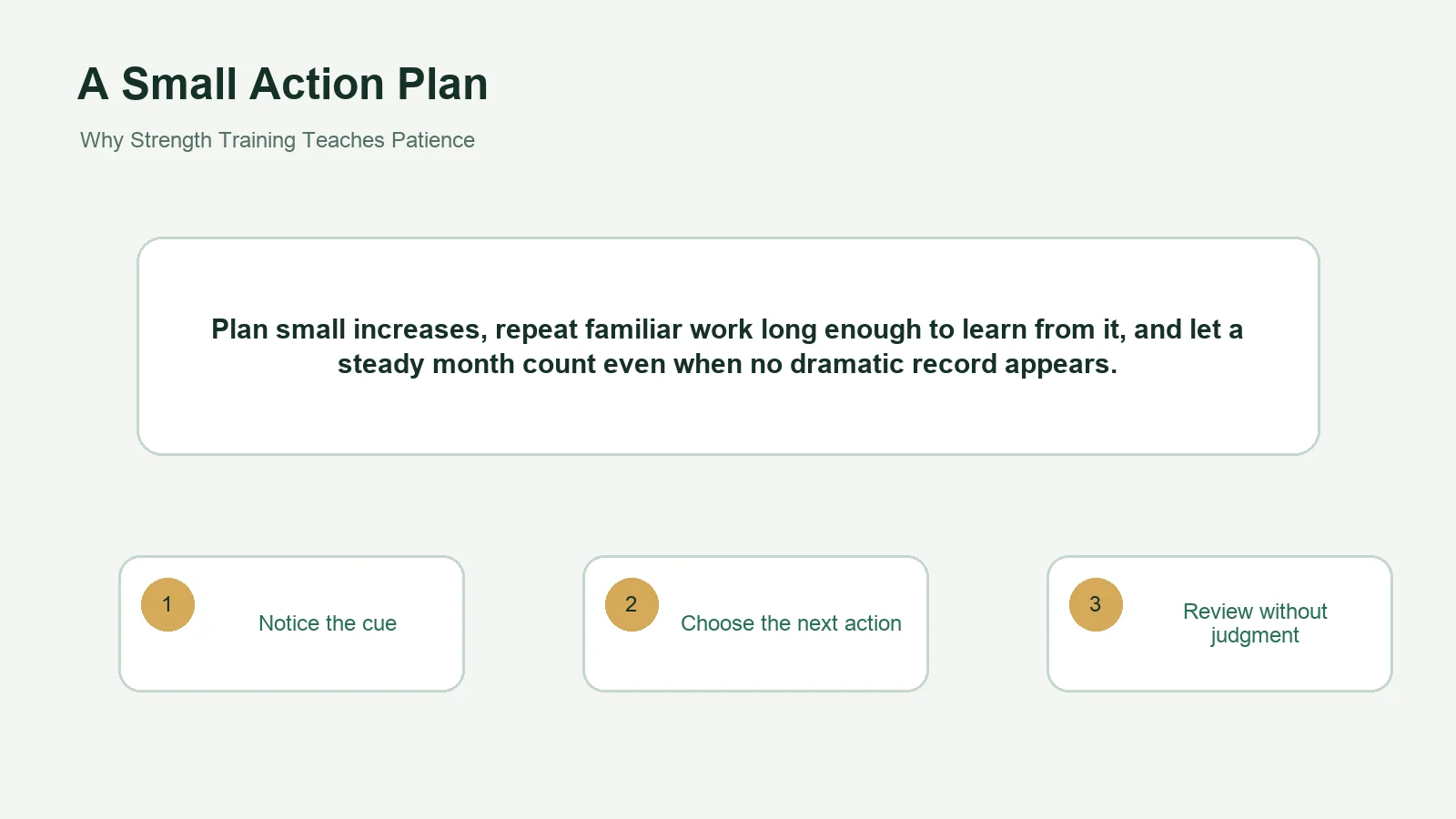
Review blocks using several signals: attendance, loads, repetitions, technique notes and how often the plan required emergency changes. A block can be productive without ending in a spectacular record. Better skill and a routine you can continue are real outcomes.
Patience grows when the scoreboard matches the timescale of adaptation. Train the session in front of you, review the trend at the planned time and let small improvements compound. Strength rewards effort, but it also rewards the ability to wait without standing still.
Learn the difference between waiting and drifting
Patience is not repeating the same work forever and hoping. A patient program has a target, a progression rule and a review date. Between reviews, you give the plan enough consistent exposure to produce information. At the review, you use that information to keep, adjust or replace part of the plan.
Drifting has no such structure. Exercises change whenever a session feels dull, missed workouts are ignored and plateaus continue without a question. The calendar alone does not turn that into patience. Write down what success should look like over the next four to eight weeks and which observations would justify a change.
Use ranges instead of perfect predictions
Training cannot promise an exact amount of progress by an exact day. Build ranges into the plan: a repetition range, an effort target and a small set of acceptable load choices. This lets you respond to the day without abandoning direction.
A range also reduces the urge to force the top outcome every time. Completing the lower end with sound technique can be the correct session. Over several weeks, the distribution of good, ordinary and difficult days tells you more than one emotional workout.
Practice technical patience inside a set
Patience operates in seconds as well as months. Take time to place the feet, set the rack height and repeat the same start position. Do not rush the first repetition because the load feels familiar. Between sets, make one clear adjustment rather than collecting five new cues.
Technical patience is visible but not dramatic. The bar may move at the same speed while the setup becomes more reliable. That reliability creates a better base for later loading and makes feedback from a coach easier to interpret.
Plan for the weeks that interrupt progress
Travel, illness, workload and family responsibilities will alter training. Decide in advance what a reduced week looks like. It may mean fewer sets, easier variations or no lifting at all. Returning after disruption should begin with an appropriate workload, not an attempt to repay a debt in one session.
This does not require predicting every problem. It requires refusing the idea that only uninterrupted progress counts. A durable program has a route back. If pain or a health concern changes training, individual advice from an appropriate professional is more useful than a generic timetable.
Review the block without moving the goalposts
At the planned review, compare the result with the original question. Did technique become more repeatable? Did the chosen repetition range improve? Was attendance sufficient to evaluate the program? Avoid dismissing progress because a new goal became more exciting halfway through.
Then choose one change. Add a small amount of load, redistribute volume, keep the block running or select a variation that addresses a clear limitation. Patient training still moves. It simply asks each change to earn its place.
Continue with a related guide
For the next practical step, read Why You Don’t Need to Love Every Workout. For a second perspective from the same topic cluster, continue with Your PR Is Someone Else’s Warm-Up – So What?.