

Lou Ferrigno’s public story sits at a useful intersection. He was already a serious competitive bodybuilder before television made him a familiar face, and the television role did not erase the athletic work that came first. That sequence is what makes his career more interesting than a simple celebrity profile. He carried credibility from a niche sport into a medium that reached people who might never have watched a physique contest.
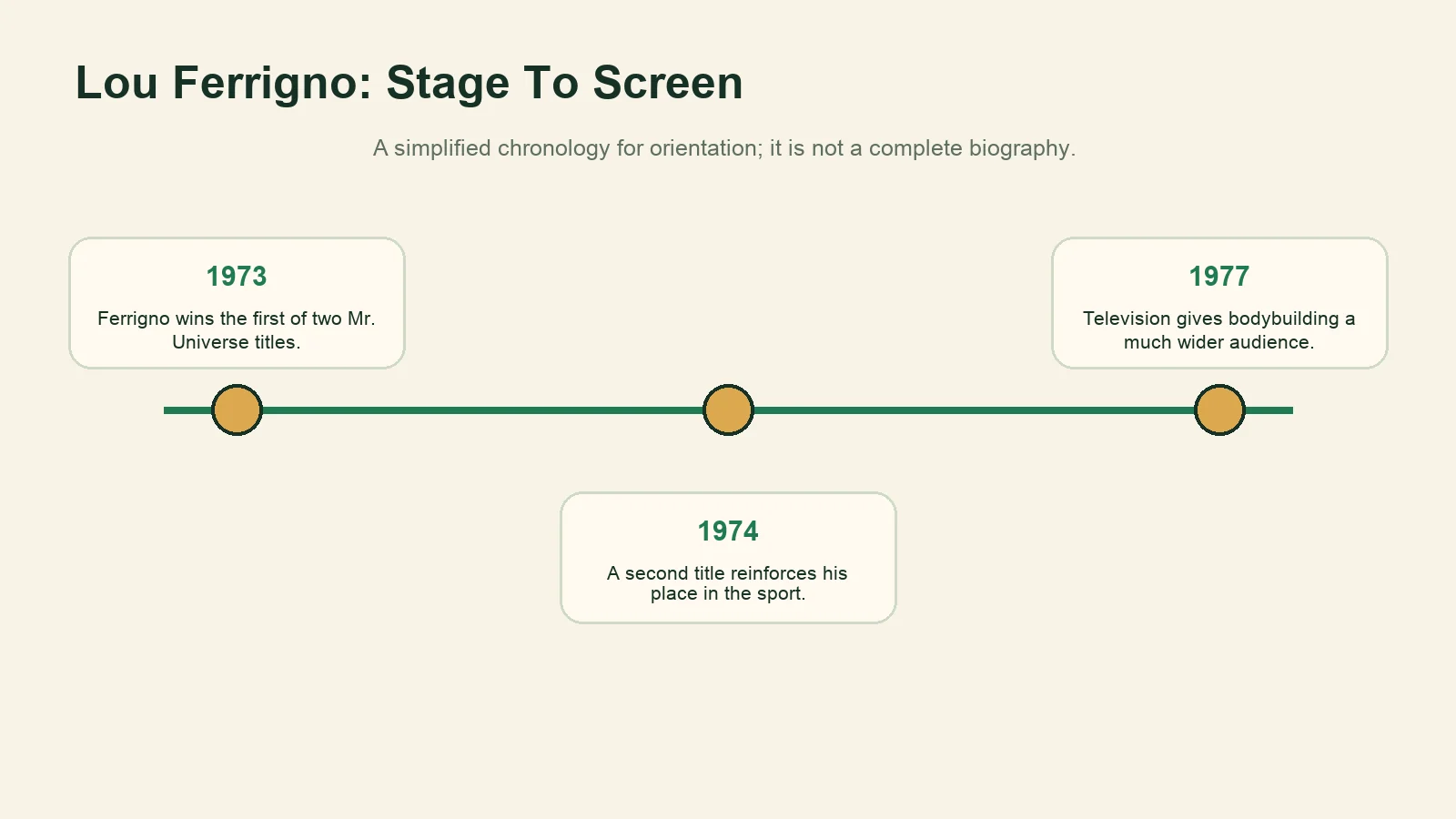
Ferrigno won IFBB Mr. Universe titles in 1973 and 1974, then competed at the Mr. Olympia in 1974 and 1975. In 1977, he became the title character in the television series The Incredible Hulk. The role did not make bodybuilding itself mainstream by itself, but it helped make a visibly muscular performer familiar in living rooms at a time when commercial gym culture was expanding.
- The competitive foundation
- A sport enters the living room
- Why representation matters
- What readers should take from the crossover
The foundation was competitive sport
The PBS profile of Lou Ferrigno notes that he had won the Mr. Universe title twice by age 22. That record establishes the order of events: Ferrigno was not selected for screen work as a generic fitness model; he arrived with a competitive identity already built in bodybuilding.
That order matters because it explains why audiences could read the role immediately. Physical presence had been central to Ferrigno’s athletic career. Television then amplified that presence through character, lighting, story, and repeated exposure. Sport and screen reinforced each other without being the same profession.
The bodybuilder-to-actor route can sound inevitable in retrospect. It was not. Sports careers are full of athletes whose skill never becomes a media opportunity. Ferrigno’s case is notable because the fit between an existing physical reputation and a particular role was unusually direct.
From stage to screen
PBS describes the production of The Incredible Hulk beginning in 1977 and the search for an imposing performer for the title role. For a history of fitness culture, the detail is important because television changes scale. A contest asks a specialized audience to care about a lineup on a given day. A weekly series gives an audience a recurring character and a visual language they can recognize without knowing contest rules.
That does not mean the screen role is a measure of health, strength, or a good personal goal. Fiction stylizes the body for drama. It is designed to be memorable, not to teach progression, recovery, or sustainable exercise. The cultural effect is still real: a person whose physique had meaning in bodybuilding now had meaning in mass entertainment.
The transition also illustrates how fitness stories often move through media rather than training advice. A film, magazine, television show, or social platform can make a sport easier to picture. That visibility may invite people into a gym, but it can also create unrealistic expectations. Good editorial history needs room for both possibilities.
Visibility changes who can imagine participation
Representation is not a complete explanation for why people train. Access, money, time, facilities, safety, coaching, and social support matter too. Still, seeing muscularity and training culture treated as a recognizable part of public life can reduce the sense that fitness belongs only to a small subculture.
Ferrigno’s case is particularly clear because he did not leave the athletic identity behind. The PBS profile presents the bodybuilding and entertainment chapters as one continuous public career, while distinguishing the competitive record from the later television role.
The lesson is not to chase a character
The first practical lesson is to distinguish a performance from a program. An actor’s image, a contest pose, and a training plan are different things. Fictional physical ideals can be entertaining, but they do not provide individualized exercise, nutrition, or health guidance.
The second is to respect transferable skills without assuming that every career path transfers. Ferrigno’s competition experience helped make him legible on screen. In ordinary life, the equivalent may be smaller: learning a movement well, becoming reliable in a team, or using a hobby as a source of confidence. A skill can travel, but the new setting still has its own demands.
The third is to treat visibility as an invitation, not a demand. Someone can enter strength training because a public figure made it seem interesting, then build a completely different practice: two brief sessions a week, a home routine, a sport-specific plan, or a long-term health habit. The lasting value lies in choosing an achievable direction.
There is another reason this crossover endures: it made the boundary between niche sport and popular culture easier to cross. A viewer did not need to know a contest division or follow a training magazine to understand a dramatic television role. That accessibility helped create curiosity, but curiosity still needs reliable information behind it. The most constructive next step for a new trainee is not to recreate a screen image. It is to learn basic movement, choose a realistic schedule, and build from what their own circumstances support.
That distinction protects both the story and the reader. Ferrigno’s career can be culturally important while a person’s own training remains modest, private, and practical. Exercise does not have to become a public image to count as progress.
Continue with a related guide
For the next practical step, read Pumping Iron: The Film That Took Bodybuilding Out of the Gym and Into Pop Culture. For a second perspective from the same topic cluster, continue with Sergio Oliva: Why They Called Him The Myth.
Conclusion
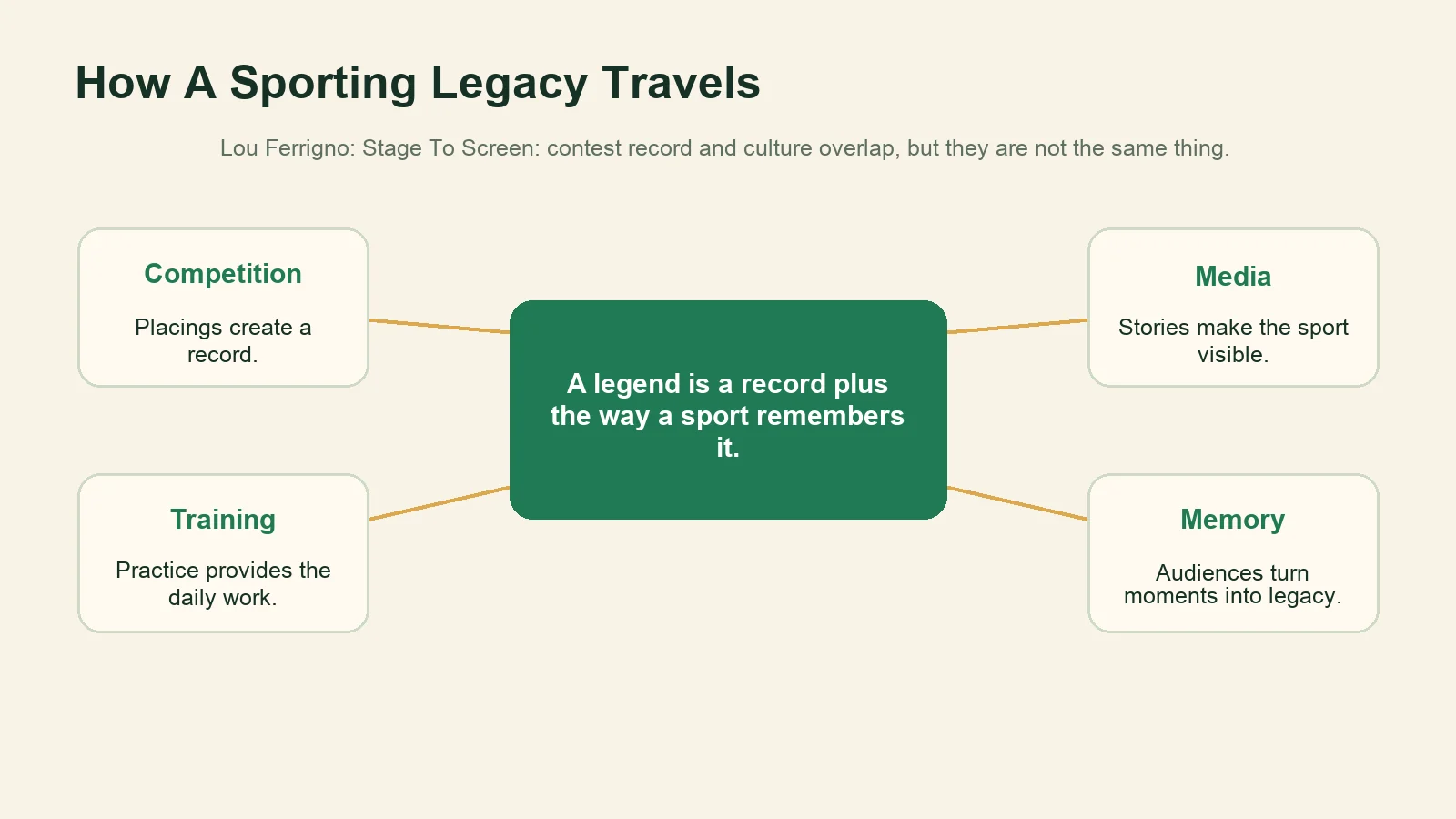
Lou Ferrigno’s career matters because it connects a competitive bodybuilding record to a much larger public stage. The two Mr. Universe titles gave the story athletic substance; the 1977 television role gave it reach. Neither half replaces the other.
For readers, the healthiest takeaway is simple: public stories can make training imaginable, but a sustainable fitness life still has to be built around personal goals, sensible progression, and real circumstances.