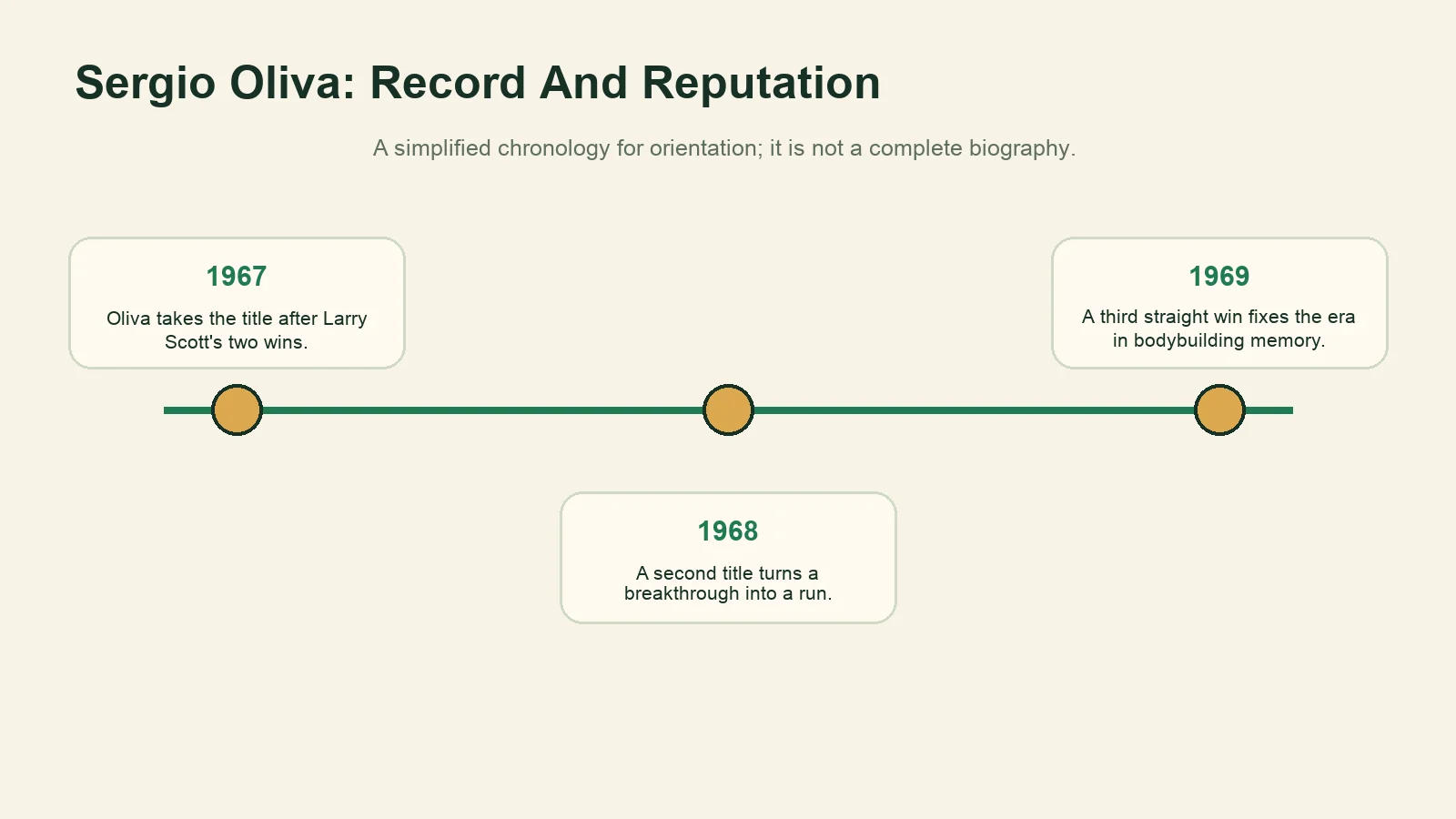
Sergio Oliva is remembered through a nickname before many people learn the record: The Myth. The phrase has survived because it sounds larger than a normal sporting label. But the useful way to approach it is to work backwards from the evidence. Oliva won Mr. Olympia in 1967, 1968, and 1969. A three-year title run is the factual spine; the nickname is the cultural response to how unusual he looked and felt on stage.
That distinction matters. Nicknames can flatten athletes into slogans. Records put the slogan back into a timeline. Oliva’s story is not a license to make sweeping claims about genetics, training secrets, or a single perfect physique. It is a chapter in the history of a contest that was still inventing its public identity.
- The record beneath the nickname
- Why stage presence mattered
- How a three-year run becomes memory
- What to take from the story
The record beneath the nickname
The IFBB Spain profile of Sergio Oliva records his Mr. Olympia wins in 1967, 1968, and 1969. Those three dates are the essential starting point. They follow Larry Scott’s two inaugural wins and precede Arnold Schwarzenegger’s first title in 1970. In other words, Oliva was not a side character in the development of the contest. He was the champion during a formative transition.
The IFBB Spain profile of Sergio Oliva describes his move from weightlifting toward bodybuilding after arriving in Chicago. Its historical account is useful because it shows a route into the sport rather than pretending a champion appears fully formed. Athletic stories become clearer when readers see that competition identity is built through changing environments and disciplines.
The term "The Myth" should therefore be read as reputation, not measurement. It captures the impact of his silhouette and presence on audiences of the time. It does not turn visual impression into a universal rule about what a strong, healthy, or successful body must look like.
Why presence carried so much weight
Physique competition is judged visually, but visual impact is more than a list of body parts. It includes proportion, posing, confidence, lighting, comparison with the field, and the expectations of the era. That is why readers should avoid translating old photographs into exact technical claims. A stage image tells us how an athlete was presented, not everything about the training, recovery, food, or support system behind it.
Oliva’s presence became memorable because the contest environment made contrast visible. On stage, audiences do not see a training log. They see a finished presentation. The most durable bodybuilding stories often begin there: a competitor gives people a visual they have not seen before, and the sport starts using that image as shorthand for a period.
That mechanism can be useful without becoming worshipful. A memorable look may grow a sport, but it can also narrow what people think success should resemble. For ordinary lifters, the important question is not whether a body matches an old ideal. It is whether training improves capability, confidence, routine, and the goals the person actually chose.
A run, not a single moment
Three consecutive titles carry a different meaning from one upset. Repetition gives the result structure. The first win establishes a possibility. The second says it was not accidental. The third lets the audience name an era. That is why Oliva’s 1967-1969 sequence remains the core of the profile even for readers who know the nickname first.
His cultural afterlife also shows how sporting memory works. The official site of Sergio Oliva Jr. identifies his father as a three-time IFBB Mr. Olympia known as The Myth. That is a family and legacy source, so it is best used for the enduring name rather than as the only authority for every contest detail. Paired with the winners archive, it demonstrates how a result becomes an inherited public identity.
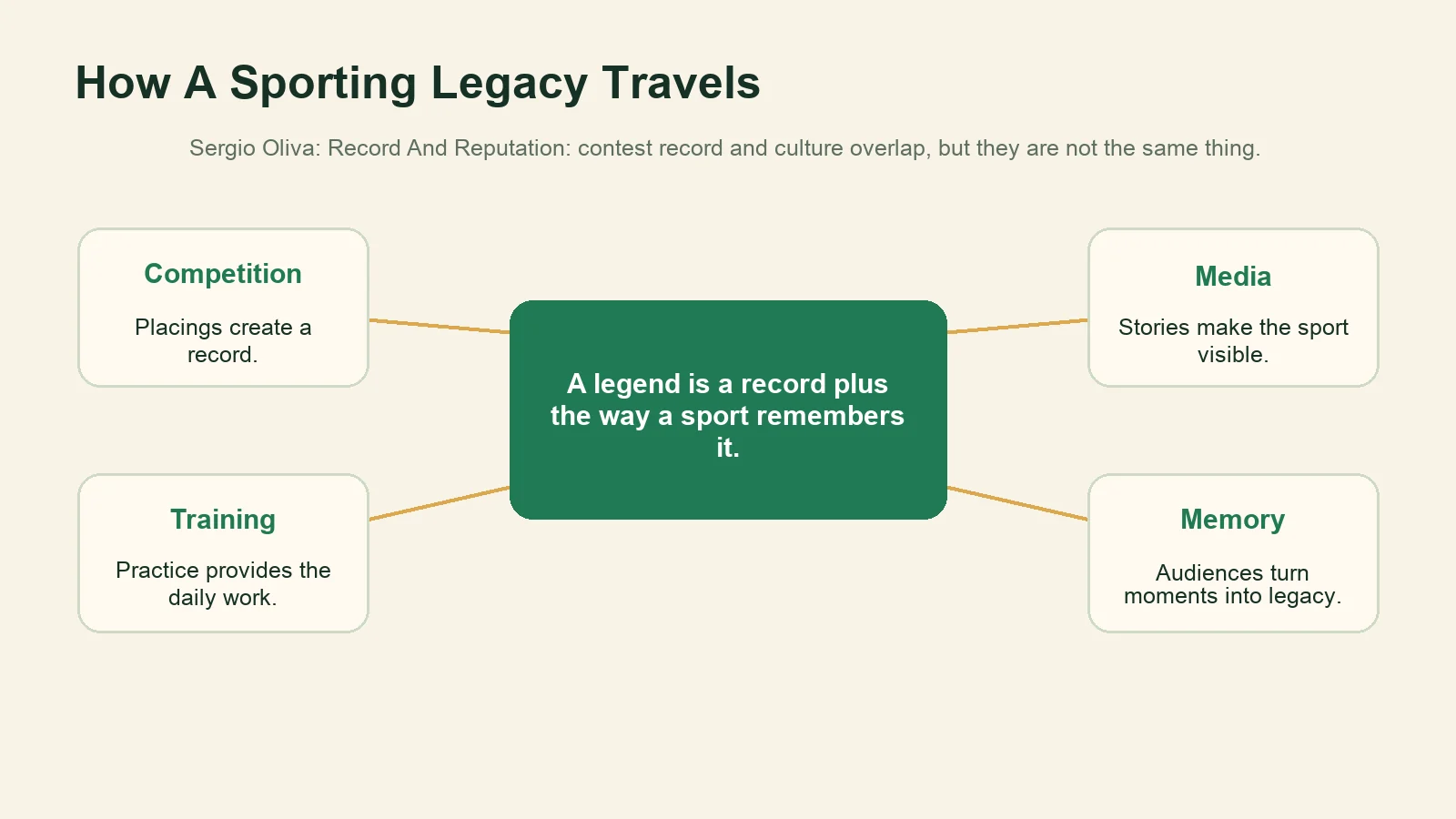
What readers should keep, and leave behind
The first useful lesson is to respect context. Old champions are often shown without the details that make professional sport possible: selection, coaching, promotion, competition rules, money, and personal tradeoffs. A strong historical profile keeps the achievement visible without pretending the route was simple.
The second is to value repeatable work over dramatic labels. Oliva’s title sequence is more meaningful than a viral photograph because it represents repeated preparation for a recurring test. Everyday lifters can apply that idea by reviewing a program across months, not by judging themselves against a single gym-day image.
The third is to keep a nickname in its place. "The Myth" is memorable because it belongs to a story and an era. It should not become a standard for a reader’s body or self-worth. Training works better when the target is personal, specific, and compatible with real life.
It is also worth noticing how quickly a sport can turn a person into a symbol. Symbols are useful because they compress history into something memorable. They are risky because they erase the changing work, the competitive environment, and the ordinary human detail. Keeping the 1967-1969 record in view is a way to resist that simplification. It lets the nickname remain vivid while putting the achievement back where it belongs: on a recurring contest stage, against a field, in a particular time.
That framing also makes the profile fairer to the reader. It leaves room to admire a competitive achievement without claiming that admiration requires imitation. The history belongs to the sport; a personal training plan still belongs to the person doing the work.
Continue with a related guide
For the next practical step, read Arnold and Franco Columbu: Friendship, Competition and the Golden Era. For a second perspective from the same topic cluster, continue with Arnold Schwarzenegger: The Kid From Austria Who Changed Fitness Forever.
Conclusion
They called Sergio Oliva The Myth because a nickname could express what spectators felt when a three-time champion appeared on stage. The better historical account does not need to exaggerate that feeling. The 1967, 1968, and 1969 wins already explain why he belongs at the center of bodybuilding’s early Olympia story.
Read the nickname as culture, the titles as record, and the era as context. That is how a sports legend remains interesting without becoming an unrealistic template.