
A personal record is valuable because it records a change in your ability. It does not need to be impressive to the strongest person in the room. If your best lift is someone else’s warm-up, the two numbers still describe different training histories. Their relationship does not reduce what changed for you.
The phrase “personal record” already contains the correct comparison. The challenge is keeping it personal in a culture built around rankings, leaderboards and public highlights.
- Define what the record proves
- Keep conditions visible
- Celebrate without testing recklessly
- Respond to dismissive comments
- Use the PR to plan
- Keep identity larger than a number
Define what the record proves
A PR proves that you performed a specific task better than you had before under the rules you used. It may be a heavier single, more repetitions at the same load, a first unassisted movement or the same work at lower effort. It does not prove that your program is perfect or that progress will continue at the same rate.
This narrow definition makes a PR useful. It is evidence, not a personality test. Record the result and the conditions, then place it inside the larger trend.
Keep conditions visible
Compare like with like. A touch-and-go bench press and a paused bench press are different tasks. A machine can change between gyms. Straps, belt use, range of motion and body weight may matter depending on the goal. Recording these details protects you from manufacturing progress by changing the test.
Conditions do not need to be laboratory-perfect. They need to be honest enough that the comparison helps. Note the variation, load, repetitions and one or two important standards. If the lift is for a sport, use that sport’s rules when testing matters.
Celebrate without turning every week into a test
A record can be satisfying. Mark it, share it if you want and enjoy the result. Then return to training. Chasing another maximum immediately often replaces productive work with repeated proof-seeking.
Plan tests at sensible points. Most sessions should build the qualities the test needs: technique, volume, strength and confidence with appropriate loads. If every workout must validate you, ordinary training begins to feel disappointing.
When someone dismisses the number
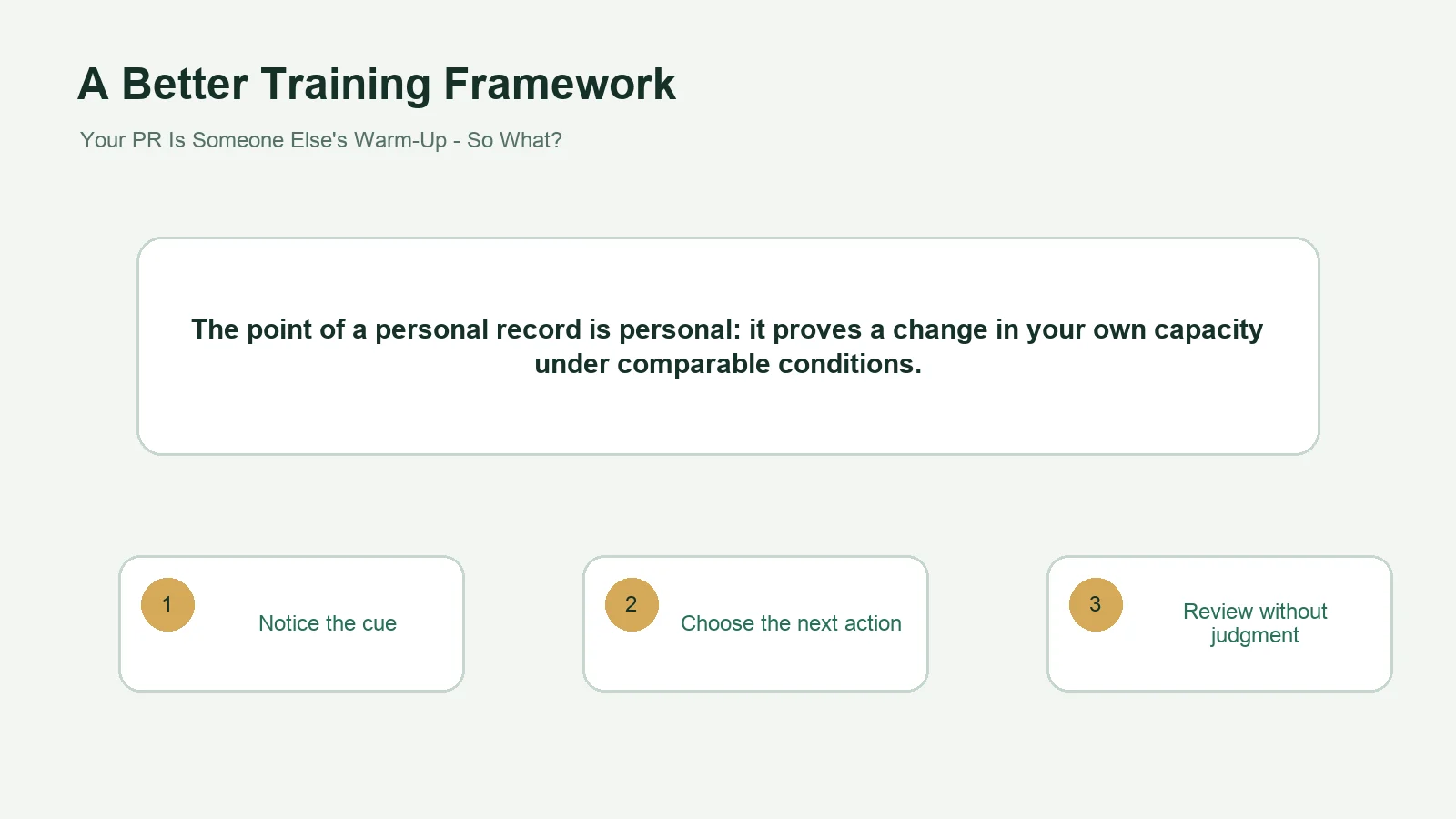
Gym culture sometimes uses strength as a shortcut for status. A dismissive comment may be a joke, poor social skill or an attempt to establish rank. You do not have to defend your entire training history. “It is progress for me” is enough.
If a coach repeatedly belittles reasonable progress, look for better coaching. Feedback can be honest about technique and programming without using humiliation. A training environment should help you practice, not require constant proof that you deserve to be there.
Online, disengagement is often the best response. Arguing with a stranger about whether your record counts rarely improves the next session. Put attention where it produces action.
Use the record to plan the next block
After the celebration, review how the PR was built. Was attendance consistent? Did a particular progression work? Did the test reveal a technical weakness? Choose one implication for the next block.
Sometimes the correct next step is not more load. You may repeat the weight with better control, build repetitions or change emphasis after a long peak. A PR is a checkpoint, not an instruction to accelerate forever.
The NIDDK guide to health habit maintenance emphasizes revisiting goals and handling setbacks as part of a lifelong routine. The same perspective keeps records in scale: they are moments inside a practice that continues.
Keep identity larger than performance
Numbers change with age, injury, schedule, equipment and goals. If self-respect depends on a permanent upward line, training becomes fragile. You can care deeply about strength while remaining more than your best lift.
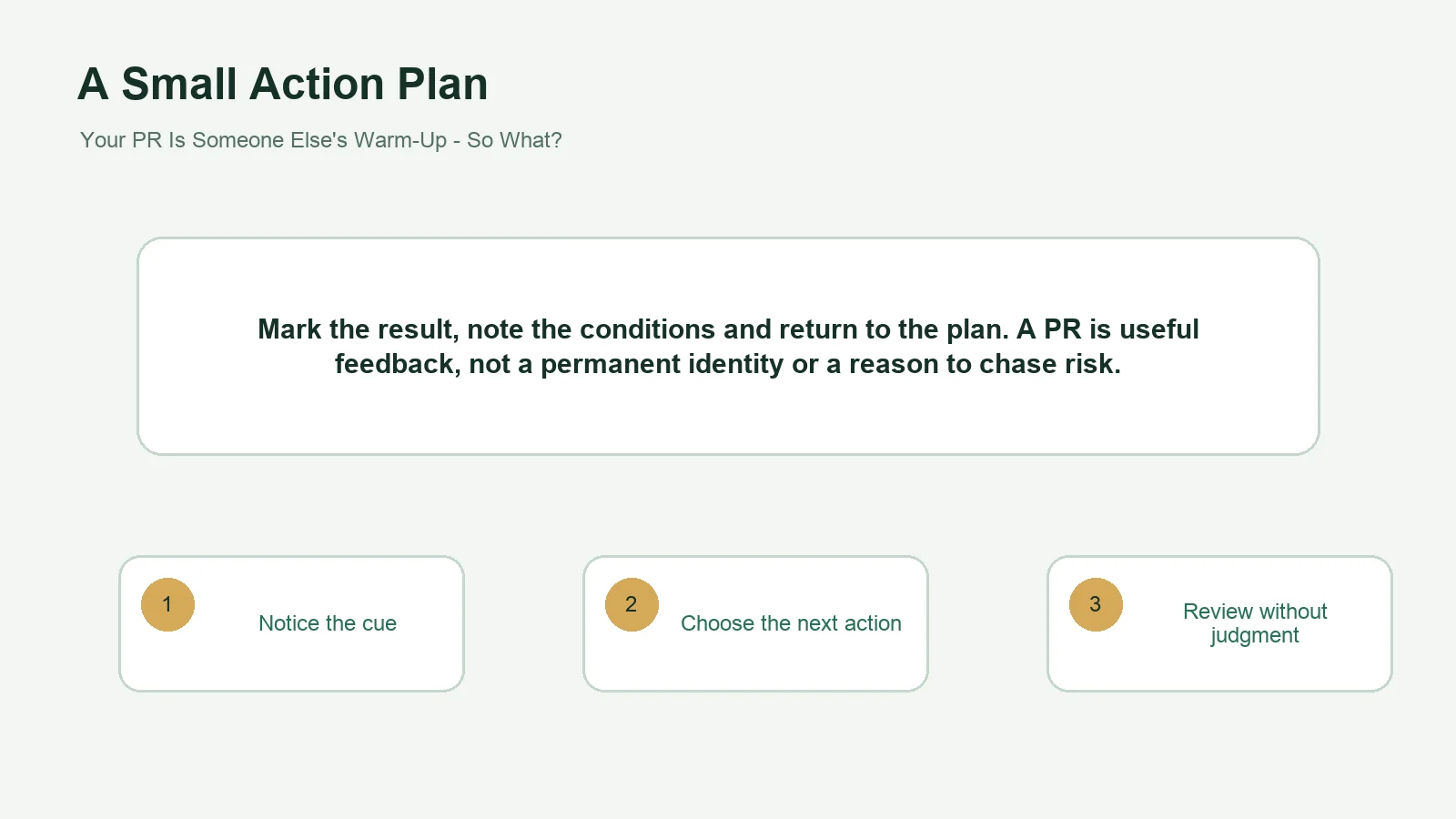
Other people will warm up with your PR, and other people will dream of lifting it. Neither comparison changes your work. Let the record mean exactly what it means: you moved your own reference point. Then use that evidence to train the next block with patience rather than apology.
Choose records that match the phase
A one-repetition maximum is only one kind of record. During a higher-volume block, a best set of five with consistent technique may be more relevant. During a return from time away, completing the planned sessions or restoring a comfortable range of motion can mark useful change. Match the record to the quality the program is building.
This approach does not make every workout a trophy. A record should still describe a real, repeatable improvement. It simply prevents a single test from dominating periods designed for something else.
Keep a record sheet that survives memory
Write the exercise, load, repetitions, equipment and standard used. Add the date and a brief note about effort. Video can help when technique is part of the question, provided filming follows gym rules and respects people nearby. Clear records let you compare honestly months later, when memory has turned most sessions into impressions.
Separate gym records from competition records when rules differ. A lift completed with different equipment or range can still be meaningful, but label it accurately. Honest labels protect the value of the achievement; they do not diminish it.
Decide whether today is a testing day
Do not let another person’s warm-up rewrite the session. If the program calls for submaximal work, complete submaximal work. Testing because the room feels competitive gives you a result under conditions you did not plan and may remove training you actually needed.
Before attempting a record, check that the variation and standard are clear, the warm-up supports the attempt and appropriate safety equipment or spotting is available. Stop if technique deteriorates beyond the standard you chose. Sharp or worsening pain is not a cue to become more committed.
Share the result without inventing a hierarchy
You can be proud without claiming that the number makes you better than another person. Describe what changed and why it mattered to you. Thank a coach or training partner when they contributed. Avoid presenting a single lift as proof that everyone should copy your program.
The same rule applies when responding to someone else’s record. Ask what the milestone means before grading it against your own reference points. A first bodyweight squat, a technical personal best and an elite competition lift can all be legitimate achievements with different contexts.
Make the day after the record ordinary
The next session usually needs the same qualities as the sessions before the PR: preparation, controlled work and a load appropriate to the plan. Resist the urge to rebuild the program around one result. If the attempt exposed a weakness, note it and address it in the next block rather than adding random exercises immediately.
Records are memorable because most training is not. That ordinary work is not filler; it creates the conditions that allow a test to mean something. Celebrate the changed reference point, preserve the details and return to the process that made it possible.
Continue with a related guide
For the next practical step, read Consistency Beats Intensity: The Case for Showing Up. For a second perspective from the same topic cluster, continue with Discipline vs Motivation: What Builds Long-Term Progress?.