

The discipline vs motivation debate is usually framed as a fight. Motivation is emotional and unreliable. Discipline is serious and strong. Choose discipline, the advice says, and progress will follow.
That is partly useful and partly too simple. Motivation can start action. Discipline can keep action aligned with a plan. But long-term fitness progress rarely comes from one heroic trait. It comes from a routine that makes the right action easier, a reason that matters to you, and a review process that adjusts the plan before resentment builds.
If you have been trying to shame yourself into consistency, this distinction matters. The better question is not "Am I disciplined enough?" It is "What makes training easier to repeat when motivation changes?"
- What motivation does well
- What discipline does well
- Why environment and planning matter
- How to build long-term progress
Motivation gives direction and energy
Motivation is the reason you care. It might come from wanting to feel stronger, age better, reduce stress, compete, look different, or feel more capable in daily life. That reason matters. Training without any personally meaningful reason can feel like chores attached to soreness.
Research influenced by self-determination theory has often distinguished between more autonomous reasons for exercise and more pressured reasons. A systematic review on self-determination theory and physical activity reported that more self-determined forms of motivation are generally linked with exercise behavior. In plain language: it helps when the reason feels owned, not merely imposed.
That does not mean every session must feel inspiring. It means the larger reason should be yours. "I train because I want my body to be useful to me" is more durable than "I train because I hate myself when I miss."
Discipline reduces the need to renegotiate
Discipline is not constant intensity. It is the ability to follow a useful rule after the original emotion fades. In training, discipline often looks boring: showing up at the planned time, recording the session, stopping before ego changes the load, and returning next week.
The strongest version of discipline does not require a motivational speech. It reduces renegotiation. If Tuesday and Friday are full-body training days, the question is not "Do I feel like becoming my best self?" The question is "What version of Tuesday’s session fits today?"
That wording matters. It keeps discipline flexible. A disciplined choice might be the normal session, a lighter session, or rest if pain or illness is present. Discipline is not ignoring reality. It is responding to reality without abandoning the whole process.
Environment quietly changes the difficulty
Two people can have the same motivation and discipline but different environments. One has a gym near work, a predictable schedule, and supportive family routines. The other has a long commute, unstable shifts, caregiving duties, and no private space to train. Telling both people to "just be disciplined" misses the point.
Environment shapes friction. If the gym bag is packed, the workout is written, and the session is short enough to fit, discipline has a lighter job. If every session requires finding clothes, choosing exercises, negotiating travel, and solving dinner, motivation gets drained before the first set.
This is why simple preparation works. Put equipment where it is easy to use. Choose a gym you can actually reach. Keep two versions of the plan: gym and home. Reduce the number of choices required after work. The less the plan depends on a perfect day, the more useful discipline becomes.
Planning beats repeated willpower tests
If-then planning is one of the most practical tools for fitness consistency. Instead of hoping you make the right decision under stress, you decide the response ahead of time.
A meta-analysis on implementation intentions found that if-then plans can support goal achievement. For training, this is not complicated psychology language. It means writing rules like:
- If I miss the morning session, then I do the 20-minute home version after dinner.
- If I feel tired, then I warm up and reassess after ten minutes.
- If the gym is full, then I use the alternate dumbbell plan.
- If I miss a week, then I restart with the next planned session.
These rules make discipline concrete. They also prevent one missed session from becoming a story about your character.
Progress needs review, not blind toughness
Long-term progress depends on feedback. If you keep missing sessions, the answer may not be more discipline. The answer may be a shorter program, a different training time, less weekly volume, better recovery, or a clearer reason.
The CDC activity guidance gives broad weekly targets, but it does not say everyone must organize training the same way. Your job is to find a structure that lets you keep returning.
Review the plan every two to four weeks. Ask:
- Did I train as planned most weeks?
- Which session was easiest to keep?
- Which session kept failing?
- Was the workload recoverable?
- What is the smallest change that would make next week easier?
That review is not softness. It is maintenance. A plan that never adapts eventually becomes a test you keep failing.
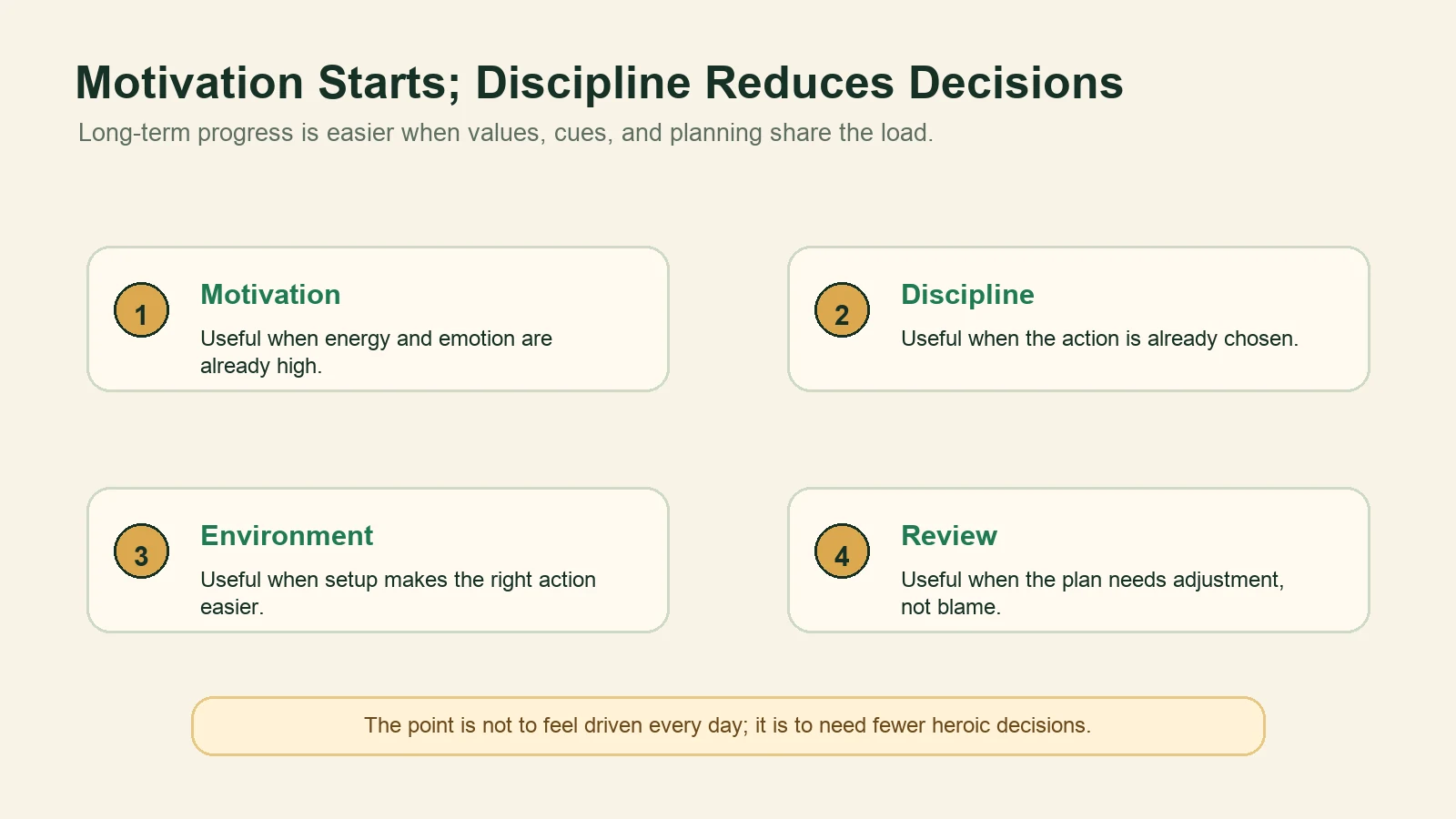
Motivation answers why you care. Discipline answers what you do next. Environment decides how hard that next action feels.
Do not make discipline a moral identity
Discipline becomes unhealthy when it turns into moral ranking. Training is important, but people also have jobs, families, money constraints, injuries, stress, and mental health. Missing a workout is not proof that someone is weak. It is a normal part of building behavior inside a real life.
The goal is not to become the kind of person who never struggles. The goal is to have a plan that helps you respond well when struggle appears. If most workouts feel miserable, if exercise is tied to punishment, or if food and training thoughts feel obsessive, that is not a discipline problem. It may be time to involve a qualified professional.
A better weekly question
Instead of asking, "Was I motivated enough?" ask, "Did the plan make the useful action easy enough to repeat?" That question points toward improvements you can actually make.
If you skipped because the session was too long, shorten it. If you skipped because the exercise list was confusing, simplify it. If you skipped because the gym was too far away, create a home fallback. If you skipped because the goal no longer matters to you, choose a reason that is less borrowed from someone else’s standards.
This is where discipline becomes practical rather than theatrical. You are not trying to win an argument with yourself every day. You are building a week where fewer arguments are required.
Use both, but assign them different jobs
Motivation is useful for choosing the direction: why strength matters, why movement belongs in your life, and what kind of person you want training to support. Discipline is useful for protecting the next action when the direction is already chosen.
Motivation Is Overrated makes the complementary point: the practical systems around training matter more than waiting for a perfect feeling.
If you expect motivation to handle daily execution, it will eventually fail. If you expect discipline to replace meaning, training can become joyless. Use motivation to choose the path, discipline to walk the next step, and environment design to make the step easier.
Continue with a related guide
For the next practical step, read How to Build a Training Habit That Actually Lasts. For a second perspective from the same topic cluster, continue with Your PR Is Someone Else’s Warm-Up — So What?.
Conclusion
Motivation and discipline both matter, but neither should carry the whole project. Motivation gives training personal meaning. Discipline keeps useful actions moving when the mood changes. Environment and planning reduce the amount of discipline required. Review keeps the plan honest.
Long-term progress is built by people who keep returning, adjusting, and repeating. Not because they feel fired up every day, and not because life never interrupts them, but because the system is designed for ordinary days.
FAQ
Is discipline more important than motivation?
Discipline is usually more reliable day to day, but motivation still matters because it connects training to a meaningful reason. The best plan uses both.
What if I have neither motivation nor discipline right now?
Start with environment and size. Make the first action visible and make the session smaller. A tiny repeatable plan is better than waiting for a perfect mindset.