
Some days you will not feel like training. Not in a dramatic way. Just flat, busy, irritated, tired, or bored. The mistake is treating that feeling as a final decision. "I do not feel like it" might mean you need a lighter session, a shorter warm-up, a different option, or rest. It does not automatically mean the plan is gone.
The useful skill is not forcing every workout at full intensity. It is learning how to make a good decision when readiness is low. Sometimes the right answer is to train normally. Sometimes it is to shrink the session. Sometimes it is to walk, stretch, or stop.
This guide gives you a simple framework: do not decide from the couch. Start with a safe first step, reassess, then choose the version that fits the day.
- Separate mood from readiness
- Use a ten-minute warm-up test
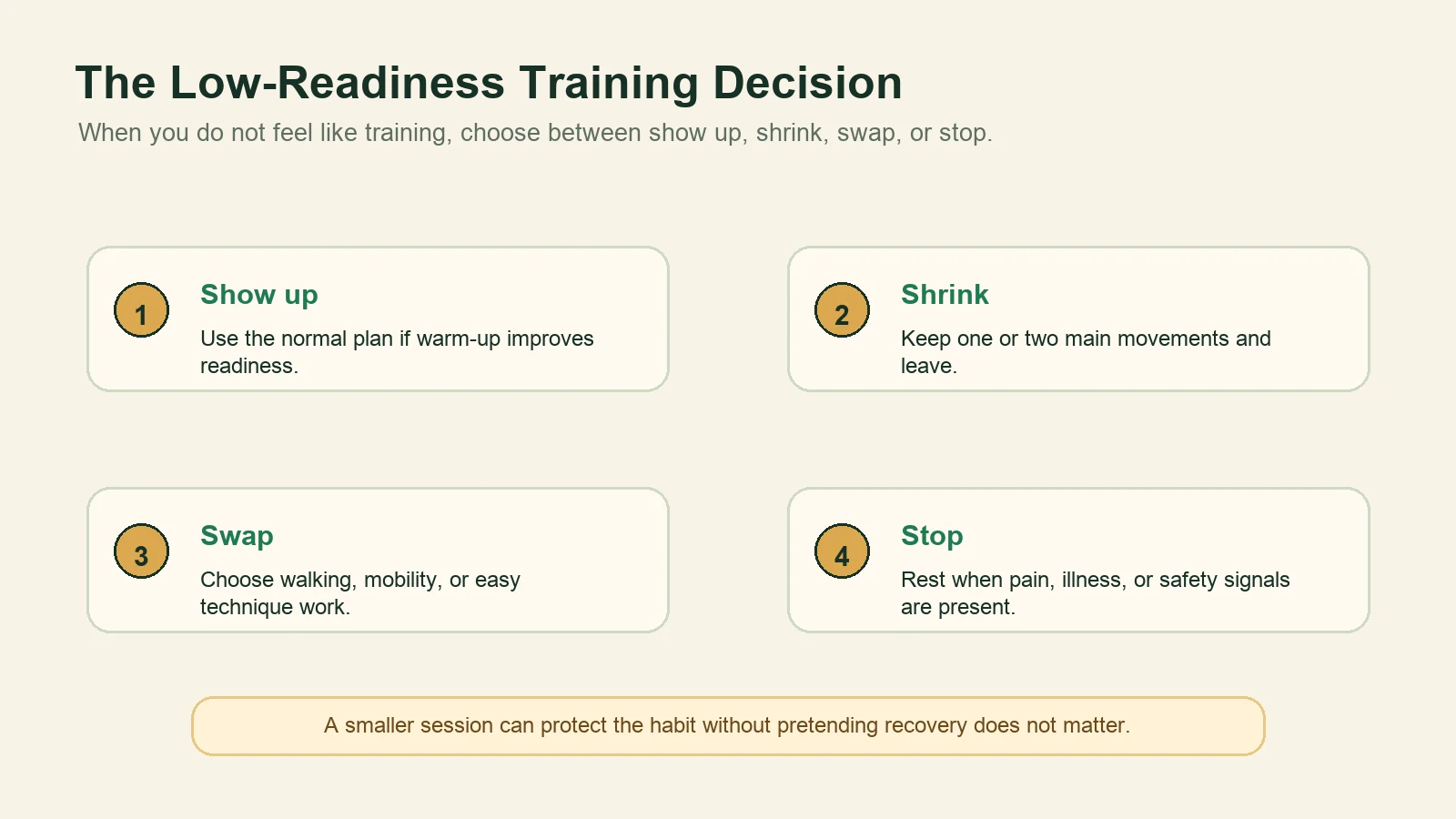
- Choose normal, minimum, swap, or stop
- Keep the habit without ignoring recovery
Separate mood from readiness
Mood and readiness overlap, but they are not the same. Mood is how you feel about training. Readiness is whether your body and situation can handle the session safely and productively.
You might be in a bad mood but physically fine. In that case, the warm-up may improve everything. You might also be motivated but under-recovered, sick, or dealing with pain. In that case, pushing harder because you are emotionally fired up may be a poor choice.
Before deciding, ask a few plain questions:
- Am I sick, feverish, dizzy, or dealing with unusual symptoms?
- Is there sharp pain or a movement that feels unsafe?
- Did I sleep so poorly that heavy lifting would be risky?
- Is the resistance mostly emotional, logistical, or physical?
If the answer points to illness, injury, or safety concerns, choose rest or professional guidance. If the answer is mostly emotional friction, use the warm-up test.
Use the ten-minute warm-up test
The warm-up test is simple: start the first ten minutes, then decide. Put on the shoes, begin easy movement, and run through lighter versions of the first exercises. You are not committing to the full workout yet. You are gathering better information.
This works because action changes context. Sitting on the couch makes the workout feel abstract and large. Moving for ten minutes makes the decision more specific. After the warm-up, you can ask: do I feel better, the same, or worse?
If you feel better, continue with the normal plan or a slightly reduced version. If you feel the same, use the minimum session. If you feel worse, stop or swap to recovery work.
This is where planning helps. A meta-analysis on implementation intentions supports the usefulness of if-then plans for goal behavior. Your rule might be: "If I do not feel like training, then I do ten minutes and reassess."
Option one: train normally
Sometimes the resistance disappears once you begin. If the warm-up feels good, technique is stable, and the first working sets move normally, continue. You do not need to analyze the original mood forever.
Keep the session boringly productive. Do the planned work. Avoid turning a low-motivation day into a personal victory lap by adding extra volume just because you started feeling better. The win is completing the useful session, not proving that you can override every signal.
For many people, these sessions are quietly important. They teach that feelings are information, not commands. You felt resistant, started carefully, and discovered that the session was available after all.
Option two: shrink the workout
If the warm-up is acceptable but not great, shrink the session. Keep the main pattern and remove the extras.
For example:
- squat or hinge: 2 to 3 moderate sets;
- push: 2 to 3 moderate sets;
- pull: 2 to 3 moderate sets;
- easy walk, carry, or mobility: 5 to 10 minutes.
Use lower loads, fewer sets, or a simpler variation. Stop before the session becomes a grind. This is not failure. It is load management for a day when the full plan does not fit.
The CDC physical activity guidance emphasizes weekly movement and muscle-strengthening patterns. A smaller session can still contribute to that pattern, especially if it keeps you from dropping the whole week.
Option three: swap the session
Sometimes the gym session is not the right choice, but movement still is. Swap heavy training for a lower-pressure option:
- a brisk walk;
- easy cycling;
- mobility work;
- light technique practice;
- a short home circuit with no near-failure sets.
This is useful when stress is high, time is short, or you know the full session would create more cost than benefit. The swap should be chosen in advance. If every swap is invented in the moment, it can become disguised avoidance. If the swap is part of the plan, it becomes a controlled adjustment.
Option four: stop and recover
Rest is not the enemy of discipline. It is part of training. Stop when there are safety signals: sharp pain, unusual dizziness, illness, worsening symptoms, or a level of fatigue that makes technique unreliable.
There is a difference between not wanting to train and not being in a good state to train. The first can often be handled with a warm-up test. The second deserves respect.
If low mood, anxiety, depression, or disordered eating thoughts are shaping your relationship with training, do not treat that as a simple discipline problem. Fitness articles can offer general behavior tools, but clinical support belongs with qualified professionals.
Start small, reassess honestly, and choose the safest useful version. The goal is to keep training trustworthy.
Make the next session easy to return to
After a low-motivation day, write down what you did and what changed. Do not write a confession. Write useful information: slept poorly, did minimum, felt better after warm-up, skipped accessories, next session normal.
This supports habit formation because the routine stays visible and repeatable. A habit formation study suggests repeated behavior in consistent contexts helps automaticity develop over time. The point is not that every workout becomes effortless. The point is that the return path becomes familiar.
Keep a short menu of fallback sessions
Do not invent the fallback while you are tired. Keep two or three options written down.
One option can be strength-focused: squat, push, pull, carry. One can be recovery-focused: walk, mobility, light stretching, breathing. One can be technique-focused: easy practice sets with no grinding. The menu should be small enough that you can choose in seconds.
This protects you from the most common low-motivation trap: turning a hard day into a planning session. You do not need to redesign your fitness life at 8:30 p.m. You need a safe useful option that keeps the thread intact.
Continue with a related guide
For the next practical step, read Motivation Is Overrated: What Actually Keeps You Training. For a second perspective from the same topic cluster, continue with The Psychology of Getting Stronger.
Conclusion
When you do not feel like training, do not let the feeling make the whole decision. Check safety, start with a low-friction warm-up, reassess, and choose normal, minimum, swap, or stop.
The best training habit is not the one that ignores every bad day. It is the one that knows what to do with bad days. That is how a single low-motivation evening stays a small adjustment instead of becoming a lost week.
FAQ
Should I force myself to train when I feel tired?
Not always. Use a warm-up test if the issue is mostly motivation. Rest or reduce the session if fatigue, illness, pain, or poor technique makes training unsafe.
What is the shortest useful workout?
For many people, 15 to 25 minutes with one lower-body movement, one push, one pull, and easy movement is enough to preserve the routine on a hard day.