
Most lifters understand that training matters. Fewer treat sleep with the same respect, even though sleep is where a large part of the training response is allowed to unfold. The workout provides a signal. Recovery decides how much of that signal becomes useful adaptation.
That does not mean sleep is magic. A perfect night does not replace progressive overload, enough protein, smart programming, or time. But if you keep training hard while sleeping poorly, you are asking your body to build with half the workshop closed.
For strength athletes, sleep affects more than “feeling fresh.” It can influence coordination, motivation, pain sensitivity, decision-making, appetite, and the ability to repeat quality sessions. Those are not small things. Strength training is physical, but it is also technical and neurological. A tired body and a tired brain rarely express strength well.
The practical lesson is simple: your bed is not the opposite of the gym. It is part of the system.
- Why sleep matters for strength
- How poor sleep changes training readiness
- When one bad night matters less than a pattern
- How to adjust training after poor sleep
- Simple sleep habits that actually help
Sleep is active recovery
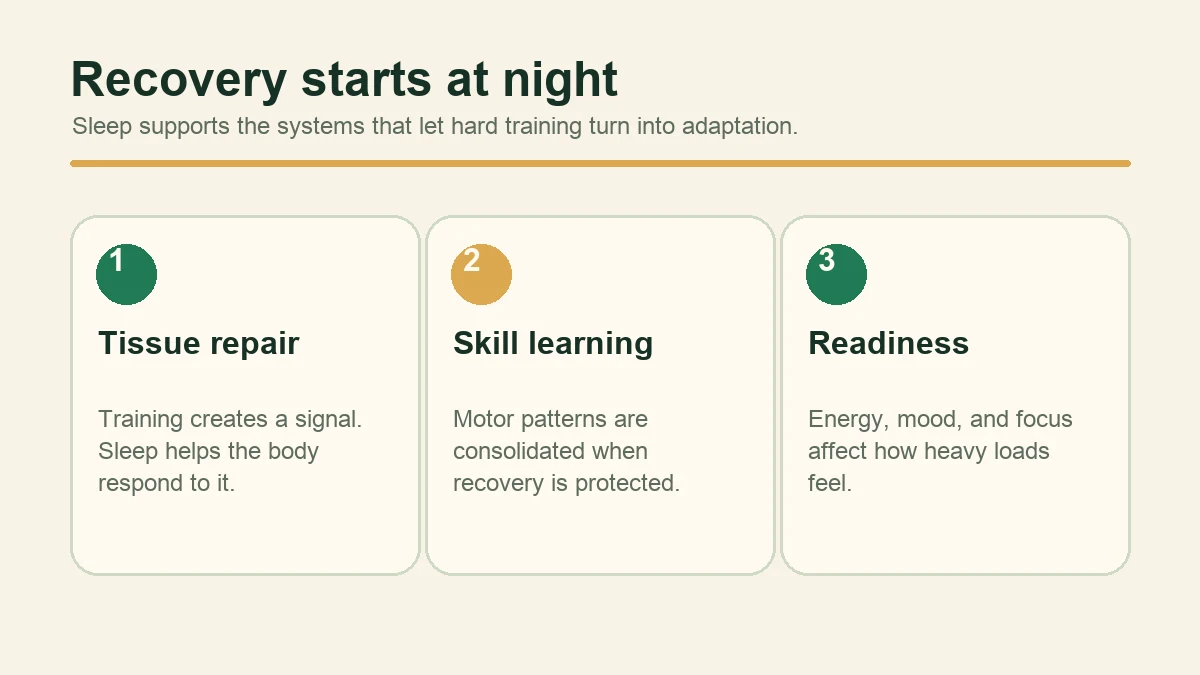
Sleep looks passive from the outside, but physiologically it is busy. The body regulates hormones, supports immune function, consolidates memory, and restores nervous-system readiness. A review of sleep hygiene and athletic recovery reports that sleep deprivation can impair reaction time, accuracy, vigor, submaximal strength, endurance, judgment, and decision-making. For lifters, that matters because training adaptation is not just about muscle fibers. It is also about skill, coordination, and the ability to produce force in a specific pattern.
The well-known Stanford basketball sleep extension study is often discussed in sports settings because extending sleep was associated with improvements in performance measures and mood in collegiate athletes. It was not a powerlifting study, and it does not prove that every extra hour of sleep adds weight to your squat. But it supports a broader point: sleep can affect athletic output, reaction time, and subjective readiness.
Strength training depends on those same human systems. A squat is not only quads and glutes. It is bracing, balance, timing, attention, and confidence under load. When sleep is consistently short, those pieces tend to become less reliable.
Bad sleep changes the cost of the same workout
The same program can feel very different depending on sleep. A session that is productive after seven to nine hours may feel irrationally heavy after several short nights. The bar has not changed. Your readiness has.
That matters because fatigue is not only local muscle tiredness. Poor sleep can affect perceived effort, mood, attention, and pain sensitivity. A hard set may feel harder. Warm-ups may feel less coordinated. Small technique errors may appear earlier. The session becomes more expensive.
The mistake is treating all tiredness as weakness. Sometimes the disciplined choice is not to force the exact plan. Sometimes it is to keep the habit, lower the cost, and protect the next sessions.
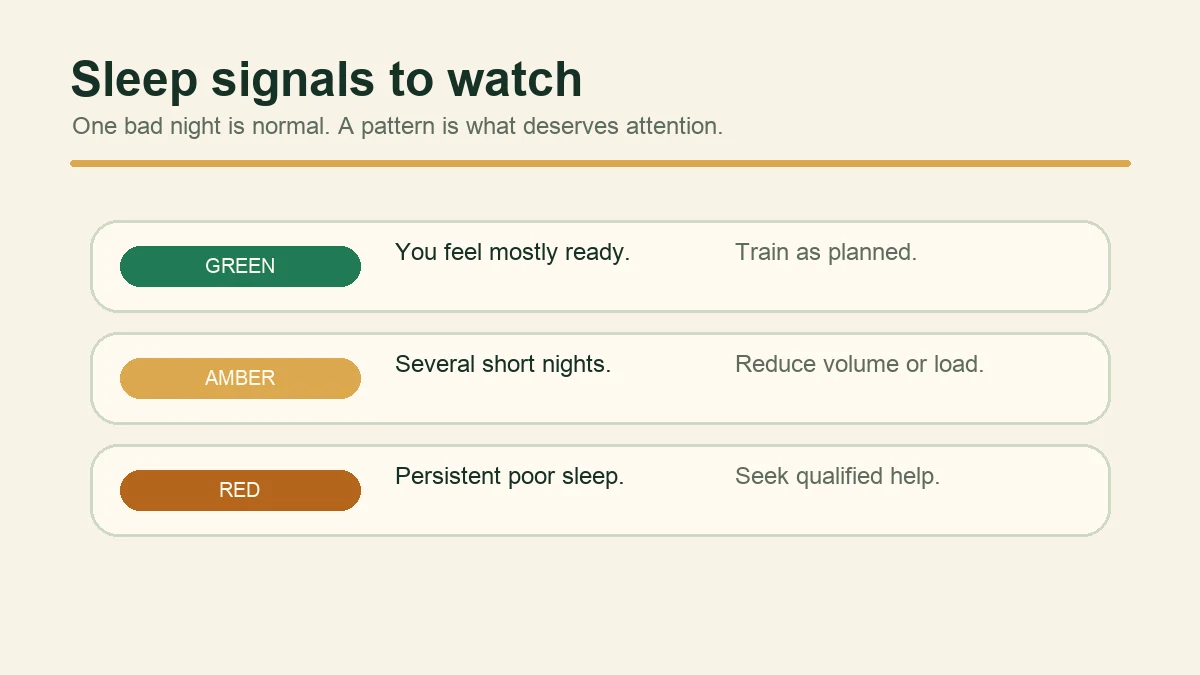
If you slept poorly once, you probably do not need to panic. Warm up, assess honestly, and train if movement feels safe. If you have slept poorly for several nights, especially alongside stress, low appetite, irritability, or a drop in performance, it is smarter to reduce volume, intensity, or exercise complexity.
One bad night is not the enemy
A single bad night happens. Travel, family, work, heat, stress, late caffeine, and random wake-ups are part of life. Strength does not vanish because you had one rough night.
Patterns are different. The CDC sleep guidance emphasizes that adults generally need sufficient sleep regularly, not occasionally. For training, the word “regularly” is the key. Recovery is cumulative. So is sleep debt.
If poor sleep is rare, adjust lightly. If poor sleep becomes the norm, do not pretend your training environment is unchanged. You may need fewer hard sets, fewer grinders, more rest days, or a temporary focus on technique and easy volume.
Sleep helps you learn the lifts
Strength is partly skill. You learn how to brace, descend, keep pressure through the foot, control the bar path, and produce force without leaking position. Sleep is involved in learning and memory consolidation, which makes it relevant to technical training.
This is especially important for beginners and intermediate lifters. If you are learning the squat, deadlift, bench press, Olympic lifts, or even unfamiliar machines, your nervous system is collecting information. Quality practice matters. Sleep helps the body and brain organize that practice.
That does not mean you need perfect sleep before learning anything. It means chronically poor sleep can make skill acquisition messier. You may repeat cues without owning them. You may feel inconsistent from session to session. You may blame the program when the actual issue is that your recovery inputs are unstable.
How to train after poor sleep
Use the warm-up as a readiness check. If the bar moves normally, coordination feels fine, and motivation improves as you get going, you can often train close to plan. If warm-ups feel unusually heavy, your technique is sloppy, or your mood drops further as the session begins, adjust.
Good adjustments include reducing top-set load, cutting one or two accessory exercises, staying farther from failure, using machines instead of highly technical free-weight lifts, or turning the session into easy movement. The goal is not to punish yourself for sleeping badly. The goal is to preserve the training week.
For example, a planned heavy squat day after three short nights might become three moderate sets of five plus light accessories. A hard deadlift session might become hinge technique and upper-body work. A hypertrophy day might keep the exercises but stop two or three reps earlier than usual.
Track readiness without becoming obsessive
You do not need a perfect recovery dashboard to make better choices. A simple three-question check is enough for most lifters: Did I sleep enough? Do warm-ups feel normal? Has performance been trending up, flat, or down?
If sleep was poor but warm-ups feel good and recent performance is stable, train. If sleep was poor, warm-ups feel unusually heavy, and performance has been sliding for several sessions, reduce the cost of the day. This keeps the decision grounded in evidence from your own training rather than mood alone.
Subjective ratings can help too. Give sleep quality, energy, and motivation a one-to-five score in your log. Over time, you may notice that certain patterns predict bad sessions. Maybe late caffeine hurts you. Maybe hard evening sessions are fine if they end before a certain time. Maybe dieting plus short sleep always wrecks lower-body days.
The point is not to become fragile. It is to become accurate. Accurate lifters make fewer emotional decisions.
Better sleep starts before bedtime
Most useful sleep habits are boring. That is good news. They do not require a recovery gadget.
Start with a consistent sleep window. If you need to wake at 6:30, the plan cannot begin at midnight. Protect enough time in bed before optimizing tiny details. Then make the room darker, cooler, and quieter where possible. Keep caffeine earlier in the day if it affects you. Create a wind-down routine that does not feel like another stressful task.
Evening training can work, but very intense sessions late at night may make sleep harder for some people. If that is you, experiment with ending earlier, lowering late-session intensity, or using a calmer post-training routine.
When poor sleep needs more than training tweaks
If poor sleep is persistent, severe, or paired with excessive daytime sleepiness, breathing interruptions, mood changes, or major performance decline, do not solve it only with deloads. Talk with a qualified medical professional. Training advice cannot diagnose insomnia, sleep apnea, anxiety, depression, medication effects, or other medical issues.
For most everyday lifters, though, the immediate win is simpler: stop treating sleep as optional. You do not adapt from the workout alone. You adapt from the workout you can recover from.
The bed will never look as heroic as a loaded barbell. It still might be the recovery tool you are underusing most.
Continue with a related guide
For the next practical step, read The Difference Between Fatigue and Overtraining. Continue with Why More Training Isn’t Always More Progress, then review what the evidence says in Creatine and Recovery: What Do We Actually Know?.