

“Do more” is one of the most tempting ideas in fitness. If three days are good, five must be better. If ten sets work, twenty must work faster. If one hard program builds strength, a harder one should build more.
Sometimes more training does help. Beginners may need more practice. Intermediate lifters may need more weekly volume for certain muscles. A person who has been coasting may improve when the work finally becomes challenging enough.
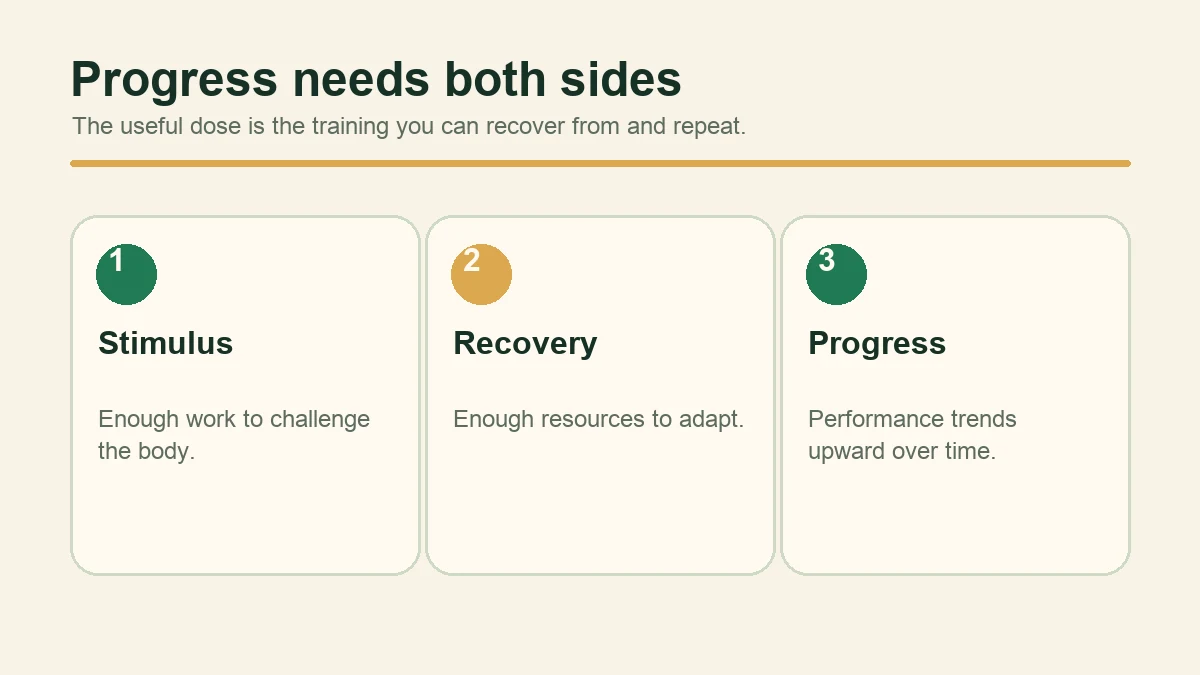
But more is not automatically better. Training is a dose. Like any dose, it has a useful range. Too little does not create enough stimulus. Enough creates adaptation. Too much can exceed what the athlete can recover from, especially when sleep, food, stress, and life outside the gym are not supporting the plan.
The real question is not “How much can I survive?” It is “How much can I recover from and repeat productively?”
- Why more training sometimes helps
- Why extra volume can stop helping
- How recovery changes the dose
- Signals that more work is becoming noise
- How to add volume responsibly
Training is a signal, not a punishment
Strength training works because it sends a signal to the body: this movement, this muscle group, this level of force, this repeated demand. The body adapts when the signal is strong enough and recovery resources are available.
That is why some volume is necessary. If you never practice the lift, never challenge the muscle, and never accumulate meaningful work, there may not be enough signal to drive progress. The Schoenfeld volume meta-analysis is often cited because it supports a dose-response relationship between weekly resistance training volume and muscle growth, at least within the ranges studied.
But dose-response does not mean infinite-response. The useful range depends on the person, the lift, the muscle, training age, effort level, and recovery context. Ten hard sets for one lifter may be productive. The same ten hard sets for another lifter, stacked on poor sleep and a stressful week, may be too much.
More work can become lower-quality work
Volume is not just a number on a spreadsheet. It has quality. Five hard, focused sets with stable technique are not the same as five exhausted sets where you are moving badly and chasing fatigue.
When volume gets too high, lifters often compensate without noticing. Range of motion shortens. Rest periods become inconsistent. Reps slow earlier. Accessory exercises become sloppy. The workout looks bigger on paper, but the useful signal may not be better.
This is especially common with programs copied from advanced lifters. An advanced athlete may tolerate more work because they have years of conditioning, better technique, more predictable recovery habits, and often a schedule built around training. A normal person with a full-time job, poor sleep, and limited food planning may need a different dose.
The body does not grade your program by ambition. It responds to what you can actually execute.
Recovery changes the meaning of volume
Training volume does not exist in isolation. The same program can be recoverable during a calm month and excessive during a stressful one.
Sleep, calories, protein, hydration, daily steps, job stress, emotional stress, travel, and illness all change your recovery budget. If that budget shrinks, the amount of training you can productively tolerate may shrink too. This is not a character flaw. It is physiology and logistics.
A useful training plan has some elasticity. It allows hard weeks, but it also allows lighter weeks. It gives you a way to reduce volume without feeling like you failed. Deloads, easier variations, and planned rest are not signs that training is weak. They are ways to keep the signal productive.
The problem with always adding
Many lifters add work whenever progress slows. Squat stalled? Add sets. Bench stalled? Add exercises. Arms not growing? Add another day. Sometimes that is the right move. Often it is just the easiest move to imagine.
Before adding volume, ask whether the existing work is being done well. Are sets close enough to the right effort? Is technique consistent? Are you repeating exercises long enough to progress? Are you sleeping enough? Are calories appropriate for the goal? Are you changing the plan every week?
If those basics are messy, more work may only add more mess.
Use trends, not single sessions
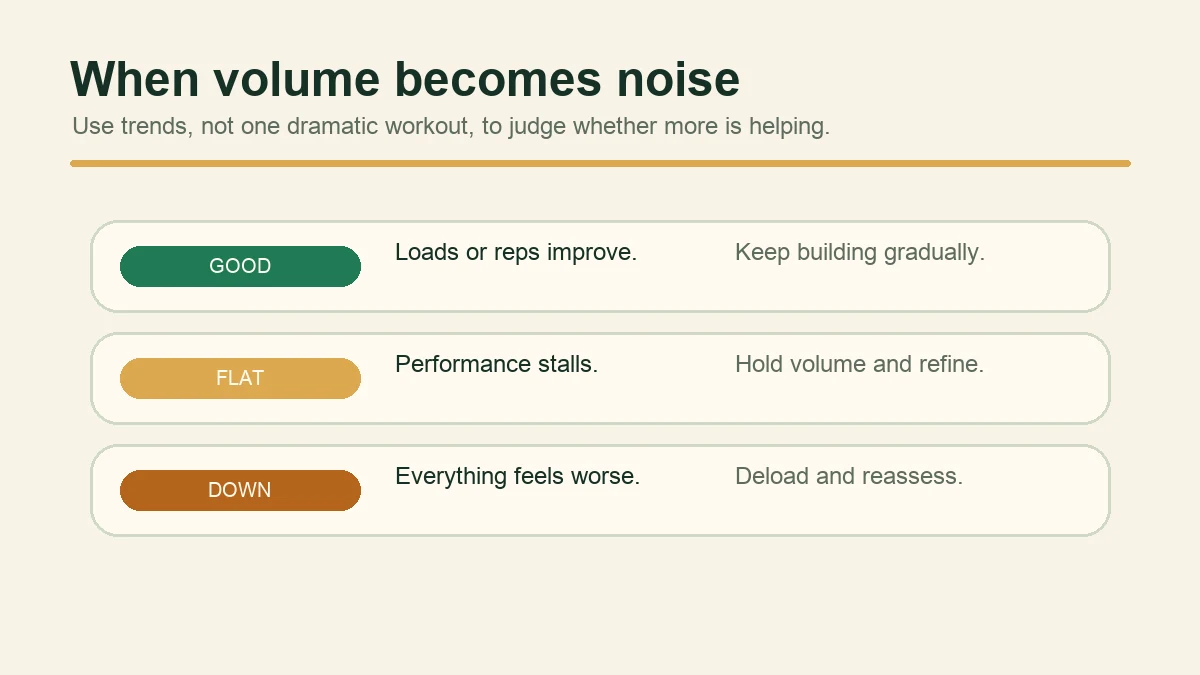
One bad workout does not prove a program is too much. A bad day can happen because of sleep, stress, timing, or random variation. Look for patterns over several sessions.
Helpful signs include stable or improving performance, manageable soreness, normal motivation, and the ability to repeat quality work. Warning signs include several weeks of declining loads, unusually persistent soreness, loss of appetite, poor sleep, irritability, and sessions that feel harder despite no increase in objective demand.
The systematic review and meta-analysis of weekly resistance-training volume is useful, but your own logbook is also evidence. If more sets are improving reps, load, technique, or muscle gain while recovery remains manageable, the dose may be productive. If more sets only make you tired and worse, the dose is not earning its place.
More frequency is not automatically more recovery-friendly
Some lifters try to solve too much volume by spreading it across more days. That can help. Ten sets on one day may feel worse than five sets on Monday and five sets on Thursday. Higher frequency can improve practice and reduce soreness from giant single-session spikes.
But frequency is still stress. A fourth or fifth training day adds warm-ups, commuting, setup time, mental load, and another demand on the week. If your life is already crowded, more frequent training may reduce recovery because it gives you fewer truly low-stress evenings.
The better question is what problem frequency is solving. If you need more practice on a lift, an extra light technique day may be useful. If you need more weekly back work but single sessions are too long, splitting volume can help. If you are simply anxious that rest days mean lost progress, more frequency may feed the wrong habit.
Recovery-friendly programming is not always less training. It is better-distributed training with a reason.
If you cannot explain why the extra day exists, pause before adding it.
How to add training without drowning in it
Add one variable at a time. If you add sets, do not also add intensity, new exercises, extra days, and shorter rest periods in the same week. You will not know what helped or what caused problems.
Start with the muscle group or lift that actually needs more work. Add two to four weekly hard sets, not ten. Keep the addition for several weeks, then judge the trend. If performance improves and recovery is stable, keep it. If progress is flat and fatigue rises, remove it.
For strength goals, remember that skill practice matters too. A meta-analysis on resistance training load helps reinforce that strength outcomes depend on how training is tested and performed, not only on total work. More random volume is not the same as better specific practice.
The goal is the minimum effective path forward
The best program is not the one that makes you most tired. It is the one that moves you toward your goal with a cost you can afford.
For some phases, that may mean more volume. For other phases, it may mean maintaining strength while life is busy. For a beginner, it may mean practicing the basics three days per week. For an intermediate lifter, it may mean targeted volume for weak points while protecting joints and sleep.
The appeal of doing less can be just as misleading when it becomes a slogan. Mike Mentzer’s Heavy Duty approach is a useful historical contrast, but the practical question remains whether a lower dose gives you enough quality practice for your goal.
More training is a tool. It is not a virtue by itself. Use it when it improves the signal. Remove it when it only increases noise.
Continue with a related guide
For the next practical step, read Creatine and Recovery: What Do We Know?. For a second perspective from the same topic cluster, continue with Recovery Is Part of the Program.