

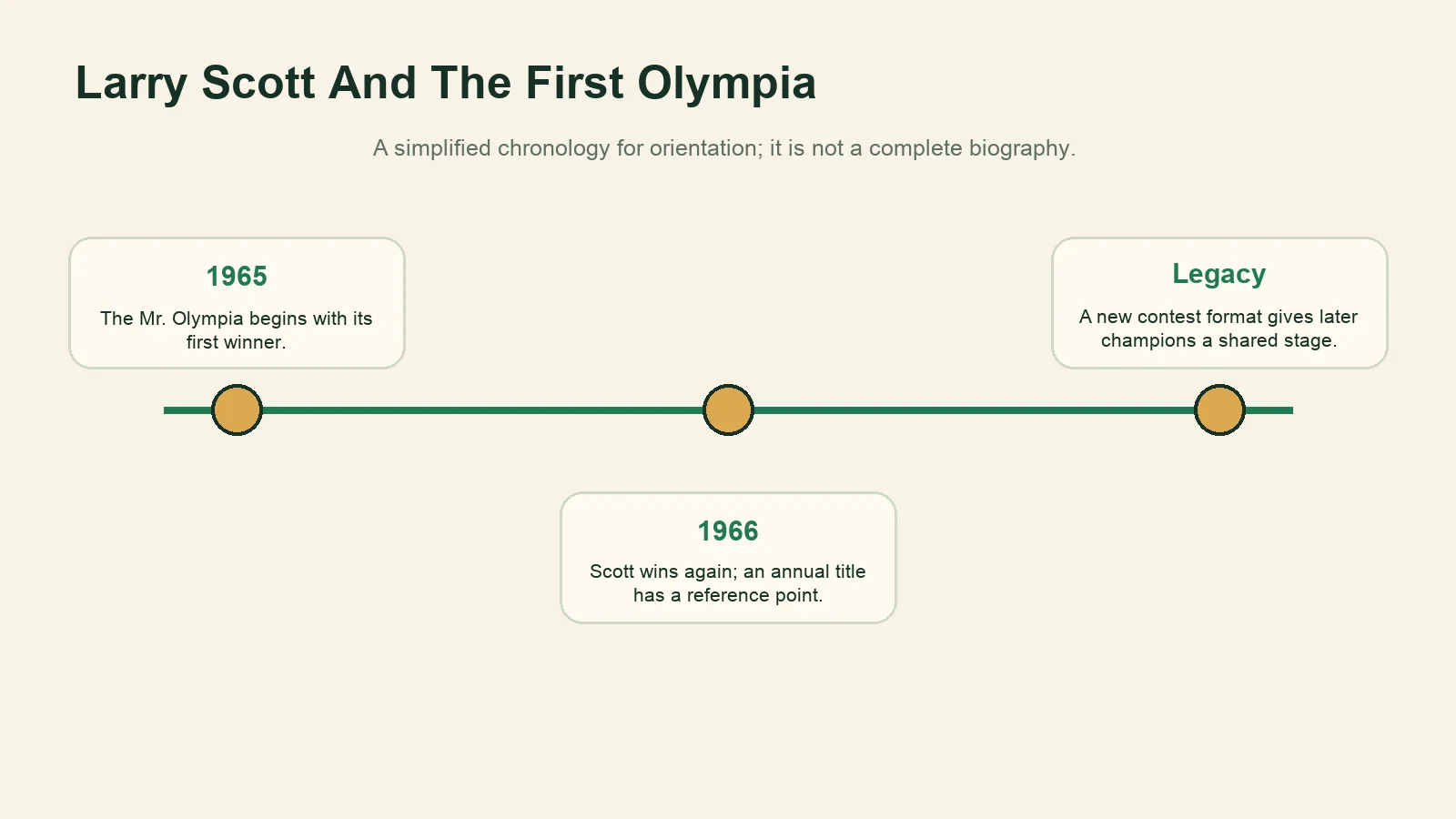
Larry Scott’s place in bodybuilding history is easy to summarize and easy to underestimate. He won the first Mr. Olympia in 1965, won again in 1966, and retired from the contest stage after the second victory. That looks like a small record beside the long title runs that came later. In practice, it gave a brand-new event its first standard, its first champion, and its first piece of repeatable history.
The useful way to read Scott’s story is not as a request to copy a 1960s physique or an old-school arm routine. It is a story about what happens when a sport creates a clear annual test. Before a contest becomes legendary, it needs a winner who makes the result feel real. Scott did that for Mr. Olympia.
- The title before the mythology
- Why two wins mattered
- How a record becomes culture
- What modern lifters can take from it
The title before the mythology
The modern idea of Mr. Olympia carries decades of champions, media coverage, arguments, and comparison. In 1965 it was simply a new contest with an unfamiliar future. Muscle & Fitness’s profile of Larry Scott identifies him as the first winner and notes his 1966 repeat. That record is the hard foundation of the story.
It matters that the contest began with continuity rather than a one-off result. A first winner says an event happened. A second win says the event can return, be defended, and become a reference point. Scott’s back-to-back titles gave later competitors something concrete to chase: not an abstract idea of fame, but an annual title with a name already attached to it.
The period also matters. Bodybuilding in the 1960s was a smaller and more fragmented world than the fitness industry readers know today. The contest did not arrive with streaming coverage, global social media, or a ready-made mass audience. Its meaning had to be built through promotion, photographs, gym culture, and the athletes who made people care about the outcome.
Why Scott was the right first reference
Scott did not appear from nowhere. Muscle & Fitness’s profile of Larry Scott describes him as the first-ever Mr. Olympia and notes that he repeated the result in 1966. That is enough to establish the competition record without turning the article into legend-making.
The first champion carries a different burden from a later champion. There is no prior winner to beat, no long comparison list, and no settled visual language for what the title should represent. The first result tells audiences what the award is trying to recognize. Scott’s early popularity, especially around arm development, made him a recognizable reference in the physical-culture world of the era.
Recognition is not the same as a universal standard of training. A historian can note what a champion represented without claiming that every reader should pursue the same look, volume, or competitive ideal. The best reading is more modest: Scott gave the event a credible beginning because he was already visible enough for the victory to mean something inside the sport.
From result to culture
An athletic record alone does not create a legend. It has to travel. Competition results move into magazines, gyms, conversations, coaching advice, photographs, and eventually nostalgia. This is why early champions are often remembered as symbols as much as athletes. They are attached to the moment when a format became important.
Scott’s two wins also created a useful sequence. In 1965, the title had an inaugural champion. In 1966, it had a defending champion. In 1967, Sergio Oliva would become a new winner and begin a different run. The series makes the sport legible: an event returns, a standard changes hands, and a new era begins.
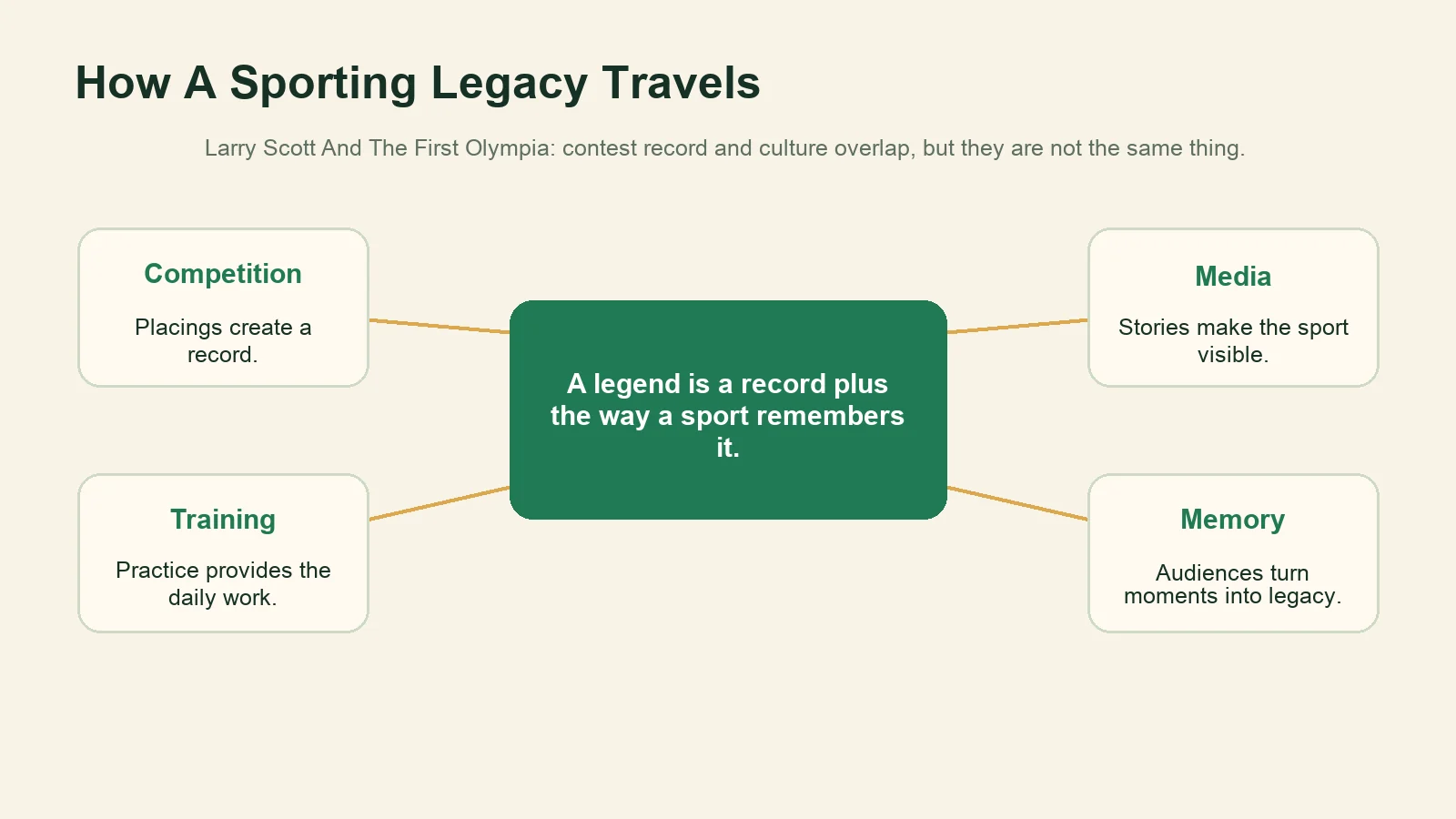
This is also why nostalgia should be handled carefully. Golden-era images are compelling, but they can hide the commercial pressures, narrow ideals, and individual costs behind professional physique competition. A historical profile should preserve the record without asking modern readers to treat the era as morally or practically simple.
What lifters can actually use
The first lesson is that a clear test changes behavior. Scott’s titles mattered because the contest had a defined moment of judgment. Everyday training does not need a stage, but it benefits from clear markers too: a planned block, a repeated lift, a technique target, or a monthly consistency review. Vague effort is hard to evaluate; specific practice is easier to improve.
The second lesson is that repetition gives a result context. One good session is not a training identity. Two successful seasons, two completed blocks, or two years of showing up say more. Scott’s second title did not merely add a number. It turned an inaugural outcome into a defended result.
The third lesson is to separate inspiration from imitation. Historical athletes can make a reader curious about discipline and craft. They cannot provide a plug-and-play plan for a different body, schedule, health history, or goal. Use the story to ask better questions about your own training, not to borrow someone else’s extremes.
There is a final historical point worth keeping. The value of an inaugural champion is not that the person becomes immune to criticism or permanently defines a sport. It is that the result gives later competitors and audiences a common starting line. Every later Olympia debate depends, in a small way, on the fact that the event began, returned, and had a first standard. Scott’s two wins are part of that institutional story. They matter even when a reader’s own training has nothing to do with physique competition.
Continue with a related guide
For the next practical step, read Lou Ferrigno: From Bodybuilding Stage to The Incredible Hulk. For a second perspective from the same topic cluster, continue with Pumping Iron: The Film That Took Bodybuilding Out of the Gym and Into Pop Culture.
Conclusion
Larry Scott’s significance is not that he solved bodybuilding or established a timeless ideal. It is that he gave Mr. Olympia an origin. The 1965 and 1966 wins turned a proposed contest into a title with continuity, and continuity is what allowed later champions to build competing eras around the same stage.
For a modern reader, the value is simple: serious progress becomes easier to understand when the test is clear, the work repeats, and the story keeps its context.