

Recovery is often described as what happens when you are not training. That makes it sound like the empty space between the important parts. In a useful strength program, it is not empty space at all. It is part of the design.
The session gives the body a reason to adapt. Recovery is what makes the next session possible at a useful quality. That includes rest days, but it also includes how hard you train on Tuesday after a difficult Monday, whether your week leaves room for sleep, and whether you know how to reduce the plan when ordinary life becomes demanding.
This is not an argument for treating every tired day as a crisis. Training should create some fatigue. It is an argument for treating recovery as a variable you plan, observe, and adjust rather than a reward you earn only after pushing too far.
- Why recovery belongs in the program
- What a recoverable week looks like
- How to use simple signals without obsessing
- How to adjust the plan when life changes
- When to stop self-managing the problem
Recovery is the part that makes training repeatable
A workout is one exposure. A program is a sequence of exposures that you can perform well enough, often enough, to move toward a goal. The difference matters. A session can be hard and still be a poor choice if it makes the next several sessions worse for no useful reason.
That is why a good program contains more than exercises, sets, and loads. It has spacing. It has easier days. It has room to repeat important movements with stable technique. It also has a response when a week goes sideways instead of asking you to force the original plan through unchanged.
The joint ECSS and ACSM consensus statement on overtraining makes the basic distinction clear: successful training needs overload, but it also needs to avoid the combination of excessive overload and inadequate recovery. The point is not to diagnose yourself from a bad workout. The point is to recognize that the dose and the capacity to absorb it belong in the same decision.
Recovery therefore is not a separate wellness project. It is part of programming. If your plan has no place for it, the plan is incomplete.
A recoverable week has a shape
The exact shape depends on the person. A novice may progress well with three full-body sessions and generous time between them. Someone more experienced may train four or five days, but distribute hard lower-body work, technical practice, and accessories so that every day is not competing for the same resources.
What matters is not finding the universally correct split. It is giving demanding work a reason to be where it is. Heavy deadlifts before an all-day move may be a poor fit. A short technique session after a long workday may be perfectly reasonable. Training frequency is a scheduling tool, not a measure of seriousness.
This is why the question of whether more training is actually producing progress belongs beside recovery. Weekly sets, days in the gym, and hard efforts only mean something in the context of what you can repeat. A plan that leaves you able to execute the next important session well is usually more useful than one that wins a single heroic week.
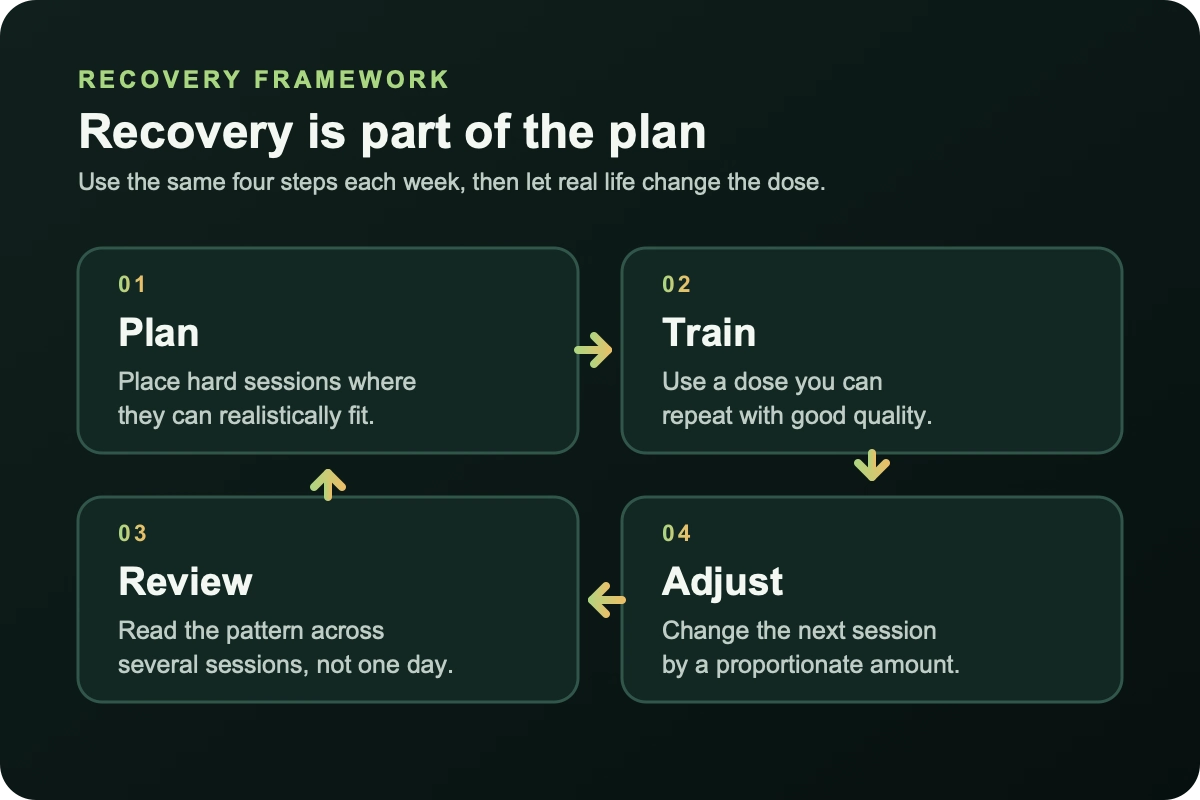
Use a few signals, not a dashboard of anxiety
You do not need a wearable score or a daily physiology test to make sensible adjustments. For most recreational lifters, a small set of observations is enough: is performance broadly stable, are warm-ups unusually heavy, is motivation persistently low, are you sleeping poorly, and are normal activities feeling harder than they should?
One poor signal is rarely decisive. An uncomfortable night of sleep, a bad commute, or a difficult workday can make a single session feel flat. Look for a pattern that persists across several sessions and includes more than one domain. The 2025 meta-analysis of training load and short-term responses found relationships between load and measures such as fatigue, soreness, sleep quality, and wellbeing, but it also rated the certainty of those relationships very low because the studies and measures varied substantially. That is a good practical reminder: a metric can inform a decision without becoming a diagnosis.
A training log is often the most useful tool. Record the planned work, what you actually did, how the important sets moved, and one short note about sleep or unusual stress. Over time, this makes it easier to see whether a difficult week was noise or whether the program needs a change.
A readiness number can be useful context, but it cannot tell you exactly what your body needs. Your training trend, sleep pattern, and real-life constraints provide the fuller picture.
Adjustment is a programming skill, not a failure
The most common mistake is treating the written plan as a test of character. When sleep is disrupted, work becomes unusually stressful, or travel removes normal routines, people often try to preserve every set and every load. That may be appropriate occasionally. It is not automatically the disciplined option.
Adjustment can be small. Keep the main lift but remove two accessory exercises. Use the planned sets at a lighter load. Replace a hard session with technique practice. Move a session by a day. These choices preserve the relationship with training while reducing a cost that no longer fits the week.
The key is to change one meaningful variable, then return to the normal plan when the situation passes. Do not respond to three hard days by replacing your whole program, buying a recovery gadget, or assuming you need a supplement. A proportionate change is easier to evaluate and less likely to create a second problem.
For sleep, the basic floor is also more useful than elaborate rituals. The CDC’s sleep guidance states that adults aged 18 to 60 generally need seven or more hours per night, while individual needs and circumstances vary. If sleep has been consistently short, the first training adjustment may simply be to avoid adding more hard work while you address the pattern. For a deeper look at training choices after poor sleep, see Sleep and Strength: Why Your Bed Might Be Your Best Recovery Tool.
Rest days should have a purpose
A rest day does not need to be a perfectly optimized recovery protocol. It can be a normal day without structured training. Walking, errands, time with friends, and early bedtime can all be compatible with it. The goal is not to create a second job called recovery.
What rest days do offer is contrast. They give joints, connective tissue, and attention a break from repeated loading. They make it easier to notice whether fatigue is resolving. They also protect time for the parts of life that help training remain sustainable: food, sleep, work, and relationships.
Some people prefer full rest. Others like easy activity because it feels good. Either can work when it matches the person and does not quietly become another demanding session. The relevant question is simple: does this leave you more ready for the next planned workout, or does it merely add more activity to justify a label?
Know when the program is not the whole question
Most routine fatigue can be addressed with a quieter week, better scheduling, or a conversation with a coach. But some situations deserve more than a self-directed deload. New or worsening chest pain, fainting, severe shortness of breath, significant swelling, sudden weakness, or pain that is sharp or persistent should not be managed through an article or a training log. Stop the activity and seek appropriate medical advice.
The same applies to fatigue or sleep disruption that is prolonged, unexplained, or interfering substantially with daily life. Training may be part of the context, but it is not automatically the cause. The overtraining consensus emphasizes that more serious performance decline requires consideration of other explanations, not casual self-diagnosis.
That boundary is not an interruption to training. It is part of responsible training.
Conclusion
Recovery is not the period where nothing happens. It is the part of the program that determines whether useful training can continue next week, next month, and next season.
Plan hard work with a reason. Leave room around it. Watch a few trends instead of chasing perfect data. When life changes, adjust the dose before the plan turns into a contest of endurance. The goal is not to avoid fatigue. It is to use fatigue as a temporary cost of work you can recover from and repeat.
FAQ
Should I take a rest day whenever I feel tired?
Not necessarily. Normal training fatigue can coexist with a productive session. Look at the pattern, the importance of the session, sleep, stress, and whether a smaller adjustment would be enough.
Is active recovery better than complete rest?
Neither is automatically better. Easy movement can feel good for some people, while complete rest may fit others. Choose the option that supports the next session rather than adding another source of fatigue.