Yes, bodyweight training can build muscle. The more useful answer is that it can do so when the exercises remain difficult enough, the total work is appropriate, and the plan has a credible way to progress. A routine of casual squats and easy push-ups performed unchanged for months is unlikely to keep producing much. A bodyweight plan that changes leverage, range, repetitions, sets, or load over time is resistance training with a different toolkit.
This is not an argument that bodyweight is identical to every equipment-based program. Barbells, dumbbells, cables, and machines can make it easier to load certain patterns precisely, especially lower-body work. But the basic question is not whether an exercise has a barbell attached. It is whether the target muscles experience a repeatable challenge that can be progressed.
The systematic review and meta-analysis comparing low- and high-load resistance training found similar hypertrophy outcomes when training was performed to failure, while heavier loading had an advantage for one-repetition-maximum strength. The study is not a promise that every bodyweight routine will work the same way. It is a useful reminder that muscle-building is not reserved for one loading tool or one rep range.
- What bodyweight training must provide
- How to make a movement harder
- Which patterns are easier and harder to progress
- How much work to start with
- When equipment becomes a useful upgrade
The challenge has to move
Muscle does not need a particular brand of equipment. It needs a sufficient training stimulus, delivered repeatedly enough to adapt to. In a practical bodyweight routine, that means an exercise cannot remain permanently easy. If you can complete the same variation for high repetitions with no meaningful fatigue and no change in form, the movement is probably no longer giving you much new information.
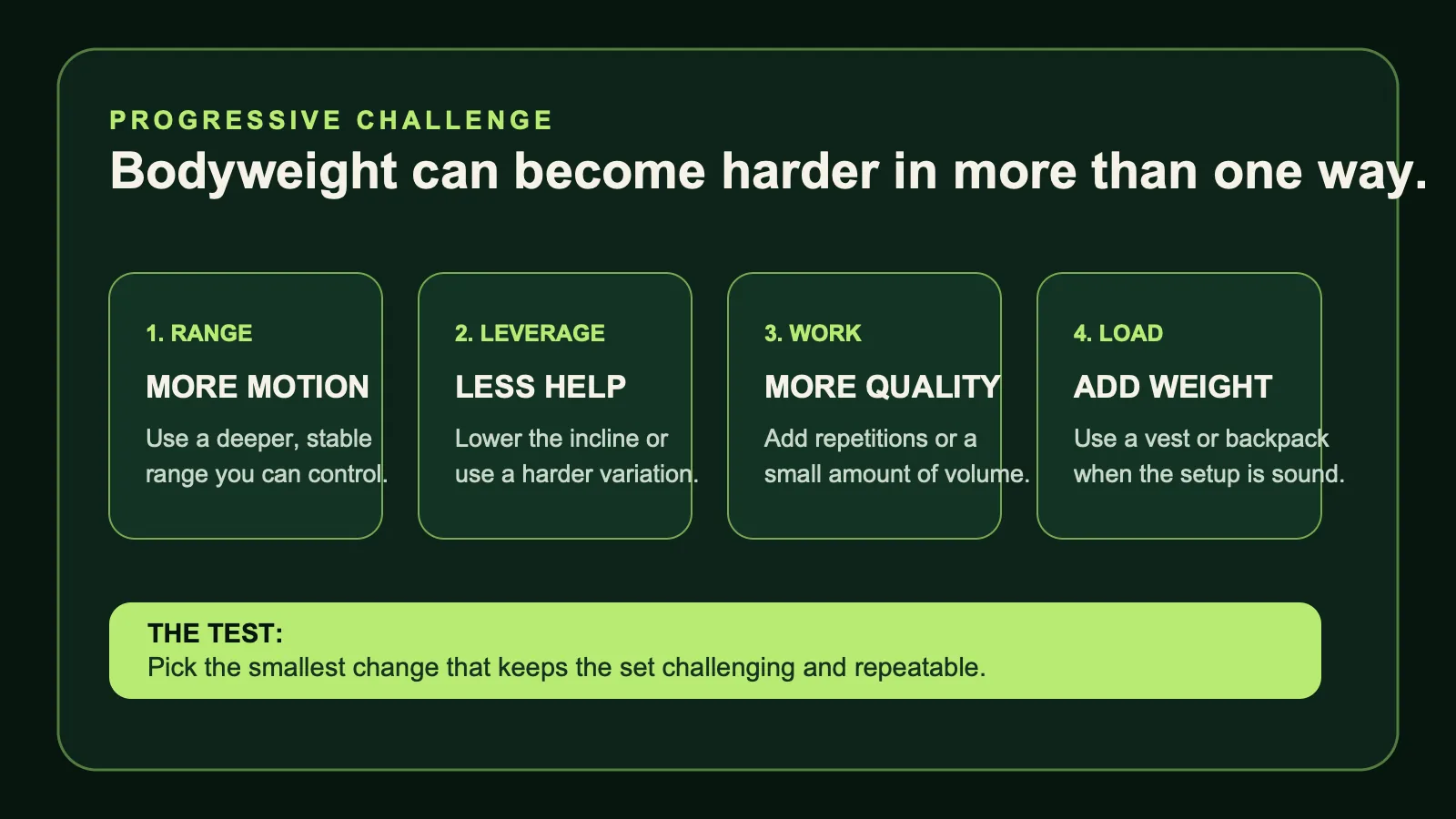
Bodyweight offers several sensible progressions. Increase range of motion when the deeper range is stable. Change leverage, such as moving from a high incline push-up to a lower incline. Add repetitions inside a defined range. Add a set if your recovery and schedule support it. Add external load only when the setup is secure and the current version is well controlled.
That is why the claim that calisthenics “does not progress” is incomplete. It may progress less conveniently in some exercises, but it still has levers to pull. The practical skill is choosing one lever at a time. The framework in The Anatomy of a Great Strength Program explains why this slower approach is often easier to sustain than changing everything at once.
Where bodyweight works especially well
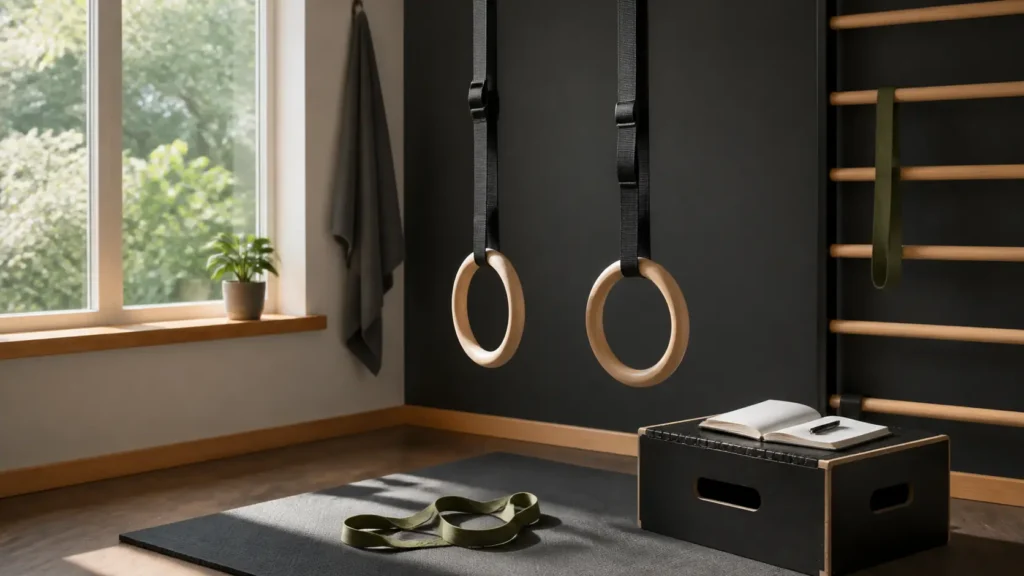
Push-ups, rows, pull-ups, split squats, step-ups, lunges, dips for people who tolerate them, planks, and hanging work all have room to progress. Rings can make pushing and pulling variations more demanding without needing a large home gym. A backpack, weighted vest, or a few plates can extend the runway further, but they are additions to a good setup, not a substitute for one.
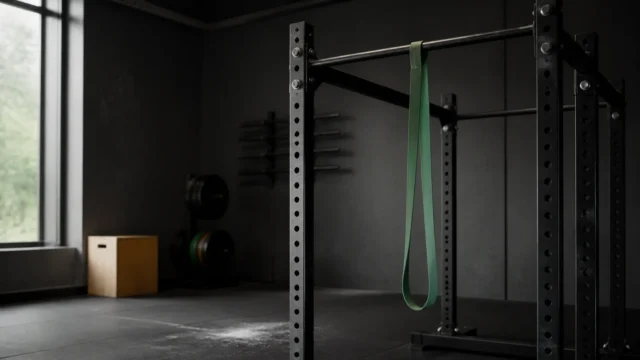
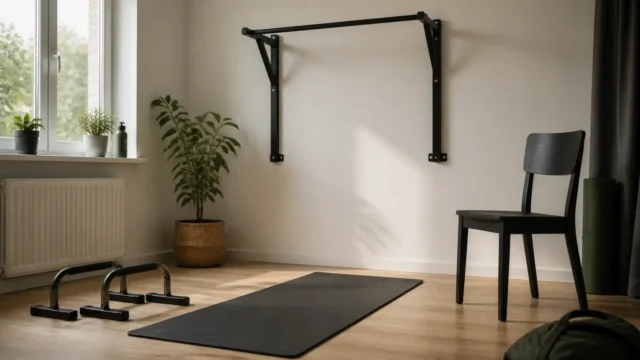
Upper-body pulling often needs some equipment because a safe pull is difficult to improvise. A pull-up bar, rings on a suitably secure anchor, or a stable row station are common solutions. Do not use a doorframe or household object unless it is specifically designed and installed for the load. If you do not have a safe pulling option, resistance bands are a practical bridge.
Lower-body training is where many bodyweight plans eventually need more creativity. Single-leg variations, controlled tempos, deeper ranges, step-ups, and split squats can be challenging, but they may become awkward before they become truly heavy. That is not a defect. It is information: a dumbbell, kettlebell, vest, or access to a gym may make lower-body progression simpler at that stage.
You do not have to chase failure
The low-load research is frequently translated into “every bodyweight set must end in failure.” That is too blunt for ordinary training. You can work hard without turning every set into a contest. Leave a small margin while you learn a variation, use stable technique, and accumulate useful work across the week. Move closer to a hard effort when the exercise and setup are familiar enough to judge it honestly.
The network meta-analysis of resistance-training prescriptions supports a similarly practical conclusion: more than one prescription can improve strength outcomes. The best bodyweight routine is not necessarily the one with the most punishing set. It is the one you can progress, recover from, and repeat.
For a new trainee, two or three full-body sessions per week is a reasonable beginning structure. Pick a push, pull, leg, and trunk pattern, perform a modest number of controlled sets, and record the variation you used. Calisthenics for Beginners: Where to Start provides that foundation. If your main push movement is already a floor push-up, use this push-up progression guide to decide what should change next.
What a realistic plan looks like
A useful bodyweight plan does not need to prove that it uses no equipment. It needs to cover the major movement patterns and keep the work honest. Here is a simple example for someone with access to a safe pull-up bar or row setup:
| Pattern | Example | Progression idea |
| — | — | — |
| Push | incline or floor push-up | lower the incline, then add load |
| Pull | row or assisted pull-up | reduce assistance or change body angle |
| Legs | split squat or step-up | add range, reps, or external load |
| Trunk | plank, dead bug, hanging knee raise | improve control before adding duration |
The plan becomes more convincing when the log answers simple questions: did you use the same variation, did you add a controlled rep, did the range stay consistent, and did the session remain recoverable? If the answer is repeatedly yes, your bodyweight work is not “just maintenance.” It is training.
One small randomized study of slow bodyweight resistance training in older healthy adults is also a useful reminder that simple resistance exercise can produce measurable outcomes in a specific population. It should not be generalized into a universal program, but it reinforces the larger point: the absence of a barbell does not mean the absence of a training stimulus.
The bottom line
Bodyweight training can build muscle, particularly when you are new to structured resistance work or when the movement variations remain challenging. It becomes less convenient when a pattern is difficult to progress safely or precisely, not when it stops being “real” training. Use the tools that keep your training clear: bodyweight first, basic equipment when it solves a real progression problem, and a routine that you can perform for long enough to learn from.
Continue with a related guide
Start with the complete routine in Calisthenics for Beginners: Where to Start. For a concrete upper-body progression, read Push-Ups: The Exercise Most People Stop Progressing Too Soon.