You do not need a training partner to make progress. Plenty of people train best alone: they can move at their own pace, keep sessions quiet, and fit them around work or family without coordinating anyone else. But one good shared session is worth trying.
Not because a partner will magically make you stronger. A good partner gives you a different view of the workout: preparation, respect for the plan, and calm attention around a hard set. That experience can improve your own standards even if you train solo the next day.
The key phrase is good partner. This is not an argument for dragging a distracted friend into the gym or waiting for a perfect match before you train. It is a small experiment: one shared session with a person who is reliable, respectful, and willing to keep the session simple.
- What a shared session can reveal
- How to keep the first trial small
- What to notice during the workout
- How to use the lesson when you train alone
A good session makes the routine visible
When you train alone, many useful habits are invisible because they are simply your normal. You warm up in a certain order, choose a rest period by feel, and decide when a set is finished. A good partner makes those choices easier to notice.
Maybe they open their log before the first set, ask what you are working on, and wait until after a set to offer one short cue. It makes the session feel organized instead of improvised.
The value is not copying their routine exactly. It is seeing that preparation can be calm. A partner can make you aware of where your own sessions lose time, where you rush a warm-up, or where you could record a little more useful information. That lesson belongs to you whether you train together again or not.
Social support can also make activity easier to sustain. The NIH overview of getting active together notes that a shared plan and encouragement can help people keep commitments to movement. In a weight room, that may be as ordinary as showing up when you said you would and beginning the planned work without a long negotiation.
Keep the first session deliberately small
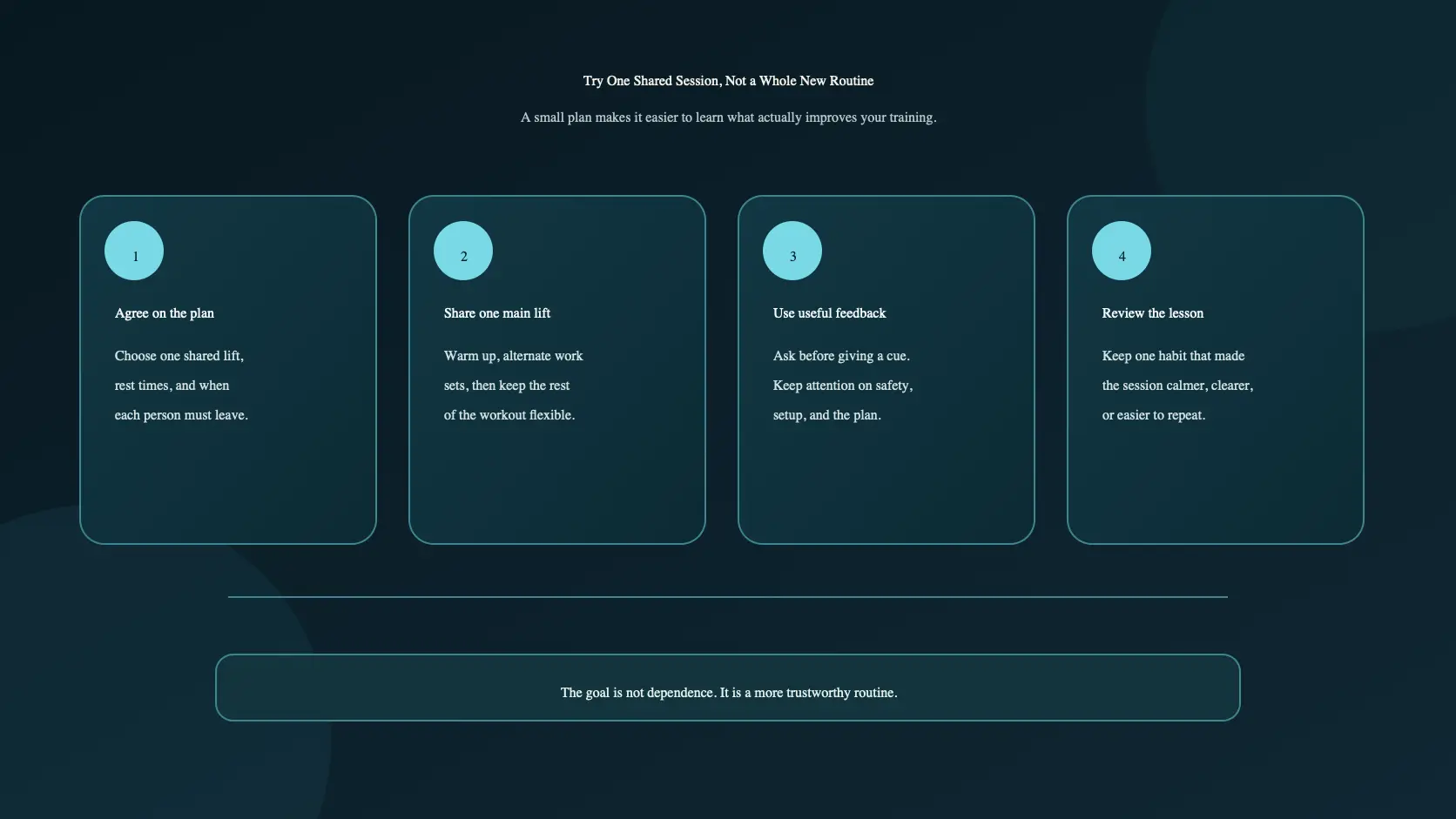
Do not try to merge two complete programs on day one. Pick one main lift or one short section of the workout to share, then let the rest remain independent. For example, warm up together, alternate work sets on a squat or bench press, and finish accessories separately.
This avoids the most common source of friction: trying to make two different training needs fit one schedule. One person may need long rests and detailed setup. Another may have 45 minutes before work. Both can still have a useful shared session if the agreement is narrow.
Before you begin, cover four practical points:
- Which lift or part of the session are you sharing?
- How much time does each person have?
- Do you want feedback during the set, after the set, or only when asked?
- What does safe assistance look like if the lift needs it?
That is enough. You do not need matching strength levels or matching goals. The fuller guide What Makes Someone a Great Training Partner covers the long-term habits of a good match. For a first session, clarity is more valuable than compatibility on paper.
Notice the quality of attention
The best part of a good partner is rarely hype. It is attention at the right moment: they are ready when you need a spot, do not interrupt a focused setup, and do not turn a normal work set into a performance.
You may realize that you benefit from a clearer setup before heavy sets, a timer between work sets, or a second set of eyes when learning a movement. You may also realize that you prefer quiet and independence. Both are useful outcomes.
A partner is not a substitute for equipment, safety arms, staff, coaching, or your own judgment. If a setup is unsafe or unclear, reduce the load or ask appropriate staff for help. The goal is not to create a spectacle around a difficult rep. It is to make the session more orderly.
Take the useful parts back to solo training
The trial works when you finish with one or two specific observations. Perhaps you train better when the plan is written before you enter the gym. Perhaps you need less phone time between sets. Perhaps a quiet check-in once a week would make a busy routine easier to keep.
You can recreate many benefits without a permanent partner. Meet a friend only for a main lift once a month. Join a class or club when the budget and access make sense. Send a planned session to someone you trust, then train separately. Or keep the entire routine solo and borrow only the habits that made the shared session work.
The article Why the Best Gyms Feel Like Communities, Not Businesses explains why a good room can offer support without demanding constant socializing. The same is true here: the point is not to make fitness your social identity. It is to learn what kind of environment helps you return with a clear plan.
A minimum version for a busy week
If schedules, childcare, transport, or gym access make a shared session unrealistic, use a minimum version: exchange a brief plan with a friend, coordinate the first ten minutes of a home workout by phone, or arrange one walk after work. The lesson is shared structure, not a specific gym arrangement. A partner should reduce friction, not become another difficult appointment.
Conclusion
Training with a good partner once can show you what reliable preparation, useful attention, and respectful feedback feel like in a real session. It may confirm that you enjoy training alone. It may lead to an occasional shared lift. Either result is useful.
Try one small, planned session. Share one main lift, keep expectations clear, and leave with one habit worth keeping. The best outcome is not dependence on another person. It is a routine that becomes easier to trust.
FAQ
Do I need a training partner to lift safely?
No. Use appropriate equipment, sensible loading, and your own judgment. A partner can be helpful in some situations, but they do not replace safeties, staff, or sound setup choices.
What if our strength levels are very different?
Different strength levels are usually manageable when the shared part of the session is limited and both people respect the other’s rest periods and setup. Matching goals and communication matter more than matching numbers.
Can I get the same benefits from a group class?
Sometimes. A class, club, or occasional check-in can provide structure and encouragement without requiring a permanent training partner. Choose the format that fits your time, budget, and preferred level of social contact.
Continue with a related guide
For practical habits that make a partnership work over time, read What Makes Someone a Great Training Partner. For the shared-space side of a better gym experience, continue with Gym Etiquette Is Mostly About Not Being That Person.