

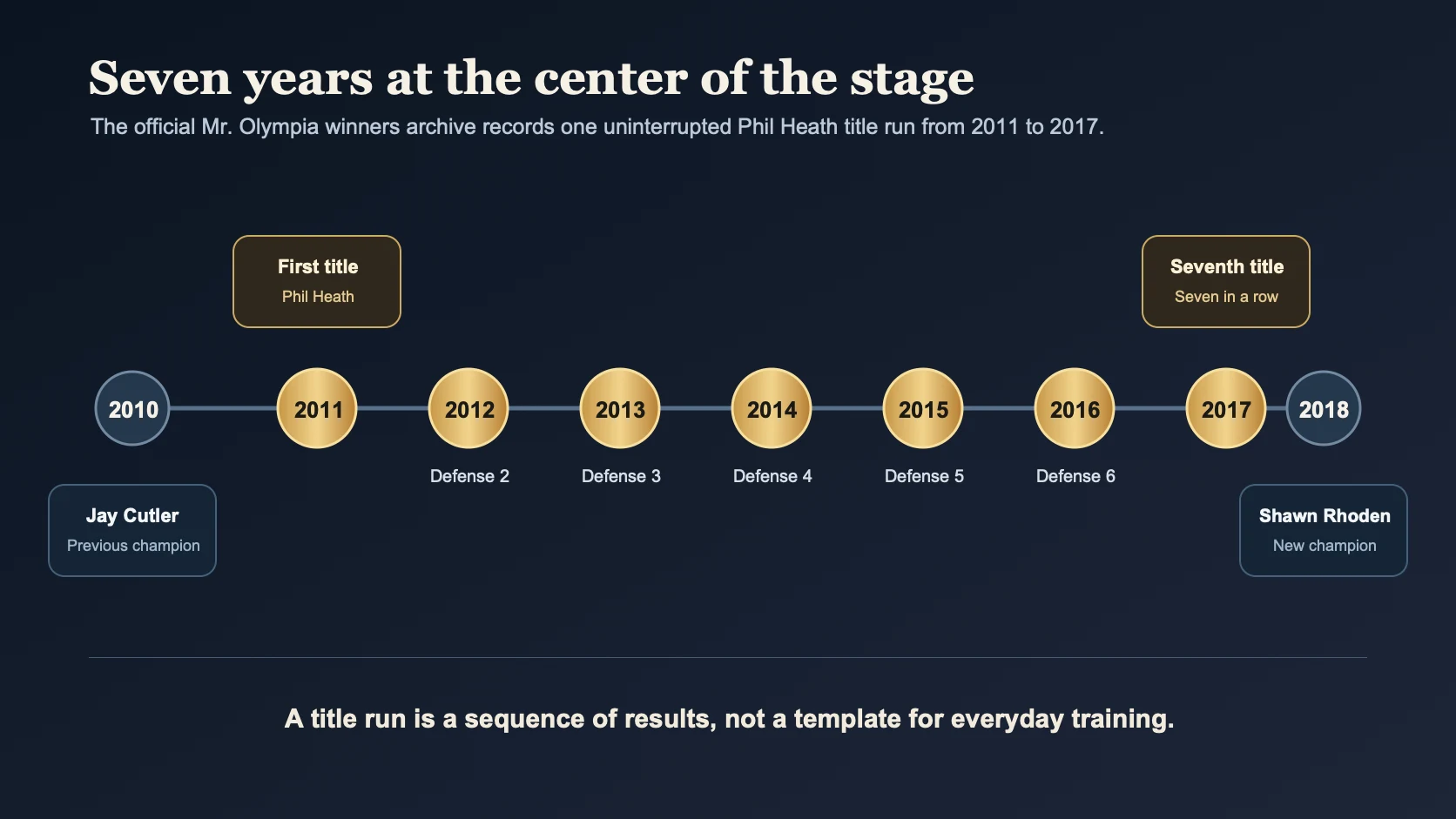
Phil Heath’s place in bodybuilding history is easy to summarize: seven consecutive Mr. Olympia titles, from 2011 through 2017. But the number is more useful when it is placed inside the sequence around it. He did not inherit an empty stage, and he did not leave a title that had become irrelevant. He followed Jay Cutler’s four-title chapter, defended the sport’s most visible contest for seven years, and was succeeded by Shawn Rhoden in 2018.
That is why “The Gift” became more than a nickname. It was attached to an athlete whose rise did not stop at one breakthrough win. The record became an era because the same result returned every year under changing competitive pressure.
This is a historical profile, not a guide to professional bodybuilding preparation. Elite contest results depend on resources, long training histories, contest-specific preparation, and tradeoffs that do not belong in an ordinary gym week. The useful lesson is about reading a long record carefully, rather than treating a famous physique or title count as a program to copy.
- The record behind the nickname
- Why the seven-title sequence matters
- The competitive handoff from Cutler to Heath
- Why 2018 changes the shape of the story
- The smaller lesson for everyday training
The record gives the story a center
The official Mr. Olympia winners archive lists Phil Heath as champion every year from 2011 through 2017. The same list shows Jay Cutler as winner in 2010 and Shawn Rhoden as winner in 2018. Those results are the factual core of the story: seven consecutive defenses, placed between two different champions.
The Olympia itself is a specific professional contest, not a laboratory that delivers a single objective answer about the best possible physique. Judging, the competitive field, preparation, presentation, and the culture of the moment all matter. But repeated wins still carry a clear historical meaning. One title identifies a peak. Seven annual wins show that an athlete kept meeting the same highly visible test long enough to become the reference point for a period.
Olympia’s own retrospective calls Heath a seven-time champion and describes the title as an identity as well as a result. Read The Top of the Mountain as a view from the contest’s organizer, not as an independent ranking of athletes. Its useful point is the narrow one: a multi-year title streak changes how a sport and its audience remember a competitor.
The rise was more than one winning night
The phrase “The Gift” can make the career sound predetermined, as if the titles simply followed from natural advantages. That is a neat story, but it hides the part that contest records make visible: the first win in 2011 was followed by six more successful defenses. Each return required another preparation and another result in the same public arena.
Heath’s own current biography describes a path from collegiate basketball to bodybuilding and identifies him as a seven-time Mr. Olympia champion. The Phil Fit biography is a first-party source, so it is useful for how Heath presents his own career rather than as a neutral account of every milestone. The externally verifiable Olympia archive supplies the title sequence that gives the public version of the story its factual backbone.
That distinction is worth keeping. A nickname, training image, and public persona can make an athlete memorable. The run of results is what turns the memory into documented competitive history. The title count does not tell a reader exactly how Heath trained, ate, recovered, or prepared at every stage. It tells us that he won the contest repeatedly.
The handoff from Cutler mattered
Heath’s first Olympia win arrived directly after Jay Cutler’s 2010 title. That makes 2011 a handoff, not merely a new name on a list. Cutler had won in 2006, 2007, 2009, and 2010 after the end of Ronnie Coleman’s eight-title reign. Heath then held the title for the next seven years.
Jay Cutler: The Years It Took to Finally Beat Ronnie Coleman explains why Cutler’s first win was the conclusion of a visible pursuit, not an overnight upset. Heath’s run is the next chapter in the same longer history: a new champion became familiar enough that later challengers were measured against him, not only against the athletes who had come before.
This is why title sequences are more useful than isolated debates about one year. The record preserves the changing context. Ronnie Coleman ended his eight-title run in 2005; Cutler won the next season; Heath began in 2011. The champions are not interchangeable, but the sequence shows how each era changes the standard faced by the next competitor.
For the earlier seven and eight-year conversations around the Olympia, Ronnie Coleman: From Police Officer to Bodybuilding Icon and Lee Haney: The Era of Size, Shape and Eight Olympia Titles provide the wider context.
2018 keeps the story honest
The official archive lists Shawn Rhoden, not Heath, as the 2018 Mr. Olympia winner. That fact gives the seven-title story its boundary. Heath did not match the eight-title record held by Haney and Coleman, and there is no need to turn that into a failure or a hypothetical argument. Seven consecutive wins is already a complete, documented accomplishment.
The boundary also protects the history from a common mistake: treating every long reign as a simple ladder where the only meaningful question is whether the next title arrives. A title run can be important without becoming the all-time record. Heath’s seven years defined the 2010s Olympia conversation because the championship stayed with him long enough to make that period recognizable.
A seven-title professional record explains why an athlete is remembered. It does not justify copying contest preparation, supplement use, training volume, or lifestyle claims without your own context.
What everyday lifters can actually take from the story
The practical lesson is not to chase an elite physique or to turn every training block into a title defense. It is to understand what consistency looks like when a result has to be repeated. A good ordinary program should be judged the same way on a smaller scale: not by one perfect session, but by whether it produces work you can return to with sound technique and a manageable recovery cost.
That does not make a recreational training log equivalent to an Olympia record. It does make the basic question useful. Are you building a repeatable sequence, or only collecting occasional hard sessions that cannot be sustained? The Anatomy of a Great Strength Program gives that question a practical structure through clear goals, manageable volume, and progression that fits the trainee rather than a celebrity narrative.
Phil Heath’s rise remains memorable because it did not end with the first win. Seven consecutive Olympia titles made the nickname, the champion, and the era reinforce each other. The record is enough. It does not need inflated lessons to remain significant.
FAQ
How many Mr. Olympia titles did Phil Heath win?
Phil Heath won seven consecutive Mr. Olympia titles, from 2011 through 2017.
Who won the Mr. Olympia before Phil Heath?
Jay Cutler won the 2010 Mr. Olympia before Heath’s first title in 2011.
Who won after Phil Heath’s title run ended?
Shawn Rhoden won the 2018 Mr. Olympia, ending Heath’s seven-year run.
Continue with a related story
For the champion immediately before Heath, read Jay Cutler: The Years It Took to Finally Beat Ronnie Coleman. For the eight-title record Heath approached, continue with Ronnie Coleman: From Police Officer to Bodybuilding Icon.