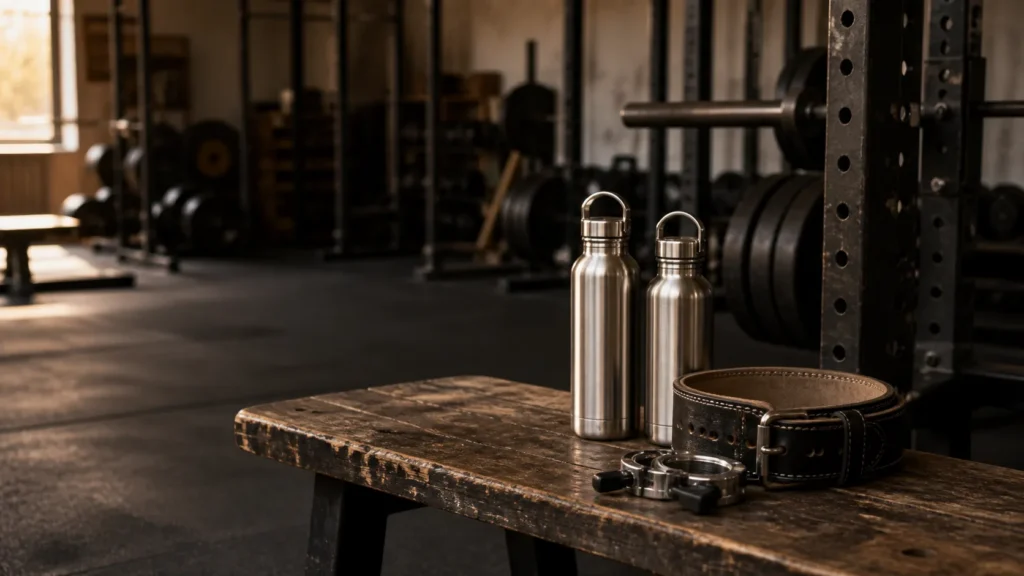
There is a particular kind of gym relationship that barely looks like a relationship at all. You know someone uses the platform after work, takes the same corner rack on Wednesday, or always arrives before the morning crowd. You exchange a nod, ask how many sets are left, maybe borrow a collar when yours has vanished. Outside that room, you would not recognize their surname, job or plans for the weekend.
That does not make the connection trivial. These are the people you only know between sets: familiar enough to make the room feel less anonymous, distant enough that training can remain your own. They are not automatically friends, training partners or an audience. Most of the time, that is exactly why the relationship works.
- Why low-pressure familiarity matters
- What makes these interactions useful
- Where the boundary belongs
- How to be a good regular
Familiarity is not the same as friendship
Friendship asks for time, attention and a place in the rest of your life. A gym acquaintance does not. You can appreciate seeing the same people without needing to make plans, explain your program or turn every session into a conversation.
That lighter level of connection has a practical value. It makes the social rules of the room easier to read. You know who trains quickly, who needs a longer setup, who is likely to share a rack fairly and when the evening rush usually begins. Familiarity removes small bits of friction before they become annoyances.
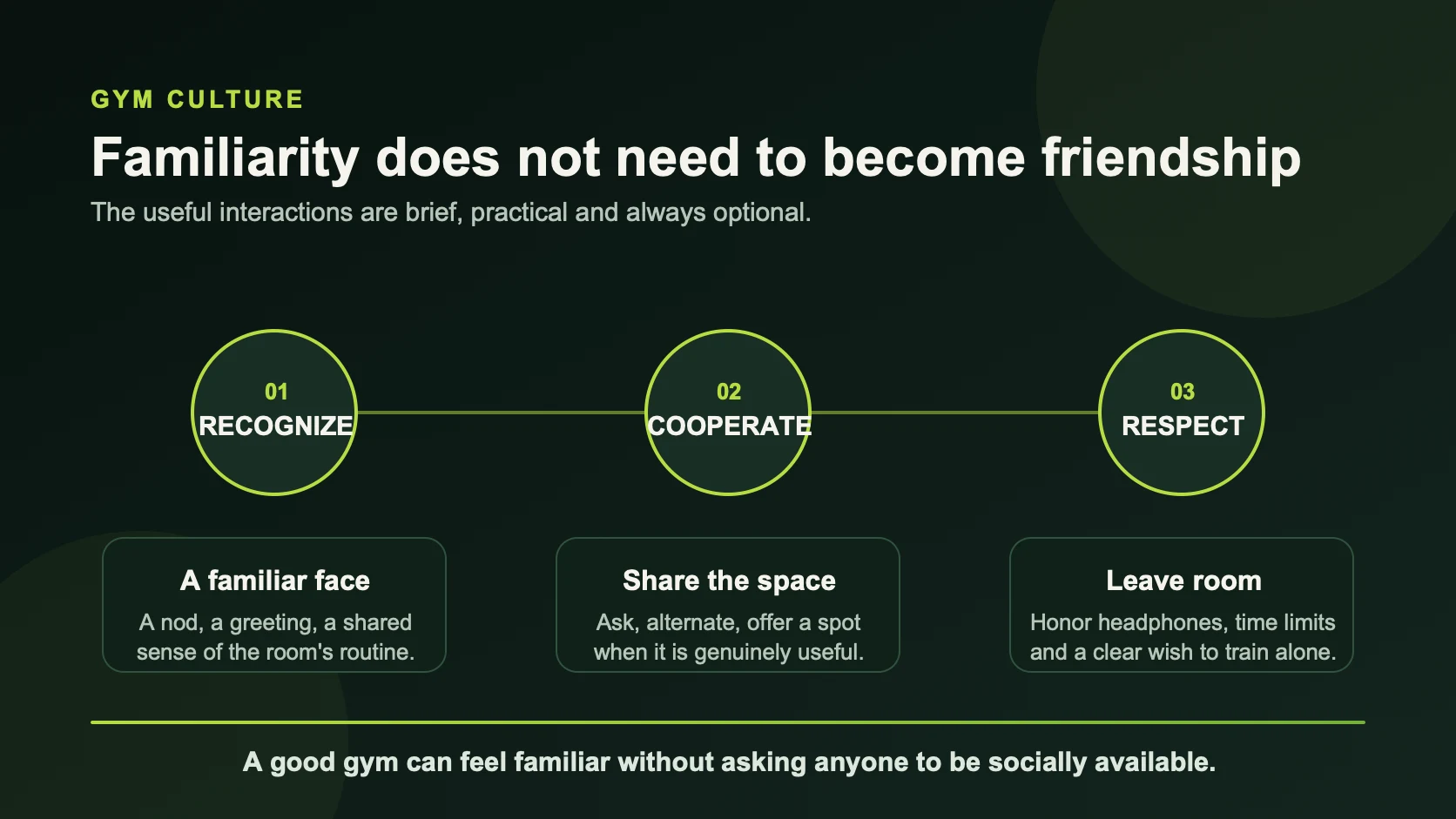
It also gives a gym some texture. A regular nod from the person on the next platform is not a promise of support, and it should not be treated as one. It is simply a signal that you both recognize the shared routine. You belong in the same room for an hour, doing separate work.
A systematic review of adult physical-activity studies found that social-network measures and physical activity were associated across the included research, while also noting that social influence is complex and not a simple cause-and-effect story. That is a useful level of caution for the weight room. A familiar face may make showing up feel easier for some people; it is not a substitute for a plan, a coach or a life outside the gym. Read the systematic review of social-network influences on adult physical activity for the research context.
The best interactions solve a small problem
The good moments between sets are usually ordinary. Someone asks, “Are you using this?” You tell them you have two sets left. You alternate without rushing either person. A stranger offers a spot before a difficult bench set, then lets you get back to work. The interaction has a clear purpose and a natural ending.
Those small exchanges are more useful than forced friendliness because they respect the reason everyone is there. They do not require a performance. You do not have to be entertaining, confident or interested in talking about training. You only need to communicate clearly.
This is closely related to the habits in Gym Etiquette Is Mostly About Not Being That Person. Returning weights, asking before taking equipment and not stretching a short conversation into a distraction are basic forms of consideration. They make it easier for the next interaction to be relaxed.
Do not turn recognition into access
Seeing someone three times a week does not make you entitled to their attention. Headphones, a focused warm-up or a short answer are not invitations to push harder. Some people use a gym as their quiet hour. Others are happy to talk on a rest break. Neither style needs correcting.
The simplest rule is to let the other person set the pace. Start with the practical question. If the answer is brief, keep it brief. If a conversation develops naturally, fine, but do not make it a test of whether they are friendly enough. Familiarity should lower pressure, not create a new obligation.
The same applies to advice. A person may look new to a lift, use lighter weights than you expect or train in a way you would not choose. Unless safety requires staff intervention, their session is not an open invitation for coaching. If you have a reason to help, ask first and accept no without taking it personally.
Be a regular people are comfortable seeing
You do not need to become the social organizer of the gym. A few reliable habits are enough:
- Acknowledge people without demanding a conversation.
- State your remaining sets and rest time honestly when sharing equipment.
- Offer help for a specific need, then allow an easy refusal.
- Leave the area as orderly as you found it, including plates, benches and collars.
- Keep your attention on your own session rather than monitoring everyone else’s.
These habits matter whether you train alone or with someone else. If you eventually want a closer training relationship, that is a separate choice. Everyone Should Train With a Good Partner at Least Once explains how to try one shared session without merging your entire routine. A partner involves planning, timing and feedback; a familiar regular does not need any of that.
Let the room stay optional
One of the strongest signs of a good gym culture is that people can participate at different levels. Some members will become close friends, join a lifting club or train together every week. Others will remain recognizable strangers for years. Both are legitimate ways to use the same place.
That distinction is worth protecting. The gym can feel more welcoming because people know how to share space, not because everyone has to socialize. You can appreciate the person who saves you a few minutes by alternating on a rack and still prefer to leave the building alone when your last set is done.
The people you only know between sets are a reminder that community does not always need a big story. Sometimes it is just a room with good rules, repeated faces and enough mutual respect to make returning feel normal.
Continue with a related guide
For a wider look at how a training space earns that feeling, read When the Gym Becomes Your Third Place. For the practical rules that keep shared spaces running smoothly, continue with Gym Etiquette Is Mostly About Not Being That Person.