"IPF Approved" sounds like a broad quality seal. In powerlifting, it is more specific than that. It tells you that an item or manufacturer has a place in the International Powerlifting Federation’s approved-equipment system for IPF-sanctioned competition. That matters if you are lifting under those rules. It does not tell you whether the gear fits you, helps your training, works in every federation, or will pass inspection on its own.
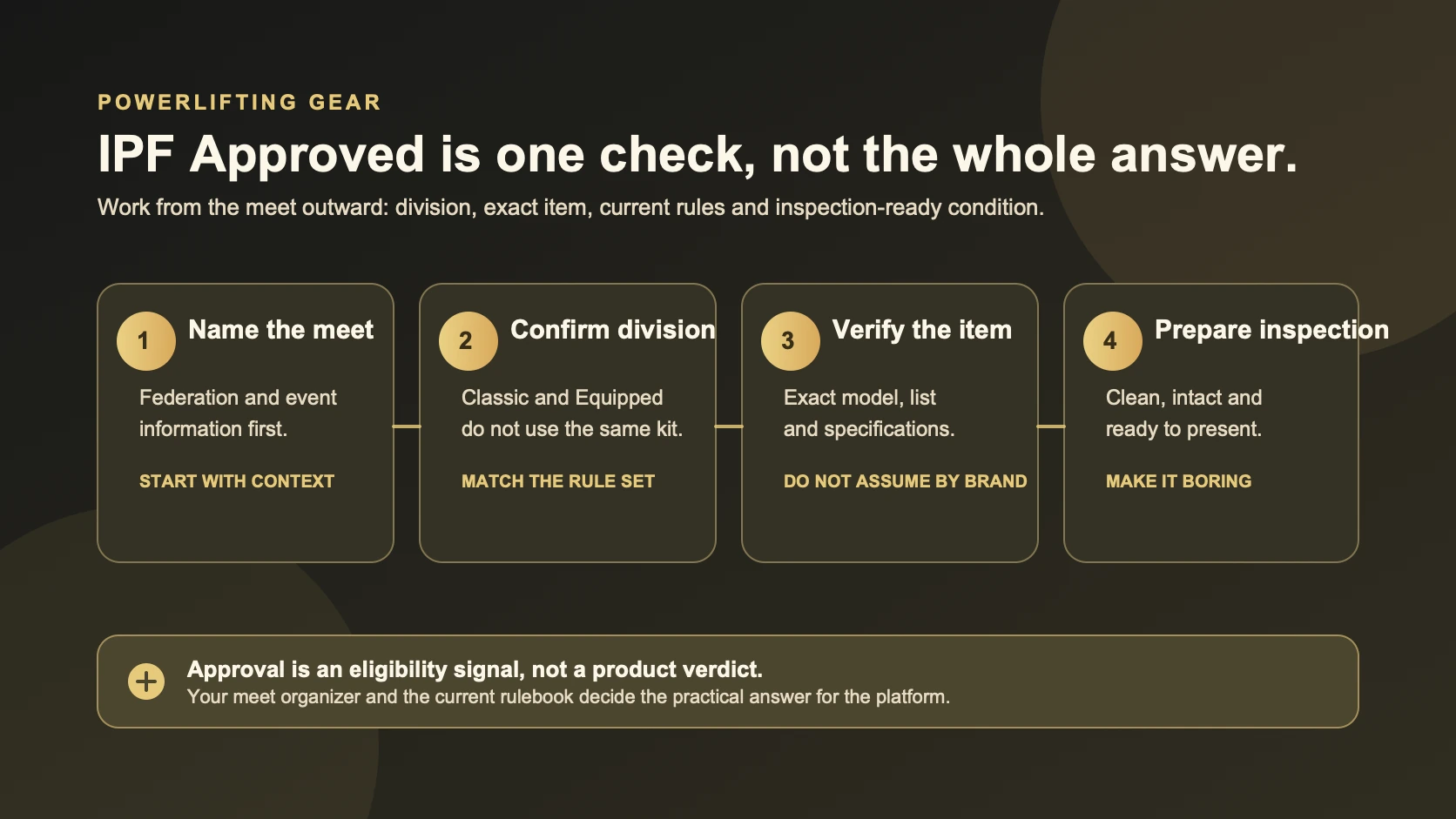
The useful way to read the label is as a competition checkpoint. It narrows the question, but it does not finish it. You still need to know the exact meet, the division, the current rules, the exact item, and whether it arrives in acceptable condition.
- What approval actually covers
- Why a brand name is not enough
- How Classic and Equipped change the answer
- What inspection adds to the process
- A practical check before you buy or pack
Approval is about competition eligibility, not a product verdict
The IPF publishes an Approved List of Apparel and Equipment for use in its sanctioned competitions. The current page says the list is valid through 31 December 2026 and identifies approved equipment by item-specific IPF IDs. The purpose is practical: referees and lifters need a common reference for items such as singlets, belts, wraps and knee sleeves.
That is not the same as a claim that an item is the most durable, most comfortable, safest or most useful choice for training. Approval is a rule-status question. A plain belt that works well in a home gym may be a better training purchase for one person and still be irrelevant for an IPF platform. Conversely, a listed competition belt can be a poor choice if its width, closure or stiffness does not suit how you train.
It also does not mean the IPF has approved every product a company makes. The list is organized around the relevant approved items and their identification, not a blanket endorsement of a brand catalog. Match the product you are buying to the current list rather than assuming that a familiar manufacturer name settles the question.
An approved item must still meet the technical rules
The IPF’s 2026 Technical Rules make this explicit. Personal equipment from an approved manufacturer must also meet the rule specifications for that item. Approval and specification work together; one does not replace the other.
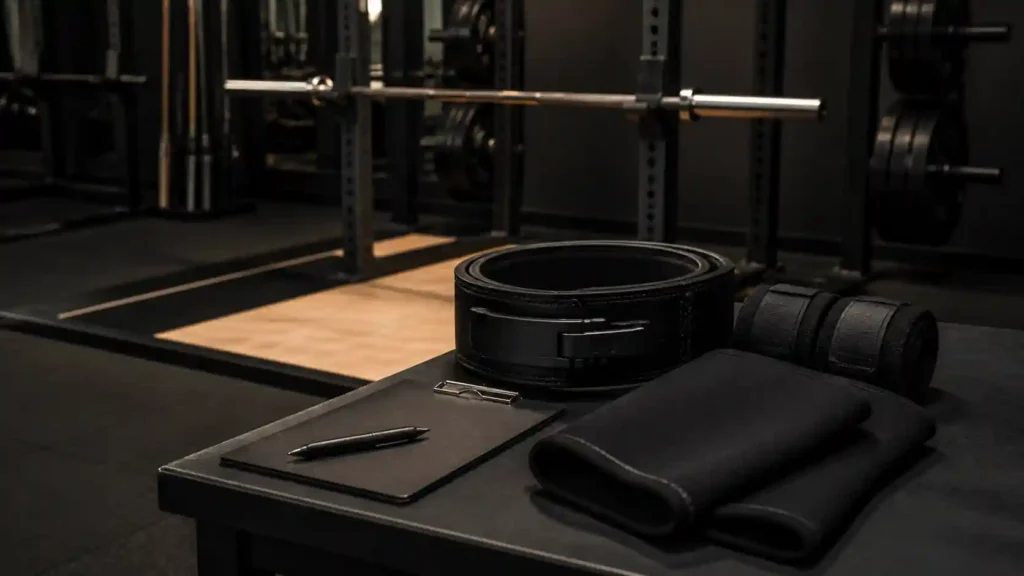
For example, the rulebook sets a maximum belt width of 10 cm and a maximum main-length thickness of 13 mm. It permits one- or two-prong buckles and quick-release, or lever, closures. The same rulebook gives knee sleeves their own limits: a maximum 7 mm thickness, maximum 30 cm length and no additional strapping, Velcro, drawstrings or padding. Those details are not product-review trivia. They are why a gear label alone cannot answer whether a particular setup is legal on the day.
Condition matters too. The IPF rulebook allows inspection officials to reject an item that is unclean or torn. Do not treat the meet bag as a storage box you open for the first time at weigh-in. Check the stitching, closure, fabric, length and general condition while you still have time to replace something.
Classic and Equipped are different equipment questions
The phrase "IPF Approved" does not tell you which division you are entering. That distinction changes what can be worn. Under the 2026 rulebook, a supportive lifting suit and supportive shirt are for Equipped competition, while a non-supportive singlet is required in Classic/Raw competition. Knee wraps are permitted only in Equipped competition; knee sleeves are not a substitute for a knee wrap, and the two cannot be combined.
This is where a simple shopping question becomes a meet-specific one. A piece of equipment can be listed and legitimate, but not permitted in your division. The rules also cover the less glamorous items that are easy to overlook: shirt construction, sock requirements, shoe limits, logo rules and where wraps may sit. Read the current rulebook and the meet information rather than relying on an old packing list, a retailer description or a video from a different federation.
The distinction is especially useful for newer lifters. You do not need to buy every item that may be allowed somewhere. Build the kit required by your division and meet, then add equipment only when it has a clear job. Your First Powerlifting Meet: The Gear That Actually Belongs in Your Bag is a practical starting point for that smaller, more reliable approach.
Inspection is part of the competition, not an afterthought
The IPF rulebook provides for personal-equipment inspection before a lifter’s bodyweight class begins. Items are examined and marked after approval; an item over the permitted length can be cut and resubmitted, while unclean or torn equipment can be rejected. The consequences can be serious if an illegal item reaches the platform, so the sensible goal is not to negotiate at the last minute. It is to make inspection boring.
Bring the item you plan to wear, not a slightly different version that "looks the same." Keep it clean and dry. Know which division you entered. If a rule, logo or product version is unclear, ask your federation or meet organizer early enough to get an answer before travel. They control the practical event context; a general article cannot overrule them.
This also explains why a lifter may carry a backup. A spare approved wrap or shirt is not an excuse to overpack. It is a way to avoid turning a small tear, missing loop or wet item into a competition problem. Pack a backup only for items you know you can use and have already checked.
Use a four-question check before spending money
Before you buy a belt, sleeve, wrap or singlet because it says IPF Approved, work through four questions:
- Which meet am I entering? Confirm the federation, organizer and current event information first.
- Which division am I lifting in? Classic and Equipped do not ask for the same kit.
- Is this exact item on the current list and within the technical rules? Check the product identity, the list, dimensions and construction rather than relying on a brand claim.
- Can I use it comfortably and present it cleanly? Competition status does not replace fit, practice or basic care.
This process may sound slower than adding a popular item to a cart, but it prevents the expensive mistake of buying an object for a rule set you are not actually using. The same logic applies when comparing knee support: Sleeves or Wraps? explains that they are different tools with different roles, not interchangeable levels of the same product.
The label is useful when you give it the right job
IPF Approved is valuable information for an IPF lifter. It helps narrow a large gear market to items intended for the relevant competition framework. It is not a universal measure of quality, a substitute for rule reading, or a promise that the item belongs in every division and every meet.
Treat the label as the start of a check: identify the event, confirm the division, match the exact item to the current list and rules, then inspect the real gear you plan to wear. That approach is less exciting than buying by logo, but it is far more likely to leave you focused on the lifts instead of the equipment table.
FAQ
Does IPF Approved mean any product from that brand is legal?
No. Check the current approved list and the exact product identity. Approval is not a blanket statement about every item a manufacturer sells.
Is IPF Approved gear required for normal gym training?
No. It is relevant to IPF-sanctioned competition. For ordinary training, choose equipment that fits your needs, budget and training environment.
Can an approved item still be rejected at a meet?
Yes. The item must also meet the technical rules, suit the division and arrive in acceptable condition. The meet organizer and officials are the right source for event-specific questions.
Continue with a related guide
For a practical first-meet packing list, read Your First Powerlifting Meet: The Gear That Actually Belongs in Your Bag. To understand why sleeves and wraps are not interchangeable, continue with Sleeves or Wraps?.