
You use the same bar, the same rack and the same warm-up weights. One day the work set moves cleanly and you wonder whether the program has finally clicked. Two days later, the same load feels slow before the first repetition is finished. It is tempting to call the first day a breakthrough and the second day a setback.
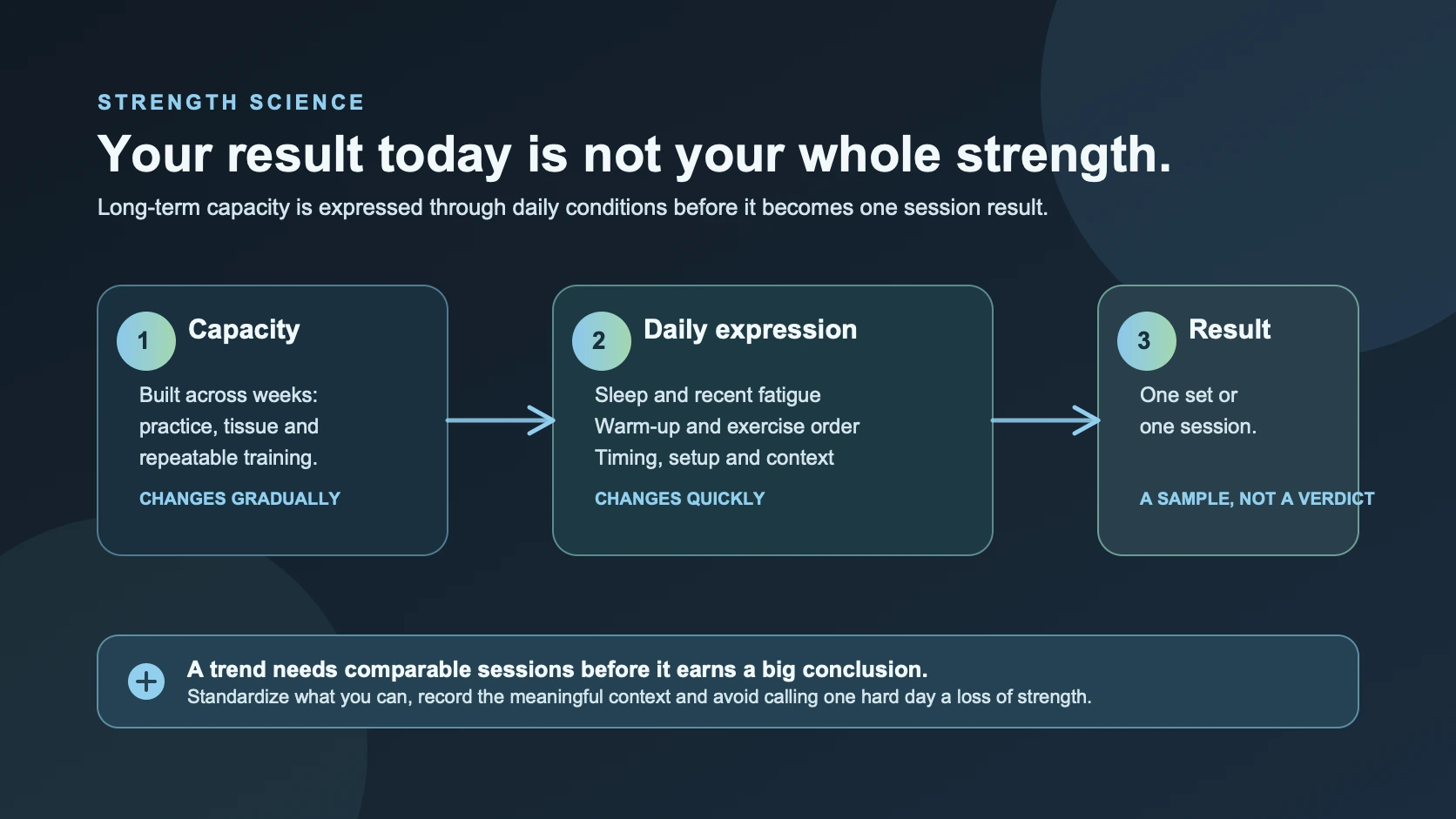
Usually, neither conclusion is accurate. Your ability to express strength can change quickly. Your underlying capacity changes more slowly. A gym result is the meeting point between what you have built over weeks and the conditions present during one attempt: sleep, recent training, warm-up, exercise order, timing, setup, attention and ordinary measurement noise.
That distinction does not make a hard session meaningless. It makes it easier to read. A single result is a sample. A repeated pattern under comparable conditions is evidence.
- Capacity and expression are not the same thing
- Why sleep and fatigue alter a familiar task
- How warm-up and exercise order change the test
- What time of day can and cannot explain
- How to respond without chasing daily readiness
Strength capacity is built slowly; performance is shown today
Strength is not a fixed number stored in a muscle. A lift asks several systems to solve a specific task at once: produce force, coordinate the movement, maintain position, judge effort and keep attention on the attempt. Training can improve each of those systems over time. That is capacity.
The result you see in a session is expression. It is what that capacity looks like through today’s conditions. A familiar squat may feel easier because the warm-up was more consistent, the bar path was cleaner or the previous night’s sleep was better. It may feel harder because you are testing it after a long workday, after several hard sessions, with a rushed setup or at a different point in the workout.
This is one reason a single max attempt is a noisy summary of progress. It is valuable when the conditions are planned and repeatable, but it cannot separate every contributor to the result. The article The Beginner Strength Explosion explains how movement-specific learning can improve force expression over the first weeks of practice. The same principle remains useful later: a better or worse result can reflect the task being expressed differently, not a sudden change in the amount of muscle you own.
Sleep changes the cost of the same task
Sleep is an obvious example because the barbell does not look different after a short night, but the person lifting it may feel different. In a 2025 systematic review and meta-analysis of sleep deprivation and sports performance, the included evidence showed average performance impairments across several outcome types, including maximum force, while ratings of perceived exertion increased. The studies were varied in population, sleep-loss protocol and test, so the result is not a prediction for your next bench press. It is good evidence against pretending sleep is irrelevant to performance.
The practical implication is modest. A poor night can make a familiar load feel more expensive. It does not prove you lost strength overnight. One rough session after unusual sleep may deserve a note, a longer warm-up or a smaller adjustment. Several comparable sessions with poor sleep and falling performance deserve a wider look at the program and recovery conditions.
For the recovery side of that decision, read Sleep and Strength. The useful point here is narrower: do not turn a daily readiness variable into a verdict on a long-term adaptation.
The test changes when the session changes
The same exercise is not always the same test. A squat performed first after a measured warm-up is a different task from a squat performed after hard rows, rushed rest periods and a crowded platform. Your legs may have the same long-term capacity, but the immediate conditions are not equivalent.
Exercise order is one example. A review of resistance-training exercise order notes that placing an exercise earlier in a session tends to preserve more repetition performance for that exercise, and longer-term strength gains tend to favor the movement placed first when priorities differ. Read the review of exercise order in resistance training as a programming principle, not as proof that every session must begin with the heaviest lift. It shows why a comparison is cleaner when the priority movement occupies a stable place in the session.
Warm-up matters for the same reason: it changes the task before the task. A 2025 meta-analysis of muscle warm-up and force-time measures found that higher muscle temperature improved rate-dependent properties such as rapid force development, while it did not show the same effect for maximum force. That result does not prescribe one universal warm-up. It does explain why a stable, specific warm-up is useful when you want to compare sessions rather than arrive cold and call the difference a strength change.
Time of day can move the result without choosing your best schedule
Many lifters notice that they feel more coordinated at one time of day than another. Research supports the possibility of daily variation, but the story is not simple enough to turn into a universal schedule rule. A 2021 systematic review and meta-analysis of diurnal variation found some performance measures favored later-day testing, including handgrip strength and explosive outcomes, while the individual studies carried a moderately high risk of bias.
That evidence is not a reason to avoid morning training or to assume an evening lift will always be stronger. It is a reminder that testing time belongs in the context column. If you train at 6 a.m. during the week and test a personal record at 7 p.m. on Saturday, you changed more than the plate count. If your meet or training schedule requires a different time, practice the relevant warm-up and task at that time rather than trying to find a perfect biological hour.
The same caution applies to food, caffeine, temperature, travel, work stress and equipment. Each can contribute a little to how a task feels. None needs to become a permanent readiness ritual before you are allowed to train.
Read the log as a pattern, not a mood
The answer to daily variation is not to collect a dozen readiness scores and negotiate every session. It is to keep the useful comparisons clean enough that a pattern can emerge. Log the exercise, load, repetitions, effort target and any meaningful deviation: poor sleep, new equipment, changed exercise order, unusually short rest or a different time of day.
Then choose a response proportional to the evidence:
- One odd set: keep the planned work sensible, note the context and avoid making a large claim.
- One difficult session: repeat a comparable exposure before redesigning the program.
- Several comparable sessions moving the same direction: review volume, progression, recovery and technique with a clearer question.
This is not permission to ignore every bad signal. A repeated decline can be useful feedback. The distinction is that you are reacting to a pattern instead of treating a single hard warm-up as proof that the program has stopped working. Fatigue, Overreaching and Overtraining Are Not the Same Thing provides the wider context for separating ordinary tiredness from a more persistent training problem.
Standardize what matters, then leave room for life
You cannot make every training day identical, and you do not need to. The goal is to control the pieces that make your main comparisons useful. Use the same movement variation for a block. Put the priority lift in a similar place in the session. Keep the warm-up recognizable. Avoid changing load, volume, technique and rest all at once.
That gives your log a stable reference without making you fragile. You can still train after a poor night, travel week or unexpected schedule change. You simply record the change and reduce the confidence you place in that day’s result. A less impressive set under difficult conditions can still be productive training; a great set under unusually good conditions can still be only one data point.
If pain, dizziness, illness, numbness or another concerning symptom is altering how you train, do not use a performance-fluctuation article to decide what is safe. Stop the activity and seek appropriate individual guidance.
Conclusion
Strength can look different overnight because the expression of strength is sensitive to the day. Sleep, fatigue, warm-up, exercise order, timing and context can all change a result without instantly changing the capacity built by training.
The practical response is not to dismiss a hard day or to worship an easy one. Keep the task comparable, record meaningful context and wait for a pattern. That is how a training log becomes more useful than a single number on a bar.
FAQ
Did I lose strength if the same weight feels heavier today?
Not necessarily. One session can be influenced by sleep, fatigue, exercise order, warm-up and other context. Look for a repeated pattern under comparable conditions before making a large conclusion.
Should I skip training after one bad night of sleep?
Not automatically. Warm up, assess how the movement feels and choose a proportionate version of the session. Repeated poor sleep or concerning symptoms deserve more attention than one ordinary rough night.
Is there a best time of day to train for strength?
Research does not justify one universal best time. Consistency and practice at the time you need to perform are usually more useful than chasing a theoretical peak hour.
Continue with a related guide
For the role of movement-specific learning in early strength gains, read The Beginner Strength Explosion. For the recovery context behind a difficult session, continue with Sleep and Strength.