Some powerlifters are remembered through a total, others through a single lift. Kirk Karwoski is firmly in the second group, but that shortcut can hide what made the reputation durable. The squat mattered because it appeared inside a long stretch of documented, world-level powerlifting results. It was not simply a huge number in a training clip.
Karwoski’s career belongs to an equipped era with its own rulebooks, weight classes and judging context. That context does not shrink the achievement. It is what lets the achievement be described accurately. His numbers should be read as results from the competition conditions in which they were made, not as a direct comparison with today’s raw records or an ordinary lifter’s next training target.
- The record behind the squat reputation
- Why a platform squat means more than a highlight
- The 455 kg result in its era
- What an ordinary lifter can take from the story
The reputation was built on the platform
The public competition record gives Karwoski’s legacy its shape. The OpenPowerlifting profile lists meet results across the 1980s, 1990s and early 2000s, with competition in several federations and weight classes. In the profile’s single-ply category, it lists personal bests of 455 kg in the squat, 255 kg in the bench press, 352.5 kg in the deadlift and a 1,047.5 kg total.
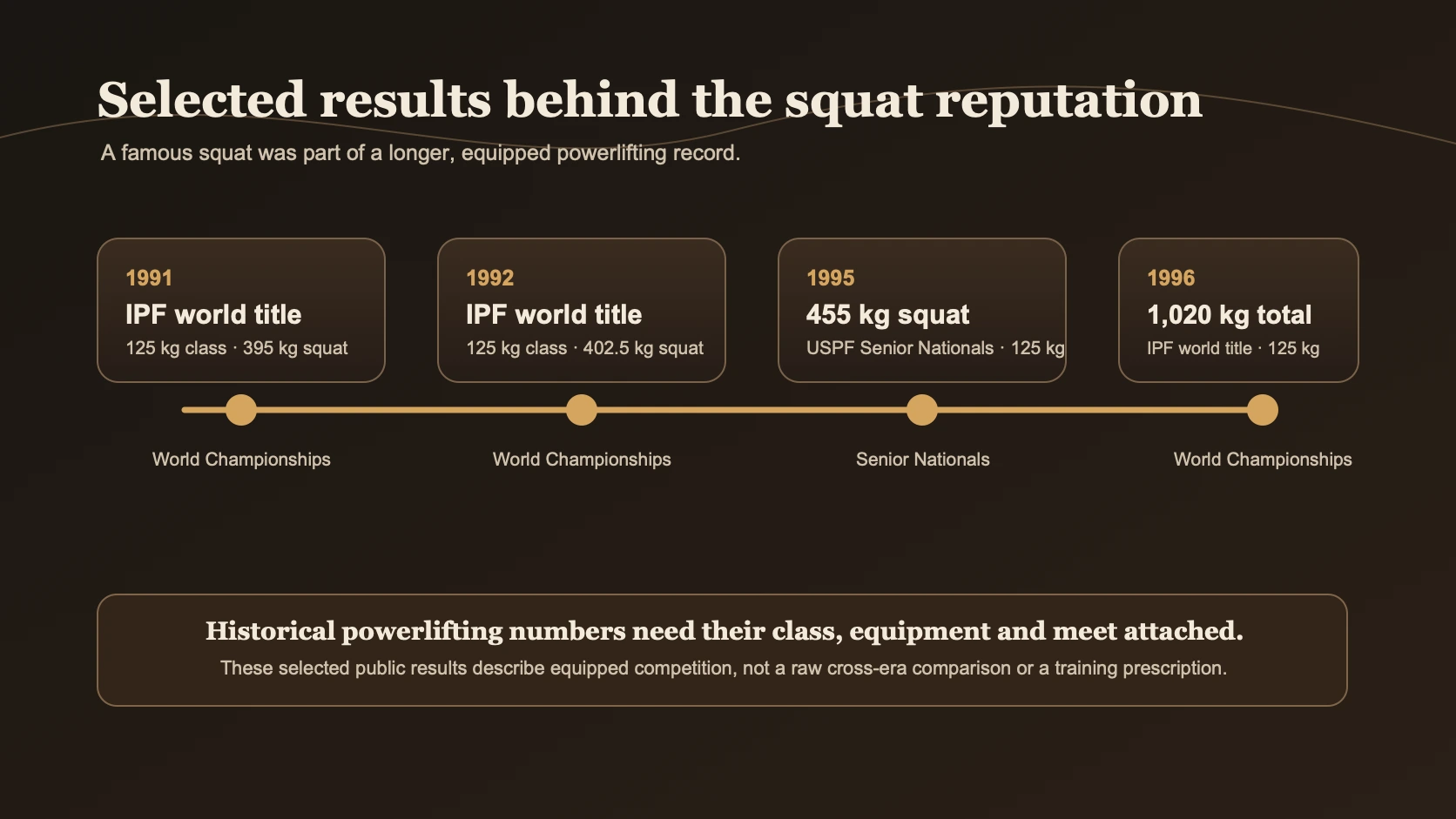
The early 1990s show why the name became closely tied to the squat. OpenPowerlifting records first-place finishes at the IPF Men’s World Powerlifting Championships in 1991 and 1992 in the 125 kg class, with 395 kg and 402.5 kg listed as the respective best squats. Those totals matter because powerlifting does not award a full-power result for a squat alone. The athlete still has to bring a bench press and deadlift to the same meet.
That wider context is the point of The Big Three: Why the Squat, Bench and Deadlift Still Rule Strength Training. A competition total asks for three different skills under the same rules and on the same day. A great squat can define a reputation, but the platform result gives it a framework.
The 455 kg squat needs its label attached
The International Powerlifting Federation’s own history of the federation describes Karwoski as the "big squatter" of the early 1990s and credits him with a 455 kg squat in the 125 kg class in 1995. The same official history calls it the class’s current world-record squat in the context of that historical account.
The result is more useful when the details stay attached. It was made in an equipped powerlifting environment, at a stated bodyweight class, in a period whose equipment and rules differed from raw competition categories now commonly discussed online. Removing those labels can make an impressive result sound simpler than it is.
The public meet record for the 1995 USPF Senior Nationals lists a 455 kg squat at 125 kg bodyweight class, alongside a 1,045 kg total. That is the kind of source trail a historical profile should follow: athlete, meet, class, equipment category and result. It is better than repeating a number with no platform context.
A world-level total kept the squat from becoming a one-lift story
Karwoski did not build a reputation on one result alone. The public listing for the 1996 IPF Men’s World Championships records him first in the 125 kg equipped class with a 437.5 kg squat, 250 kg bench press, 332.5 kg deadlift and 1,020 kg total. That result came after the 455 kg squat in the public record and shows why the story cannot be reduced to a single peak lift.
The distinction is useful for reading all strength-sport history. A single spectacular number can become a legend. A sequence of meet results shows how an athlete performed while the competition, attempts, bodyweight and other lifts were part of the same day. It also makes room for the fact that different sources organize historical records differently. A federation archive, a meet-result database and an all-time list may not use identical categories or update practices.
This is why What "IPF Approved" Really Means matters even for a historical story. Equipment rules are not decoration around a result. They help define the kind of performance being discussed. A single-ply equipped squat, a raw squat and a lift recorded under another federation’s rules should not be treated as interchangeable numbers.
The useful lesson is precision, not imitation
The wrong lesson from a famous squatter is to copy a legendary training week, buy equipment, or force a personal record every time a bar is loaded. Karwoski’s record does not prescribe a routine for someone with a different bodyweight, training history, access to equipment or reason for lifting.
The smaller lesson is more durable. A lift becomes meaningful when it is practiced consistently enough to be recognizable, recorded honestly and measured in the right setting. That is as true for a lifter adding five kilograms to a controlled squat as it is for a world-level athlete posting a historic result.
Building a Deadlift That Doesn’t Stall makes the same programming point from another competition lift: keep enough of the work stable to see what is changing before you change the entire plan. The squat does not need to become an era-defining number to deserve that same patience.
Karwoski’s legacy lasts because the record is both specific and repeatable in the public history: world-level victories, huge equipped squats and competitive totals. The 455 kg squat is the headline. The platform record is what gives the headline its weight.
FAQ
What was Kirk Karwoski’s best recorded squat?
OpenPowerlifting lists 455 kg as his best single-ply squat. The IPF history page identifies a 455 kg squat in the 125 kg class in 1995 as the class’s historical world-record squat.
Did Kirk Karwoski compete in raw powerlifting?
Yes. The public results database includes later raw competition entries, but the 455 kg squat discussed here is listed in the single-ply equipped context. Keep the category attached when comparing results.
Why is Kirk Karwoski associated with the squat?
The association comes from the size of the documented 455 kg result and repeated world-level competition performances. His totals and other lifts provide the competition context behind the famous squat.
Continue with a related guide
For the three competition lifts behind any powerlifting total, read The Big Three: Why the Squat, Bench and Deadlift Still Rule Strength Training. For modern equipment-rule context, continue with What "IPF Approved" Really Means.