

“Cardio kills gains” survives because it turns a difficult programming question into a clean warning. If you lift and run, ride or row, the warning says one of those habits must be sabotaging the other. The research gives a more useful, less dramatic answer: resistance and endurance training can coexist, but the combined dose can matter when the same legs, time and recovery have to serve two demanding goals.
Researchers call the combination concurrent training. The question is not whether concurrent training works at all. It plainly can improve aerobic capacity and strength compared with doing only one of those modes. The better question is what outcome you want to protect when the goals compete: maximal strength, muscle size, explosive power, endurance performance, or a practical mixture of them.
This guide explains what reviews of concurrent-training studies can and cannot tell a recreational lifter. The included trials differ in exercise mode, experience, total workload and testing methods, so they do not produce one schedule that fits everyone. They do show why the slogan is too simple.
- What researchers mean by interference
- What the current review evidence finds
- Why lower-body power can be more sensitive
- How to use the evidence when you plan a week
Interference is a comparison, not a diagnosis
In this literature, interference usually means that a combined endurance-and-resistance program produces a smaller gain in one outcome than resistance training alone. It does not mean that the person failed to improve. A runner who adds squats may get stronger; a lifter who adds cycling may improve aerobic fitness. The comparison asks whether the result was smaller than it might have been if one goal had received all of the training resources.
That definition matters because “gains” are not one thing. A one-repetition maximum, a muscle-size measure, a jump test and an endurance test answer different questions. An intervention can improve several of them while still showing a trade-off in one. The cost, when it appears, also has to be weighed against the benefit of being fitter in more than one way.
A 2026 umbrella review of concurrent-training meta-analyses brought together 17 meta-analyses, covering 144 individual studies and 1,492 healthy participants. Compared with resistance training alone, concurrent training improved aerobic capacity while strength, power and hypertrophy outcomes were reported as comparable overall. That is a useful high-level summary, but it cannot erase the variation inside the studies or determine the best program for a powerlifter, a distance runner and a busy general trainee at once.
The average result does not make every setup equal
The combined program has a dose. The endurance mode, duration, intensity, weekly frequency, resistance program, order of sessions and time between them all change what the week asks of you. Adding two easy bike rides to a sensible strength plan is not the same exposure as adding frequent hard running intervals around lower-body lifting.
A 2024 network meta-analysis included 40 studies and 841 participants to compare different concurrent-training types. Its lower-limb strength estimates favored resistance training alone across the tested endurance modalities, while the authors found the effects varied with the modality and outcome. The confidence intervals around several muscle-size comparisons were wide. That is evidence for context and uncertainty, not a case for treating every form of cardio as equivalent.
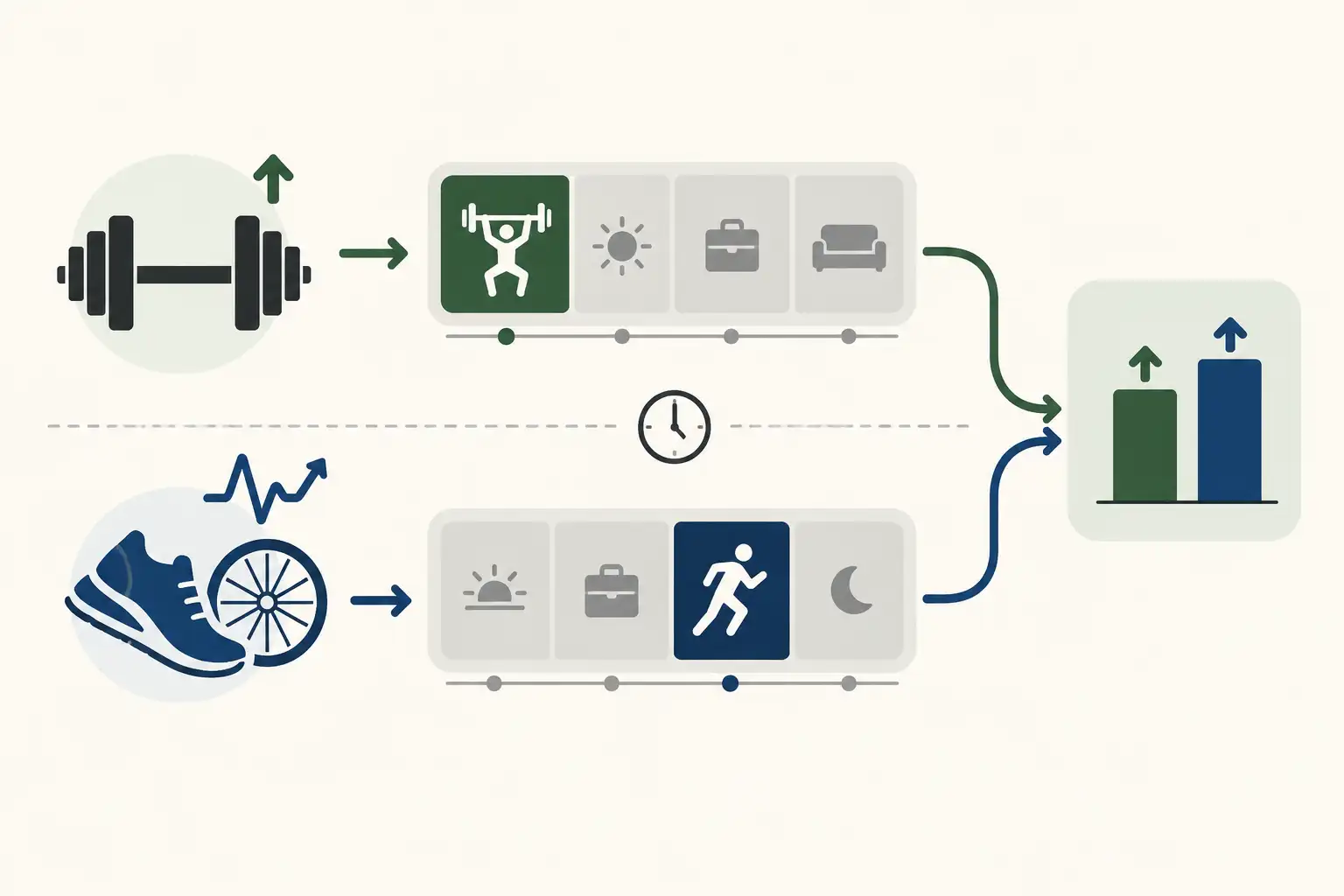
A separate 2021 systematic review and meta-analysis found no compromise to muscle hypertrophy or maximal strength overall when aerobic and strength training were combined. It did find that explosive-strength gains could be more attenuated when the two modes were performed in the same session rather than separated by at least three hours. This is one reason an athlete whose main goal is sprinting or jumping may organize the week differently from someone training for general health.
The studies also cannot settle every mechanism story. Discussions often reduce the issue to one molecular pathway blocking another. Acute molecular signals can be interesting, but they do not directly tell us what months of training will produce in a particular person. Total work, local fatigue, food, sleep, exercise selection and whether the person can repeat the plan remain practical parts of the explanation.
Protect the outcome that matters most
If maximal strength is the leading goal, make the high-priority strength work clear in the calendar. Put your best concentration and freshest lower-body effort where it belongs, keep the essential sets repeatable, and add endurance work in a dose you can recover from. The point is not to avoid all fatigue. It is to avoid spending the resources needed for your most important work before you do it.
Session order may help at the margin. A systematic review and meta-analysis of within-session sequence found that resistance followed by endurance favored lower-body dynamic-strength change compared with the reverse order; it found no sequence effect for hypertrophy in its pooled data. The review included only 10 studies, so that result is a planning preference rather than a law. If you need to do both modes in one visit and strength is the priority, lifting first is a reasonable default to test.
If endurance performance is the leading goal, reverse the priority when necessary. A serious run workout deserves fresh enough legs and attention to be performed well. You may still lift in the same week, but the strength work can be placed where it supports the sport rather than stealing the quality of its key endurance session.
For general fitness, the decisive question is often more ordinary: can you maintain both habits? A moderate bike ride, walk or easy row can fit around resistance training very differently from repeated hard intervals. Keep the plan small enough that the quality of the main sessions remains visible. The current evidence is more reassuring for this practical mixed approach than the slogan suggests.
Measure the whole week before blaming cardio
Do not assign every flat squat session to the morning ride. First check whether you changed several things at once: added mileage, changed a lift, reduced sleep, shortened rest between sets, started a calorie deficit or increased effort on both modes. A combined program is hard to evaluate when every variable moves together.
A short log can make the next decision clearer. Record the key strength sets, the demanding endurance sessions, their order and any change in sleep or appetite. If the same lower-body lift repeatedly loses quality after a particular endurance workout, separate the sessions when practical, reduce that endurance dose, or move the hard work to a different day. Make one meaningful change and review it over several comparable exposures.
The strength work itself should match the goal. Heavy, Moderate or Light? Choosing Reps for Strength explains why loads and repetitions are selected for a purpose. Cardio does not make that specificity disappear. It makes a clear purpose even more useful.
The same is true for muscle growth. The evidence that different loading prescriptions can build muscle does not mean every workout can be made equally dense without consequence. Can Light Weights Build as Much Muscle as Heavy Weights? covers the role of effort, volume and practical exercise choice. When you add endurance work, choose versions of both modes that you can continue to perform with useful form and a recoverable total workload.
What the research cannot promise
The reviews largely synthesize short-to-medium-term interventions in healthy participants, not year-long schedules for elite athletes with highly specific competition demands. The studies do not guarantee that a particular amount of running, cycling or intervals will fit your lifting plan. They also cannot turn a persistent performance drop, unexplained fatigue or pain into a normal consequence of concurrent training. Those situations need broader context and, when appropriate, individual professional guidance.
The evidence also does not require you to micromanage every session. Separating modes can be useful when both are demanding, especially for power-oriented lower-body goals. It is not a condition for a worthwhile program. A simple, consistent plan that includes both strength and aerobic activity often beats a theoretically perfect split that does not fit your week.
Conclusion
Cardio does not automatically kill gains. Concurrent training asks you to decide which outcomes matter most, give those sessions the best available resources, and keep the rest of the week recoverable. The trade-offs are real enough to plan around, especially when lower-body strength or explosive power is the priority. They are not a reason to treat aerobic fitness and strength as incompatible.