
Getting strong is simple in principle and messy in real life. You need to train, recover, and gradually ask the body to do more. The hard part is doing that for months without turning every week into a test of your identity.
A sustainable approach to strength is not soft. It still requires effort. It simply avoids the trap of training so hard, so often, or so chaotically that the plan cannot repeat. Strength grows best when the work is challenging enough to adapt from and controlled enough to recover from.
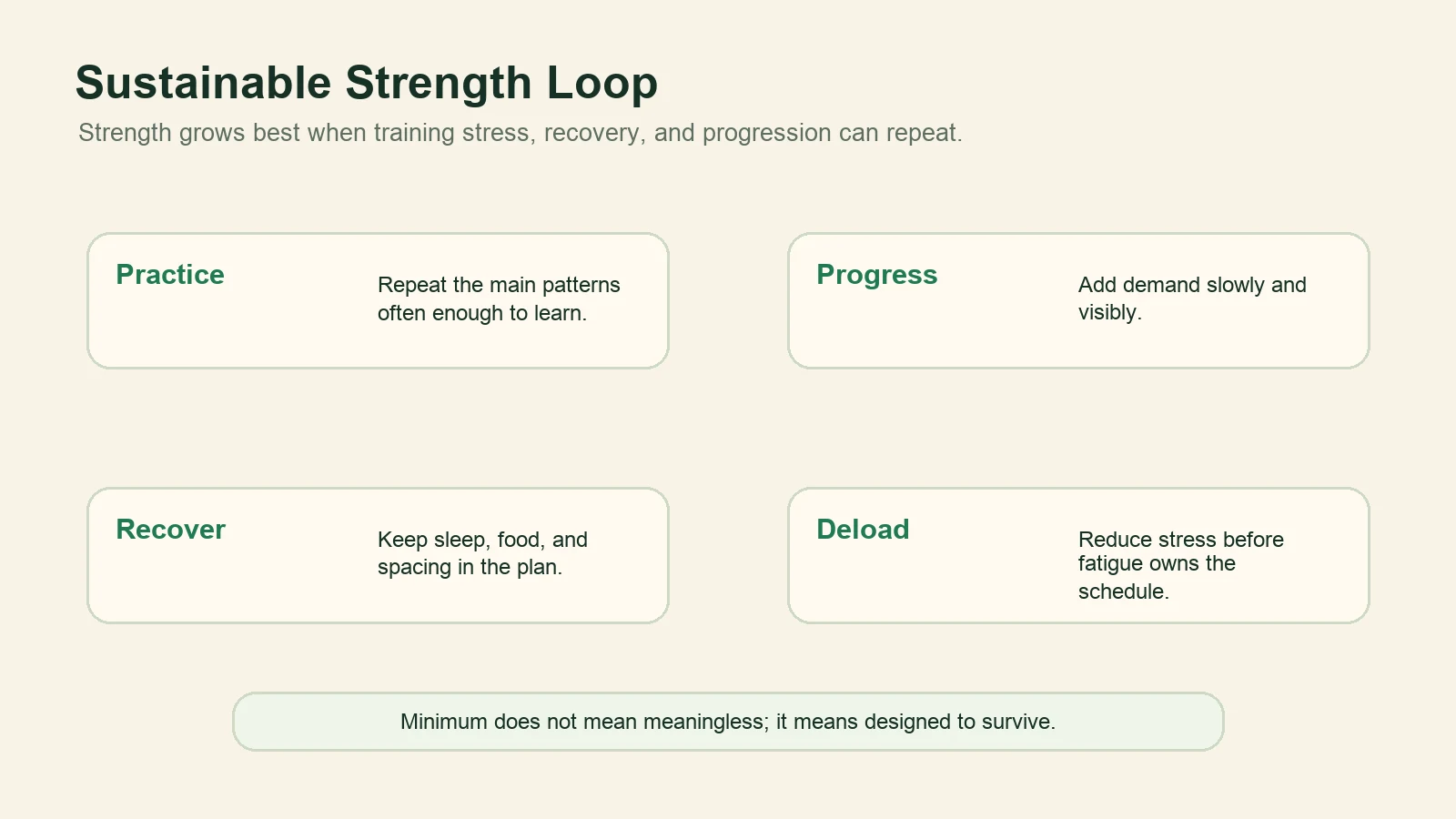
This guide is for healthy adults who want to get stronger without burning out. The short version is this: practice the main patterns, progress gradually, recover on purpose, and use lighter phases before fatigue takes over.
- Practice before you chase intensity
- Progress slowly enough to repeat
- Recover like it is part of training
- Use deloads and phases without drama
Practice before you chase intensity
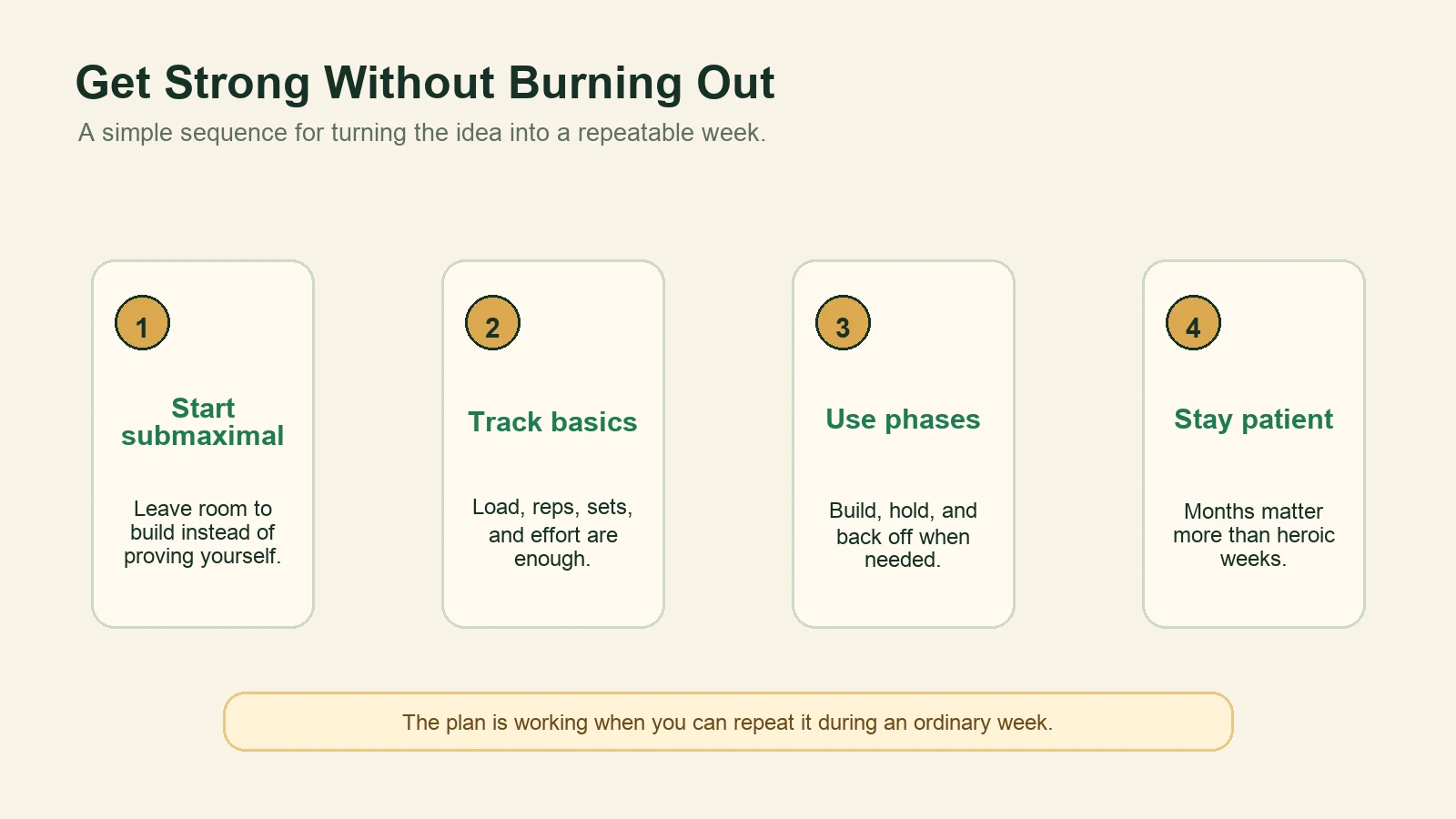
Strength is specific. You get better at the movements you practice. That does not mean every set has to be maximal. In fact, many lifters learn better when the load is heavy enough to demand attention but light enough to keep positions controlled.
For most everyday lifters, the main patterns are enough: squat, hinge, push, pull, carry, and brace. The exercise names can change. The patterns stay. A beginner might use goblet squats and dumbbell rows. An intermediate lifter might use barbell squats and weighted pull-ups. Both are practicing strength.
The CDC adult physical activity guidance includes muscle-strengthening activity at least two days per week. That baseline matters because strength work can begin with repeatable exposure, not with a maximal program.
Progress slowly enough to repeat
Progression is the engine, but aggressive progression is not always better progression. Add load, reps, sets, range of motion, or control when the current work is clearly manageable. Do not add everything at once.
The ACSM progression model for resistance training describes training progression through variables like load, volume, rest, and exercise selection. In plain language, you have more tools than "go heavier." Sometimes the right progression is one more rep. Sometimes it is the same load with better control. Sometimes it is holding steady for another week.
Track the basics: exercise, load, reps, sets, and how hard the work felt. That is enough for most people to see whether the plan is moving.
Recover like it is part of training
Recovery is not separate from getting strong. It is the part that lets training become adaptation. If sleep, food, and stress are constantly ignored, the program may look good on paper while the body becomes less ready to train.
Protein matters too. The ISSN protein position stand notes that many exercising individuals benefit from daily protein around 1.4-2.0 g per kilogram of body weight. That does not mean every lifter needs to track forever, but it does mean recovery is partly built at the table.
Rest days are not weakness. They are spacing. Most people get stronger when hard work and recovery are both scheduled instead of one being improvised.
Use deloads and phases without drama
A deload is a planned reduction in training stress. It can mean less load, fewer sets, easier exercises, or a shorter week. It is not a moral failure. It is a tool.
Some people need deloads on a schedule. Others need them when performance drops, sleep worsens, joints feel irritated, motivation collapses, or life stress spikes. The key is noticing fatigue before it owns the program.
Think in phases. Build for a few weeks. Hold or sharpen. Back off when needed. Then build again. That rhythm is less exciting than chasing a personal record every session, but it is how more people stay strong for years.
Keep the plan boring enough to measure
A sustainable strength plan should be interesting enough to train, but boring enough to measure. If exercises change every week, it becomes hard to know whether you are stronger or simply doing different things.
Keep a few main lifts or movement patterns stable for several weeks. Change accessories when they stop helping, but do not rebuild the whole plan whenever motivation dips. Repetition is not the enemy of progress. It is often the evidence trail.
This also makes confidence easier. When you see the same lift improve by one rep, one small plate, or one cleaner set, progress becomes visible. That kind of visible progress is quieter than hype, but it is much easier to sustain.
When fatigue is high, keep the movement pattern and reduce the dose. Two controlled sets can maintain the skill while you recover.
Continue with a related guide
For the broader framework, read Fitness for People With Actual Lives. For a practical way to keep training compact, continue with You Don’t Need to Live in the Gym to Become Strong.
Conclusion
The sustainable approach to getting strong is not complicated: practice the main movements, progress gradually, recover well enough to repeat the work, and reduce stress before fatigue forces you to stop.
Strength built this way may feel slower at first, but it has a major advantage. It can keep going.
FAQ
Do I need to lift heavy to get strong?
You need loads that are challenging enough to practice force production, but not every set needs to be maximal. Heavy work can help, but sustainable progress usually includes controlled submaximal work too.
When should I deload?
Consider a deload when performance drops, fatigue stays high, sleep suffers, joints feel irritated, or life stress makes normal training hard to recover from.