
Muscle damage sounds like it should cause muscle growth. Training stresses the muscle, the muscle gets damaged, the body repairs it bigger and stronger. That story is simple, memorable, and incomplete.
Muscle damage can happen after resistance training, especially when the exercise is new, eccentric stress is high, the range of motion is unfamiliar, or volume jumps too quickly. But damage is not the same thing as hypertrophy. Soreness is not a growth score. And chasing damage can easily reduce the quality of the training that actually drives progress.
This article explains the current practical view. The short version: muscle damage may accompany training, but productive hypertrophy is better explained by repeated mechanical tension, recoverable volume, and adaptation over time.
- What muscle damage means
- Why soreness is not proof of growth
- What the repeated bout effect shows
- When damage becomes a problem
- How to train for growth without chasing pain
What muscle damage actually means
Exercise-induced muscle damage refers to disruption that can occur in muscle tissue after demanding or unfamiliar exercise. It may show up as soreness, temporary strength loss, swelling, tenderness, or increased markers associated with muscle disruption.
The review asking whether exercise-induced muscle damage plays a role in hypertrophy is useful because it separates damage from growth rather than assuming they are the same process. Damage can be part of the response to training, but that does not prove it is the cause of hypertrophy.
This distinction matters in real programs. A workout that creates a lot of damage may feel impressive, but if it reduces performance for the next several sessions, it may lower the total amount of useful training you can do.
Soreness is not a reliable growth signal
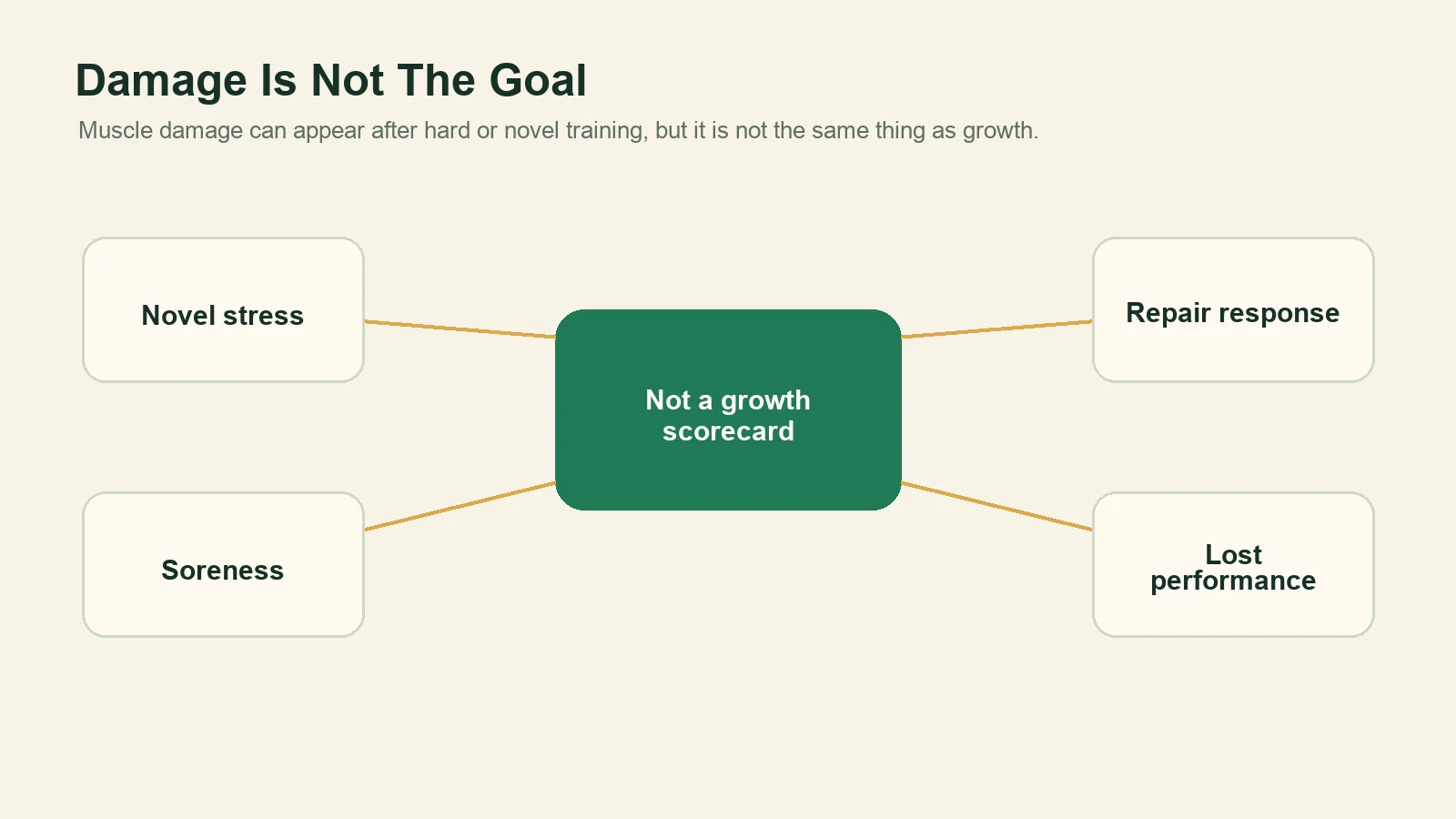
Delayed-onset muscle soreness is common after new or hard training. It can make a workout feel productive because the feedback is obvious. But obvious is not the same as accurate.
You can get sore from doing an unfamiliar exercise with light loads. You can also stimulate growth with familiar exercises that create very little soreness. Soreness reflects a response to stress and novelty, not a direct measurement of new contractile tissue.
This is why "I am not sore" does not mean "the workout failed." If performance is improving, measurements are trending in the right direction, and the target muscles are receiving hard progressive work, low soreness may simply mean your body is adapted to the training.
Damage and stimulus can overlap without being identical
The confusing part is that productive training can cause some damage, especially when the lifter is new to a movement. That makes it tempting to say the damage caused the growth. But two things can happen together without one being the main cause.
Think of a long hike. You may get sore feet, but the goal of the hike was not foot damage. The soreness came with the stress. Training works similarly. Hard resistance exercise can create mechanical tension, metabolic stress, fatigue, and some tissue disruption. The most useful long-term target is the productive signal, not the disruption itself.
This is why a little soreness after a new exercise is normal, while deliberately trying to maximize soreness is poor programming logic.
Early training can include damage and swelling
One confusing part of hypertrophy research is that early training changes can include swelling and repair processes. The Damas review on resistance training, muscle protein synthesis, damage, and hypertrophy cautions that early acute responses do not map neatly onto later muscle growth. Some early increases in muscle size signals may reflect repair and edema rather than stable hypertrophy.
For lifters, the practical lesson is patience. The first few weeks of a new program can produce soreness and fast changes in how muscles feel. That does not necessarily mean the program is building muscle at an extraordinary rate. It may mean the body is adapting to novel stress.
True hypertrophy is judged over longer blocks, not by how destroyed the muscle feels after week one.
Eccentric work is powerful but easy to overdo
Eccentric actions, where a muscle lengthens while producing force, are often associated with more soreness and damage, especially when they are novel. Lowering a weight slowly, running downhill, or emphasizing loaded stretch can create a strong response.
Eccentric work can be useful. It can load muscles heavily, expose them to long lengths, and build strength through ranges that matter. But it is not automatically better because it creates soreness. If a lifter adds too much eccentric emphasis too quickly, the cost can show up as reduced performance, altered technique, and missed training.
The better approach is gradual exposure. Add eccentric control where it improves the exercise, not as a soreness challenge.
The repeated bout effect changes the story
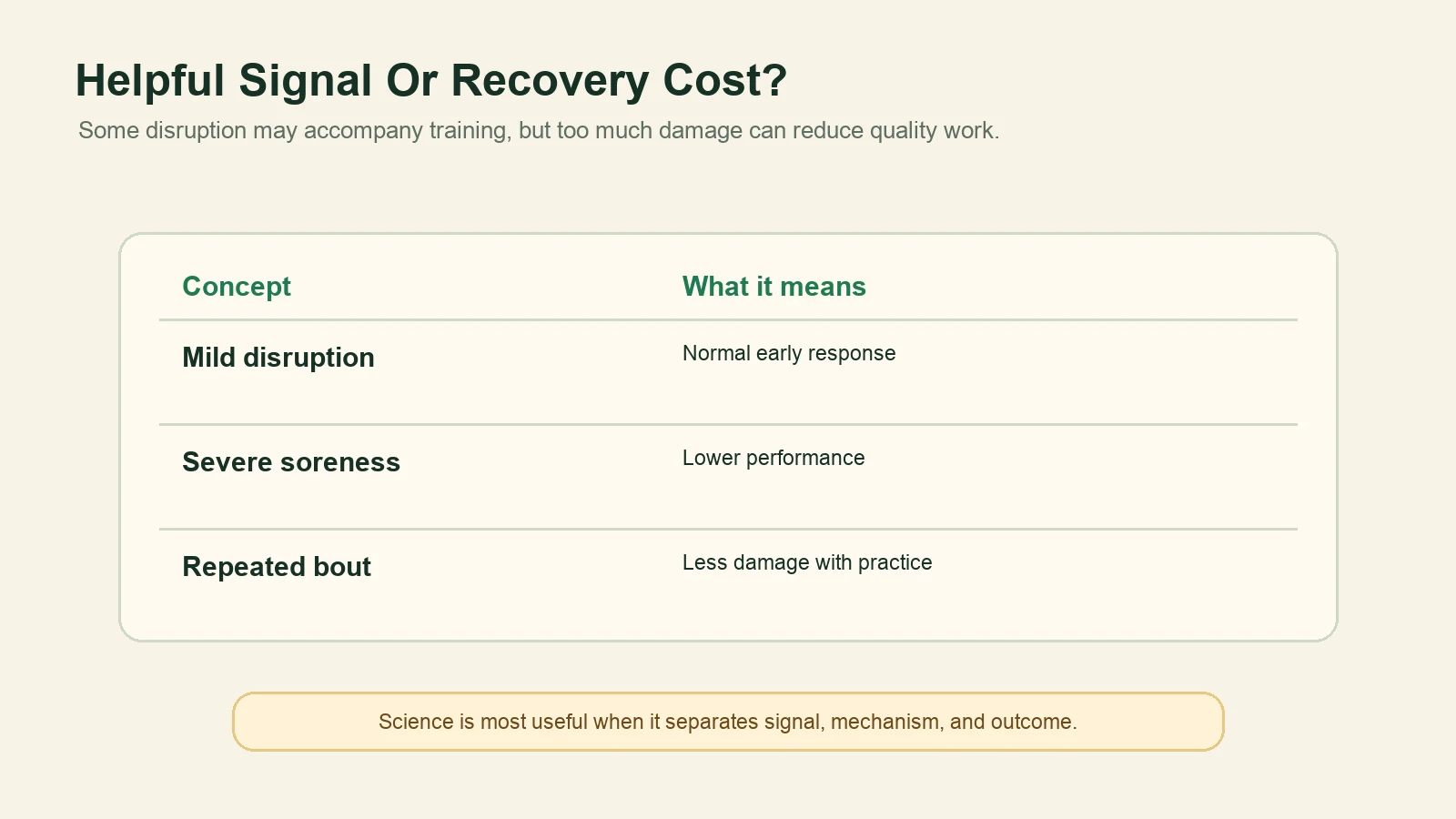
When you repeat an exercise, it usually causes less soreness and damage than the first exposure. This is known as the repeated bout effect. The body becomes more prepared for the stress.
If damage were the main cause of growth, then familiar training that causes less soreness should become much less useful. But in practice, repeated exercises can continue building muscle when volume, effort, and progression are appropriate. That suggests the ongoing growth signal is not simply damage.
The repeated bout effect is helpful because it lets you train productively without being crippled by soreness every week. Less damage can mean better performance, more consistent volume, and a cleaner progression.
Mechanical tension remains the better target
The Schoenfeld mechanisms review includes muscle damage as one proposed mechanism, but also places mechanical tension at the center of hypertrophy discussions. More recent work, including the 2023 review of mechanical overload-induced hypertrophy, reinforces mechanical overload as the more useful primary anchor.
This does not mean muscle damage is irrelevant in every possible context. It means it is a poor target for normal training decisions. You cannot precisely dose "good damage" by chasing soreness. You can dose load, sets, reps, range of motion, exercise selection, and proximity to failure.
Those are better levers.
Why beginners are especially vulnerable to the myth
Beginners often get sore from almost anything new. That creates a false lesson: soreness feels like proof that training worked. In the first month, a new lifter might associate pain with progress because the two arrive together.
Over time, the body adapts. The same useful exercises may create less soreness. If the lifter thinks soreness is required, they may start changing exercises too often, adding unnecessary finishers, or increasing volume faster than recovery allows.
That pattern slows learning. Consistent exercises allow better technique, clearer progression, and less wasted recovery. Novelty has a place, but it should serve the program.
Damage is also hard to measure in normal training
Most lifters cannot directly measure muscle damage. Soreness, swelling, and temporary weakness are indirect and noisy signs. They are influenced by sleep, stress, exercise novelty, hydration, expectations, and individual sensitivity.
This matters because the body does not come with a dashboard that says "optimal damage achieved." The variables you can actually control are exercise choice, load, sets, reps, tempo, range of motion, effort, and progression. Those variables are enough.
Too much damage can reduce productive work
A little soreness may be harmless. Severe soreness is different. If soreness changes your technique, limits range of motion, reduces force output, or makes you skip sessions, it has a cost.
This is especially common when people restart training after a break. They do too much too soon, get sore for days, then miss the next sessions. The first workout felt heroic, but the training week got worse.
Damage also makes it harder to interpret progress. If performance drops because the muscle is still recovering from excessive disruption, you may think the program is not working, when the real issue is that the dose is too high too soon.
Soreness can happen, but sharp pain, swelling that seems unusual, dark urine, or symptoms that feel severe deserve medical attention rather than another workout.
How to train for growth without chasing damage
Use familiar exercises long enough to progress them. Introduce new movements gradually. Increase volume in small steps. Train hard, but keep enough quality to repeat the work. Judge progress over weeks.
This does not mean every session should feel easy. Hypertrophy training is demanding. The target muscle should work. Sets should become challenging. But the goal is recoverable challenge, not maximum tissue disruption.
Practical signs you are on track
Look for performance stability and gradual improvement. Are reps or loads increasing over time? Are target muscles receiving enough work? Are you recovering well enough to train them again? Are measurements, photos, or other markers trending in the expected direction over months?
Those signals are more useful than soreness. If soreness is low but progress is good, do not sabotage the plan by adding random novelty. If soreness is high and progress is poor, reduce novelty or volume and rebuild.
Where damage may still matter indirectly
This does not mean the body ignores disruption. Repair processes are part of adapting to training stress, especially when a movement is new. The careful interpretation is that damage may be part of the environment around adaptation, not a target that should be maximized.
For normal programming, that distinction changes behavior. You can accept mild soreness as a normal side effect while still designing the plan around progressive tension, repeatable volume, and good performance. That is very different from trying to make every session hurt more than the last.
Continue with a related guide
For the next practical step, read How Muscle Actually Gets Stronger. For a second perspective from the same topic cluster, continue with Mechanical Tension Explained.
Conclusion
Muscle damage can occur after training, but it should not be treated as the cause or goal of muscle growth. Soreness is an unreliable signal, early swelling can confuse interpretation, and excessive damage can reduce the quality of future training.
For hypertrophy, chase progressive, recoverable tension. Use enough volume and effort. Repeat exercises long enough to improve them. Let soreness be occasional background information, not the scoreboard.
FAQ
Do sore muscles mean they are growing?
Not necessarily. Soreness can happen from novelty or damage, but it does not reliably measure hypertrophy.
Should I change exercises often to create more damage?
Usually no. Too much novelty can increase soreness and reduce progress. Use enough consistency to improve exercises over time.