Muscle soreness has a strange reputation. Some lifters chase it because it feels like proof. Others fear it because it feels like something went wrong. The truth is less dramatic: soreness is information, but it is not a perfect report card.
Delayed onset muscle soreness, often called DOMS, usually appears several hours after training and can peak a day or two later. It is common after new exercises, longer ranges of motion, eccentric-focused work, higher volume, or returning after time off.
Soreness can tell you that a stimulus was unfamiliar or demanding. It cannot reliably tell you that the workout was excellent, that muscle growth is guaranteed, or that you are injured. It is one signal among many.
The best approach is to understand soreness without worshipping it.
- Why soreness happens
- Why soreness is not proof of growth
- How to train when sore
- When soreness should concern you
- How to reduce unnecessary soreness
Soreness often follows unfamiliar stress
DOMS is especially common when the body faces something new. A beginner’s first squat session can create soreness. So can a new lunge variation, slow eccentrics, downhill running, high-rep Romanian deadlifts, or returning to training after a vacation.
The classic review by Cheung, Hume, and Maxwell describes delayed onset muscle soreness as a complex response after exercise, especially when the work includes unfamiliar or eccentric loading. The exact experience varies widely. Some people get sore easily. Others rarely do.
That variation is important. If your friend is destroyed after leg day and you feel fine, it does not automatically mean they trained better. It may mean the exercise was newer to them, the eccentric stress was higher, their recovery context was different, or they simply respond differently.
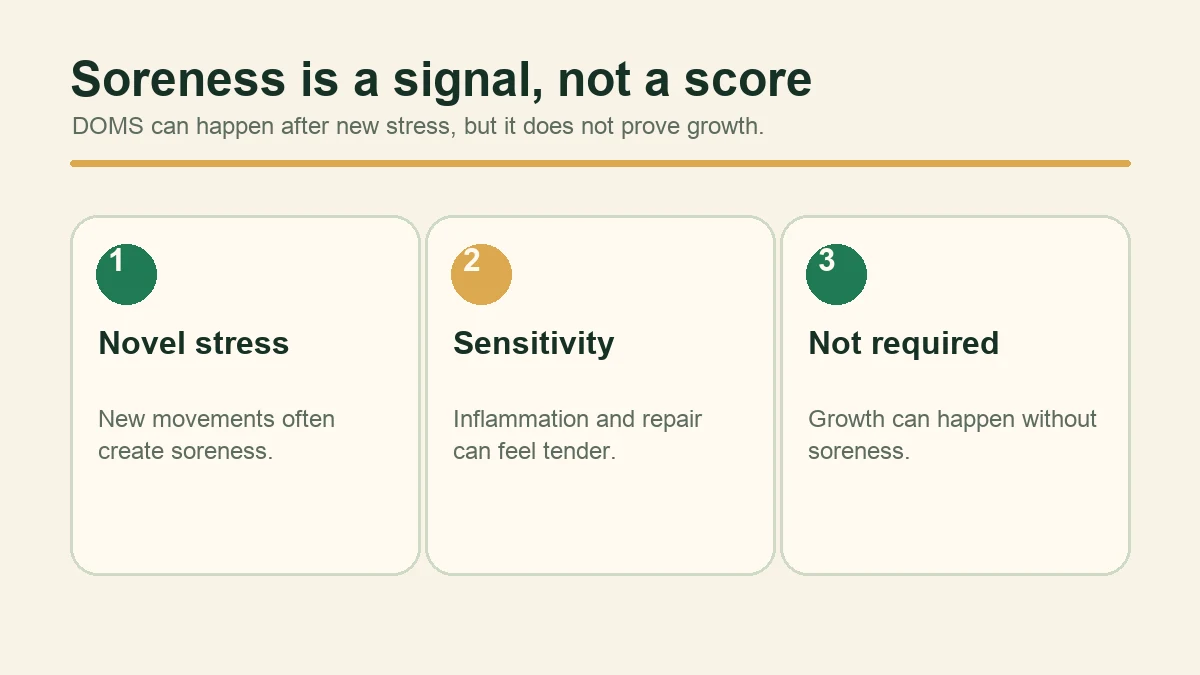
Soreness is not the same as muscle growth
This is the big myth: if you are sore, you grew; if you are not sore, you wasted the workout.
Muscle growth is driven by repeated training stimuli over time, especially mechanical tension, sufficient volume, progressive overload, and recovery. Soreness may appear alongside those stimuli, but it is not the mechanism you are trying to maximize.
The literature on exercise-induced muscle damage and hypertrophy is useful here because it separates muscle damage from the broader growth process. Muscle damage can occur after training, but more damage is not automatically more growth. Excessive damage can reduce performance, limit training quality, and delay the next productive session.
That is why chasing soreness can backfire. If every workout leaves you unable to train well for four days, the program may feel intense but deliver fewer quality sessions.
No soreness does not mean no progress
As you adapt to an exercise, soreness often decreases. This repeated bout effect is one reason experienced lifters can train hard without feeling wrecked after every session.
That is good. Reduced soreness can mean the body is better prepared for the stress. You may still be building strength and muscle if performance is improving, sets are challenging, and weekly training is consistent.
Progress markers are more useful than soreness markers. Are reps increasing at the same load? Is technique more stable? Are you adding load over time? Are target muscles getting enough hard work? Are measurements, photos, or performance trends moving in the right direction? Those signals matter more than whether stairs feel dramatic the next morning.
How to train when sore
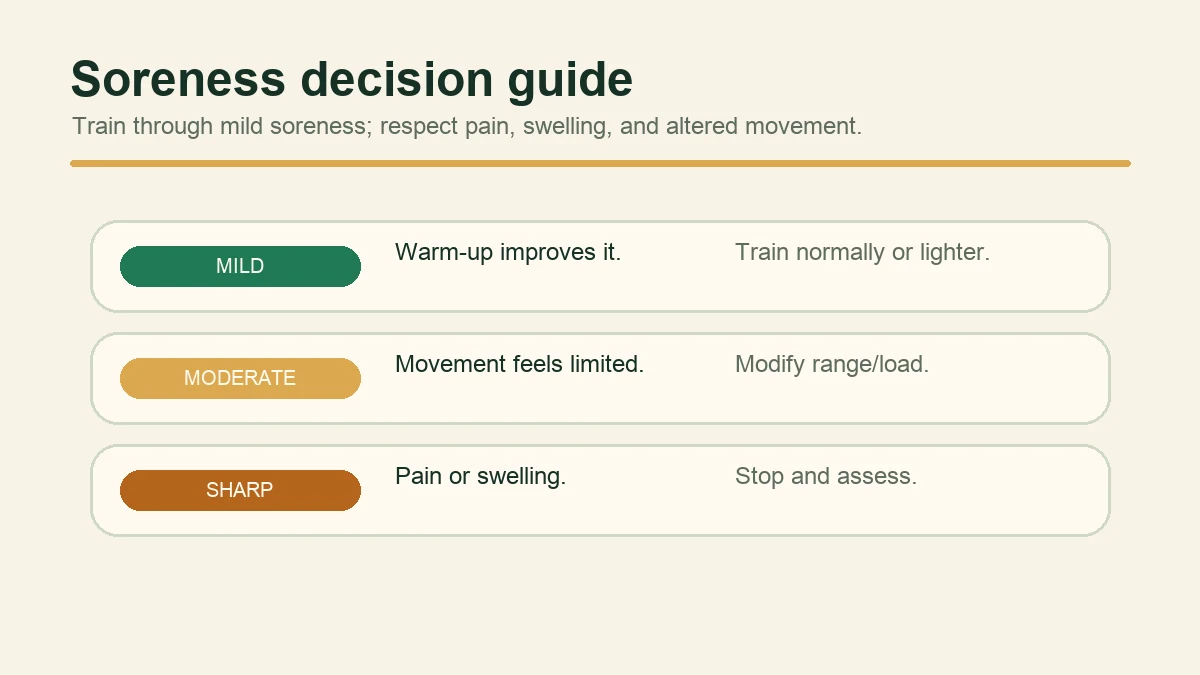
Mild soreness is usually not a reason to skip training. Warm up and see how movement feels. If soreness improves as blood flow increases and technique feels normal, you can often train as planned or slightly lighter.
Moderate soreness may call for adjustments. Use lighter loads, fewer sets, slower progression, machines, or a reduced range of motion if needed. You can also train a different muscle group while the sore area recovers.
Sharp pain, swelling, bruising, weakness, loss of normal range of motion, or pain that worsens as you warm up is different. That is not “good soreness.” Stop and assess. If symptoms are severe, unusual, or persistent, speak with a qualified medical professional.
Soreness can reduce workout quality
The problem with severe soreness is not only discomfort. It can change how you move. If your quads are extremely sore, your squat pattern may shift. If your pecs are painfully sore, your bench setup may feel unstable. If your hamstrings are tender, hinge technique may degrade.
That matters because poor movement under fatigue can increase the cost of training. You may still get through the workout, but the signal becomes messier. Sometimes the smarter session is easier technique work, light blood-flow movement, or training another area.
The research discussing muscle damage and protein synthesis after resistance exercise also helps explain why soreness and damage should not be treated as trophies. The body has to repair damage. If damage is excessive, resources may go toward repair instead of productive repeated training.
The beginner soreness trap
Beginners often get sore because almost everything is new. That can make soreness feel like the main sign that training is working. The first few weeks become a hunt for the feeling: more exercises, more sets, harder finishers, deeper stretches, slower negatives.
This usually creates too much noise. A beginner does not need advanced suffering. They need consistent practice, repeatable technique, and enough challenge to improve without making the next session impossible.
If you are new, leave the gym with some energy in reserve. You should feel like you trained, not like you survived a small accident. Add work gradually. Repeat lifts long enough to learn them. Let soreness decline as your body adapts. That decline is often a sign that training is becoming more sustainable, not less effective.
Intermediate lifters can fall into the same trap after changing programs. Novelty creates soreness, so the new plan feels powerful. But after four weeks, the question is not whether the plan made you sore. The question is whether it improved your lifts, your muscle gain, or your ability to train consistently.
There is also a social side to this. Gym culture sometimes rewards soreness stories because they sound intense. But the person who trains calmly for twelve months usually beats the person who collects brutal Mondays and missed Thursdays. Reliable training is less cinematic, but it compounds better over a real training year, especially when life gets busy.
How to reduce unnecessary soreness
You do not need to eliminate soreness. You need to make it manageable.
Progress new exercises gradually. If you have not done split squats in months, do not start with five brutal sets to failure. Begin with a lower dose, then add over several weeks. Be especially cautious with exercises that load muscles in a stretched position, like Romanian deadlifts, walking lunges, incline curls, or deep split squats.
Keep some exercises stable long enough to adapt. Constant novelty is a soreness machine. Changing everything every week may feel exciting, but it makes progression harder and soreness more likely.
Use light movement when sore. Easy walking, cycling, mobility, or low-load sets can help you feel better, even if they do not “flush toxins” in the magical way fitness folklore sometimes claims. Keep it easy. Recovery work should not become another hard workout.
Respect soreness, but do not chase it
Soreness means your body noticed something. That is useful information. It does not mean the workout was perfect.
The goal is not to be sore. The goal is to train hard enough, recover well enough, and repeat long enough for adaptation to accumulate. Sometimes that includes soreness. Often, the best progress happens when soreness is present but controlled.
Your muscles do not need drama to grow. They need a clear signal, enough recovery, and time.
Continue with a related guide
Start with the cluster overview in Why More Training Isn’t Always More Progress. Then continue with Sleep and Strength: Why Your Bed Might Be Your Best Recovery Tool.