

Strength training can be demanding without taking over your calendar. The body responds to a sufficient training stimulus followed by recovery; it does not award extra points for time spent wandering between machines. For many recreational lifters, two or three focused sessions can provide enough practice and progressive work to become noticeably stronger.
The real question is not how little you can get away with. It is how to make the time you choose coherent. A short session needs a clear exercise list, sensible rest and a progression rule. It also needs limits: beginners should stop movements that cause sharp or worsening pain and seek appropriate assessment rather than trying to solve symptoms through generic advice.
- Define what stronger means
- Choose a realistic frequency
- Organize a focused session
- Progress without adding hours
- Know when more time is justified
Define what stronger means
Strength is specific. Improving a barbell squat, becoming confident with dumbbells and making daily tasks easier are related goals, but they do not require identical plans. Choose two to five movement patterns that matter to your goal and track them consistently. This gives a short program a real target.
Early strength gains often include better coordination and familiarity, not only larger muscles. That is one reason a stable exercise menu is efficient. Repeating a lift teaches setup, tempo and effort judgment. Constant exercise changes may make sessions feel busy while reducing the practice that helps a beginner improve.
Two or three days can be a complete plan
The World Health Organization’s physical activity guidance includes muscle-strengthening activity on two or more days each week for adults. That is a population-level health guideline, not a personalized strength program, but it demonstrates that daily gym attendance is not the baseline requirement.
Two full-body sessions can cover a squat or leg-press pattern, a hinge, a press and a pull. A third day can repeat the main skills with a different emphasis or add work that did not fit comfortably. The right frequency is the one that lets you perform enough quality work, recover and return on schedule.
Avoid copying a five-day split simply because it looks serious. More days divide the work; they do not automatically create a better stimulus. If commuting, changing and waiting for equipment make each visit expensive, fewer well-planned sessions may be the more disciplined design.
Organize a focused session
Begin with the exercise that needs the most skill or attention. Follow it with two or three movements that cover the remaining patterns, then add accessories only if they serve a stated goal. Write the plan before you enter the gym. Decision-making during the session is one of the easiest ways for 50 minutes to become 90.
Rest long enough to perform the planned work with control. Efficiency does not mean rushing heavy sets or turning strength work into a circuit by accident. Use a timer when conversation or phone use stretches breaks well beyond what you need. Pair low-conflict accessories, such as a row with a leg curl, only when the arrangement does not compromise technique or equipment etiquette.
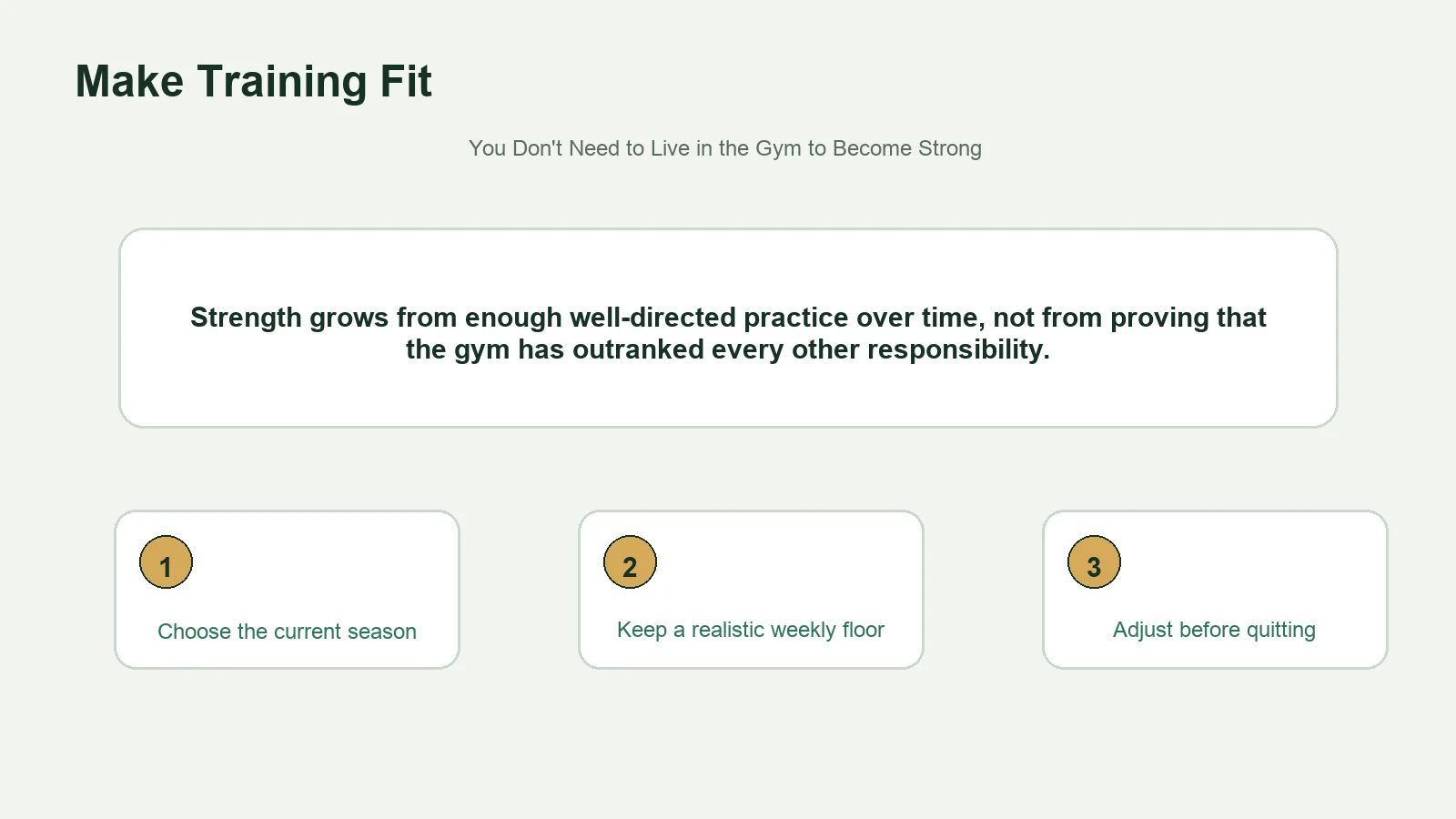
Progress without adding hours
Progression can come from a small load increase, another controlled repetition, improved range of motion or cleaner execution. None requires adding a new training day. Choose one method and apply it gradually. If you reach the top of a repetition range with the intended effort and technique, add a small amount of load and return to the lower end.
When progress stalls, examine the current work before expanding the schedule. Are sets consistently challenging enough? Are you repeating the movements long enough to learn them? Is sleep poor? Are you missing sessions because the plan is already too large? A targeted adjustment is usually more informative than adding volume everywhere.
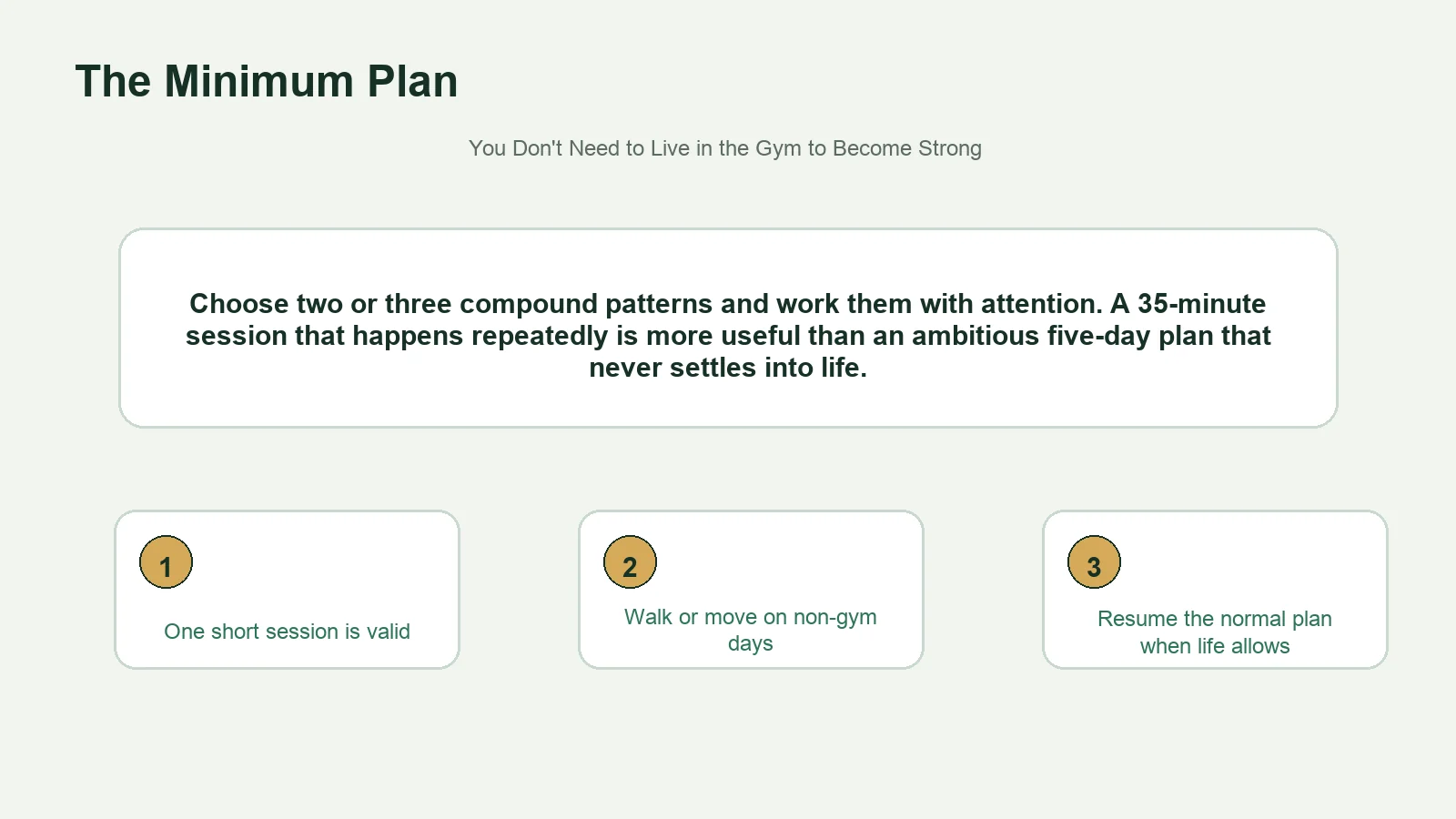
When more time is justified
Additional sessions can help when your goals become more specific, your current sessions are too crowded or a sport requires more practice. The extra time should solve a visible problem. A fourth day might distribute volume, improve technical practice or make room for conditioning. “More feels advanced” is not a sufficient reason.
The gym should support your life and goal. If two or three focused sessions are producing progress, there is nothing incomplete about them. Keep the plan clear, progress the work you can recover from and leave enough room to live the life that strength is meant to improve.
Test the plan against a normal month
Run the same compact schedule for four weeks before deciding that it is too small. Record the main exercises, completed sets and a simple note about effort. Also record the practical cost: how long each visit took, whether you arrived on time and which part of the session was repeatedly rushed. This produces better information than judging the plan by how dramatic it looks on paper.
At the end of the month, keep the movements that are progressing and remove work that has no clear purpose. If one pattern receives too little practice, add a set or redistribute the existing work before adding another gym day. If sessions routinely run long, reduce optional accessories or prepare the next station during a sensible rest period rather than cutting rest from demanding sets.
A compact program should still include ordinary safeguards. Use equipment you understand, leave room for controlled repetitions and ask a qualified coach for help when a movement remains confusing. If pain is sharp, worsening or changes how you move, stop treating the session as a test of discipline. A shorter schedule is valuable because it is focused, not because it asks you to ignore useful feedback.
Continue with a related guide
For the broader framework, read Fitness for People With Actual Lives. Continue with The Sustainable Approach to Getting Strong, then explore how the gym can become a useful third place and why the best gyms feel like communities.