

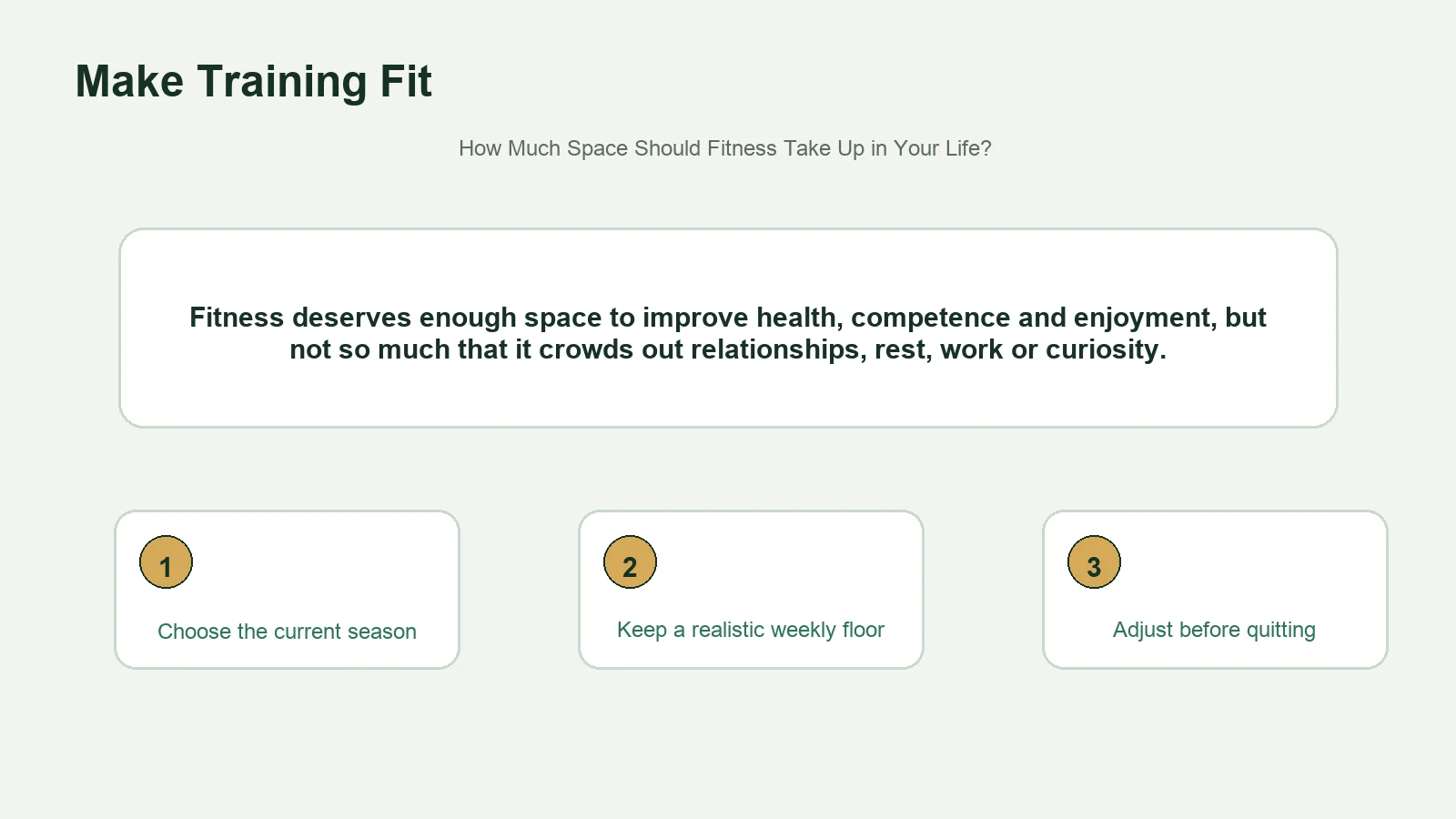
Fitness should occupy enough space to improve your life and little enough space that the rest of your life remains recognizable. That balance is personal. Someone preparing for a competition may choose a larger temporary commitment. Someone caring for children or managing a demanding job may need a smaller routine. The important question is whether the current investment matches the current goal.
This is not an argument for minimal effort. It is an argument for an explicit budget. Time, attention, money and recovery are finite. When fitness consumes them without a clear return, the routine can become another source of stress rather than a source of capability.
- Start with the role of fitness
- Set a time and attention budget
- Notice when the balance drifts
- Adjust for different seasons
- Keep a minimum version
Start with the role of fitness
Write one sentence that explains why you train now. It may be to become stronger, prepare for a sport, manage daily energy or maintain a routine you enjoy. A clear role makes boundaries easier. If the goal is general strength, a schedule that resembles professional contest preparation is probably solving a problem you do not have.
The CDC summary of adult physical activity benefits describes both immediate and long-term benefits of regular activity. Those benefits can support a full life; they do not require making fitness the organizing identity of every day. Public-health guidance is a floor for perspective, not a demand for optimization.
Set a time and attention budget
Count the full cost of training: travel, changing, warm-up, the session, food preparation and the mental time spent planning or consuming fitness media. Two one-hour sessions may occupy more than two hours. That is not automatically too much, but it should be visible.
Choose a weekly budget that leaves room for sleep, relationships, work and unstructured time. Then design the program inside it. This order matters. If you choose an oversized program first, every other responsibility becomes an obstacle. If you set the budget first, exercise selection and frequency become practical decisions.
Attention needs a budget too. A person can train three hours a week and think about training all day. Consider limiting program research and social-media checking to a specific window. The rest of the week can then benefit from the routine without being colonized by it.
Notice when the balance drifts
More fitness is not always more wellbeing. Warning signs include repeatedly cancelling important plans for ordinary workouts, feeling unable to rest, training through concerning symptoms, spending beyond your budget or judging every meal and social event by its effect on performance. One isolated decision does not define a problem, but a persistent pattern deserves attention.
Scale the plan down before resentment or exhaustion forces a complete stop. Remove optional accessories, reduce sessions or choose a maintenance block. If exercise, food or body-image concerns feel compulsive or distressing, a qualified mental-health or healthcare professional can provide individual help. A blog cannot diagnose that situation.
Adjust for different seasons
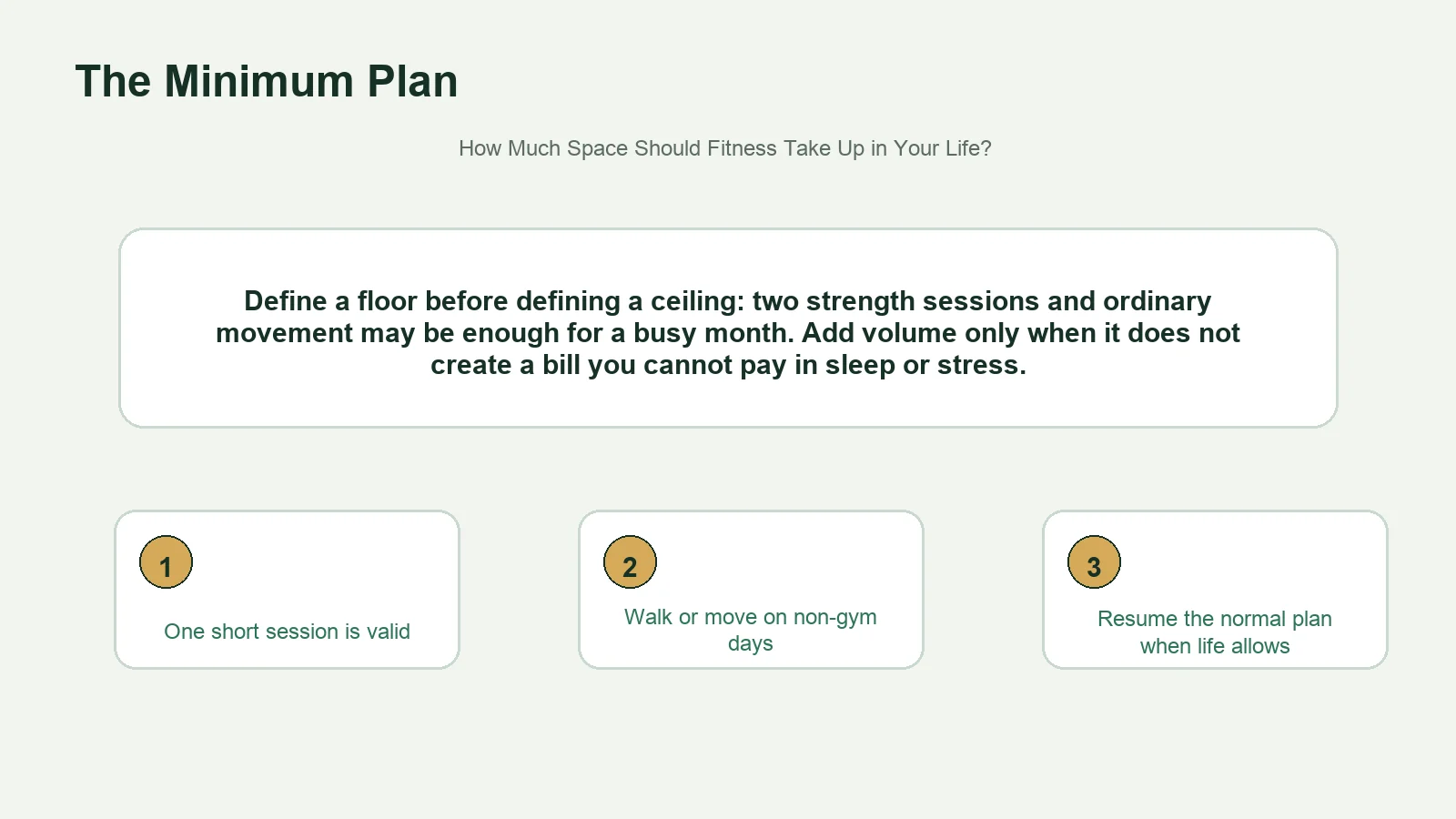
Your answer can change. During a quiet month, three or four sessions may fit comfortably. During travel, exams, caregiving or a major work deadline, one or two shorter sessions may be appropriate. Reducing training for a season does not erase previous work or commitment.
Discuss recurring training time with the people affected by it. A predictable schedule is often easier for a household than constant last-minute negotiation. Flexibility should work both ways: protect the agreed training slot, and be willing to move it when something genuinely more important occurs.
Keep a minimum version
Define what remains when your available space shrinks. It could be two brief strength sessions, one home workout and regular walking, or a temporary focus on movement and sleep. The minimum is not the ideal forever. It is a respectful response to limited capacity.
Fitness should make more of life possible. Give it a role, a budget and a boundary. When the routine supports energy, capability and enjoyment without demanding constant sacrifice, it is taking up enough space.
Review the tradeoffs, not only the workouts
Once a month, compare the routine with the reason you chose it. Ask whether the plan is improving strength, skill or enjoyment at a cost you still accept. Include the less visible tradeoffs: late evenings, rushed meals, missed social time, recurring equipment purchases and the attention spent worrying about a session after it is over.
This review should not become another optimization project. Write down what is working, one source of friction and one adjustment for the next month. The answer may be to protect training time more firmly, not always to reduce it. A plan that is continually displaced by low-priority tasks is not balanced simply because it is small.
Use temporary goals honestly. A competition or demanding training block may justify more time for several weeks, but give that period a start, an end and a plan for returning to normal. Open-ended escalation is how a focused hobby can begin occupying every available space. Fitness fits well when its demands are visible, chosen and revisited rather than assumed.
Continue with a related guide
For the next practical step, read How to Balance the Gym With a Full-Time Job. For a second perspective from the same topic cluster, continue with How to Make Strength Training Part of Your Life.