

Getting stronger is physical, but the way you interpret training affects whether you stay with the process. A heavy set can be read as useful practice, a threat, a test of identity or simple data. Those interpretations influence attention, effort and the decisions you make after a good or bad session.
Psychology does not replace programming, sleep or technique. It helps you use them. The practical goal is not permanent confidence. It is a way to respond to uncertainty without turning every workout into a referendum on your ability.
- Strength is a skill and an adaptation
- Build evidence-based confidence
- Interpret effort accurately
- Use goals at different scales
- Respond to setbacks
- Keep identity flexible
Strength is both skill and adaptation
A lift improves through repeated exposure, coordination, muscular adaptation and a program that manages fatigue. This means a single performance is noisy. Sleep, equipment, stress and familiarity can change what you express that day without erasing the underlying work.
Understanding this reduces catastrophizing. A poor session is not proof that you lost all progress. A surprise personal record is not proof that every variable is perfect. Look for trends across comparable sessions and use the program to create more useful exposures.
Build confidence from evidence
Confidence that depends on hype disappears when the bar feels heavy. Confidence based on evidence is quieter: you completed the previous progression, repeated the setup and handled similar work. Keep a log that captures these facts.
Before a challenging set, review one relevant piece of evidence rather than giving yourself a speech. “I completed three repetitions at a nearby load last week” is specific. It supports a decision without guaranteeing the outcome.
Small wins are useful when they represent the skill you are building. A controlled final repetition, a consistent pause or a session completed after a difficult workday can all provide evidence. They should not be inflated into proof that limits no longer apply.
Interpret effort without drama
Strength training should sometimes feel hard. Hard does not automatically mean dangerous, and discomfort does not automatically mean productive. Learning the difference requires experience, conservative progression and attention to symptoms. Sharp or escalating pain, dizziness, numbness or other concerning responses are reasons to stop and seek appropriate guidance, not tests of mental toughness.
Use effort ratings as estimates, not moral scores. A set at a perceived eight out of ten means you believed a small number of repetitions remained. It does not mean you were brave enough. Over time, comparing estimates with actual performance can improve judgment.
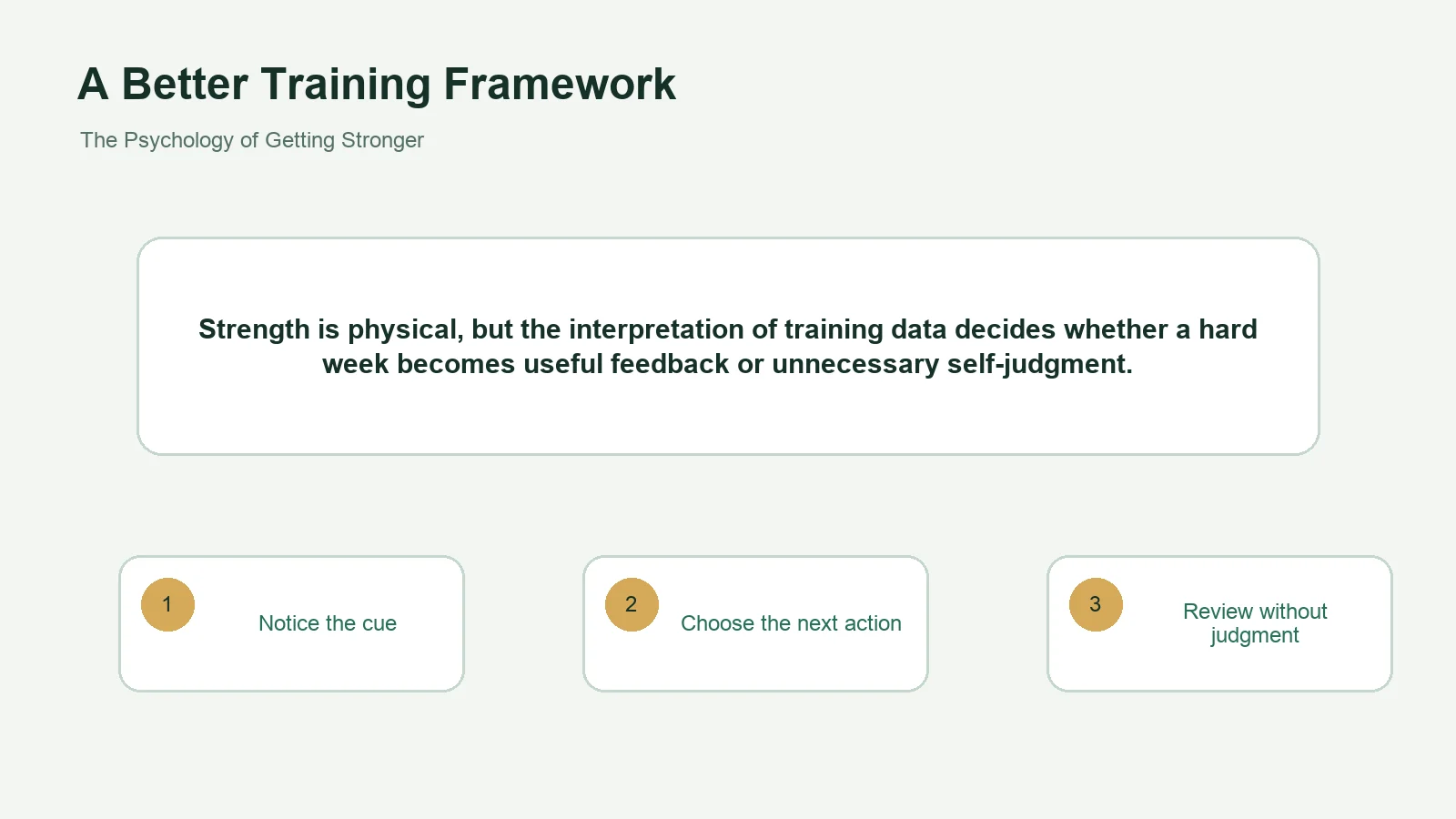
Use goals at different scales
Outcome goals provide direction: a first pull-up, a heavier squat or a return to regular training. Process goals tell you what to do this week. Session goals narrow attention further: complete the planned sets with a repeatable setup.
Problems arise when the outcome is the only goal. You cannot force a future result today, so every session becomes an emotional preview. Process goals restore agency. You can follow the progression, sleep on schedule and record the work even when the outcome is months away.
Review outcomes at planned intervals, not after every set. A testing week or end-of-block review provides more context than daily speculation. Between reviews, return attention to the next controllable action.
Respond to setbacks like an editor
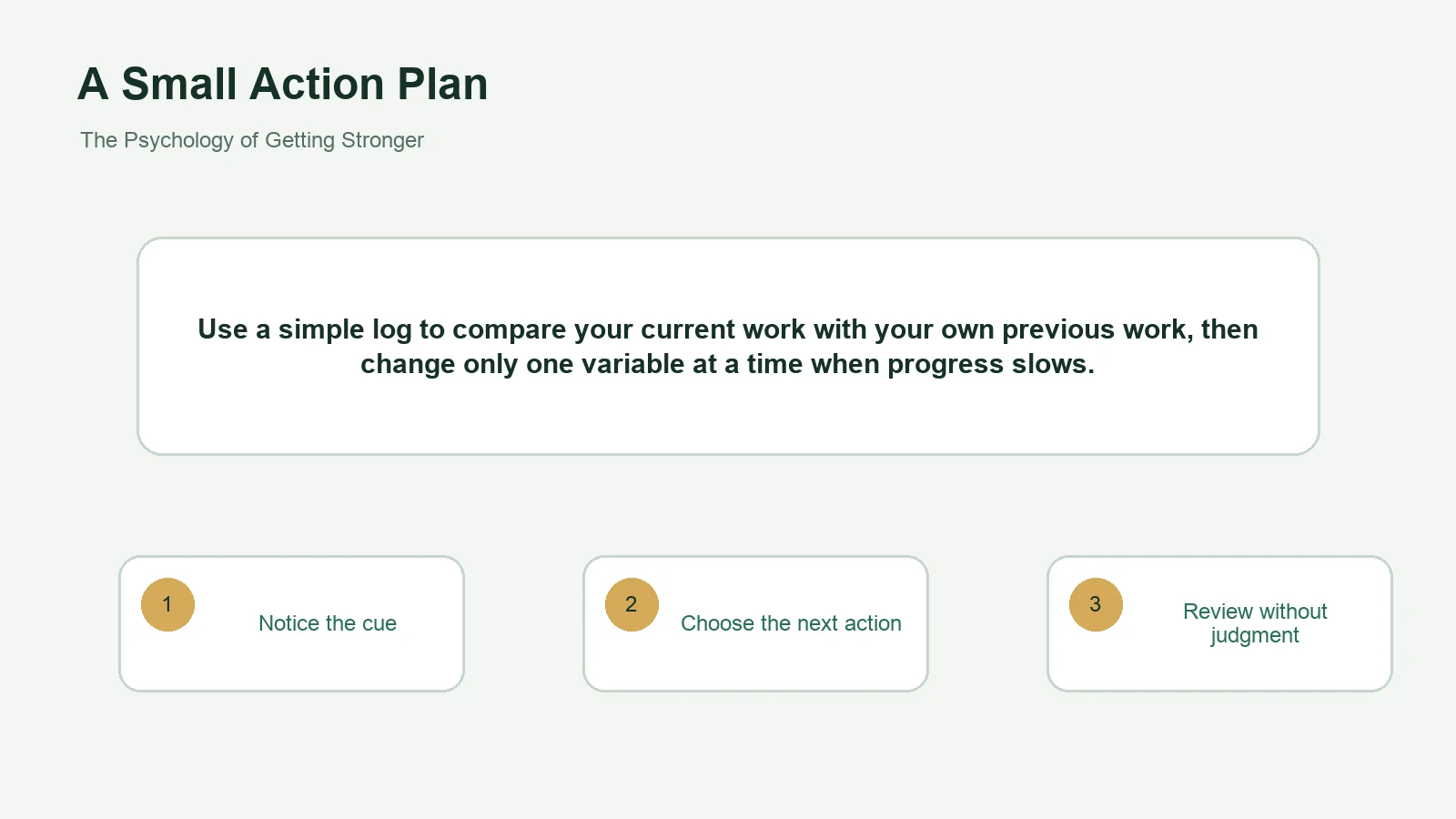
When progress stalls, describe what happened before explaining why. Was the same load repeated? Did repetitions drop across several weeks? Did attendance change? Explanations should follow the data, not arrive as accusations.
Then choose the smallest plausible adjustment: repeat the week, reduce fatigue, alter a variation or ask a qualified coach to review technique. If pain, illness or mental-health concerns are involved, the appropriate next step may be professional assessment rather than program experimentation.
The NIDDK behavior-change guidance treats setbacks as part of maintaining a routine. This is psychologically useful because it replaces the fantasy of a clean upward line with a process of review and return.
Keep identity flexible
Calling yourself a lifter can support consistency, but identity becomes fragile when it depends on a number. You remain a person who trains during a deload, after a disappointing meet or while rebuilding. The practice is larger than one performance.
Make room for other roles and interests. A flexible identity lowers the emotional cost of necessary rest and makes return easier. Getting stronger is a meaningful project; it does not need to carry your entire self-worth.
The psychology of strength is therefore less about aggression than interpretation. Build confidence from evidence, keep goals at the right scale and respond to setbacks with useful questions. The bar provides feedback. You decide whether that feedback becomes information or a verdict.
Confidence should follow evidence
Confidence in the gym does not have to arrive before action. It can be a conclusion drawn from repeated evidence: you followed the setup, completed the planned repetitions and handled a difficult set without abandoning technique. This kind of confidence is narrower than a motivational slogan, which makes it more useful. You do not need to believe that every lift will succeed; you need a reason to trust the next decision.
Build an evidence log beside the training log. Record one thing that became more repeatable, such as a consistent walkout, a calmer warm-up or better judgment about when to stop a set. These notes make progress visible when the load has not changed. They also reduce the temptation to use a maximum attempt as the only proof that training is working.
Separate arousal from readiness
Feeling excited, aggressive or nervous can change how ready a session feels, but those states are not the program. Use the planned warm-up to assess movement and effort under today’s conditions. A quiet day can still produce good work, and an exciting day can still require restraint. Music, caffeine and a training partner may change arousal; none replaces a progression rule or sound technique.
Create a short pre-set routine that works at ordinary emotional intensity. Check the equipment, use one technical cue, take the planned breath and begin. If the routine only works after a dramatic build-up, it will be difficult to repeat across normal weeks.
Respond to a missed lift without writing a story
A failed repetition is a specific event. It may reflect load selection, fatigue, technique or simply the normal uncertainty of challenging work. Record what happened before deciding what it means. Was the attempt outside the program? Did the setup change? Were earlier sets already slower than expected? One observation can guide the next choice; a global judgment about talent cannot.
After an unexpected miss, reduce the load if needed and complete useful work with control. If failures repeat, review the recent trend with a qualified coach rather than testing more often. Confidence grows when setbacks produce proportionate decisions. The objective is not to feel invulnerable. It is to remain capable of choosing the next sensible action when the session is imperfect.
Keep strength in proportion
Training can support identity without becoming the only source of it. Maintain relationships, skills and responsibilities that do not depend on the number on the bar. This protects enjoyment when progress slows and makes it easier to take necessary time away.
If worry, body-image concerns or compulsive exercise begin affecting daily life, generic mindset advice is not a substitute for individual support. A normal training practice should expand what you can do, not continually narrow the terms on which you allow yourself to feel successful.
Continue with a related guide
For the next practical step, read Why Strength Training Teaches Patience. For a second perspective from the same topic cluster, continue with Why You Don’t Need to Love Every Workout.