

Progressive overload is often taught as a simple command: put more weight on the bar. That can be useful, especially when a new lifter is getting stronger quickly. It is not the whole idea. If adding weight makes the range shorter, the setup inconsistent, or the target muscle disappear from the exercise, the number on the plate may have changed while the quality of the training has not improved.
A better definition is practical: progressive overload is a planned way to make useful training work more demanding over time. Load is one lever. Repetitions, range of motion, control, exercise assistance, set quality, and weekly volume can also be levers. The best choice is the one that serves the goal of the movement and leaves you able to repeat the work.
This guide is for healthy adults using resistance training for general strength or muscle-building. It cannot identify the cause of pain or replace individual coaching or clinical care. Stop a movement that produces sharp or escalating pain, new neurological symptoms, or symptoms that do not settle, and seek an appropriate individual assessment rather than trying to progress through it.
- What progression is actually trying to improve
- Why a heavier bar is not always a better set
- How to progress repetitions, load, and volume
- When range, control, or less assistance count
- How to decide when a repeat week is the right choice
Progressive overload is a planning method
The phrase does not describe one special physiological switch. It is a planning method: expose yourself to work that is meaningful enough to adapt to, then adjust that work when the current dose becomes familiar or too easy for its purpose. The ACSM position stand on progression models treats resistance training as a set of variables, including load, repetitions, volume, frequency, and exercise order. Those variables are tools, not a weekly dare.
That distinction matters because exercises have different jobs. A barbell squat may be partly a skill practice. A cable row may be a way to add controlled pulling volume. A split squat may be limited by balance before leg strength. Progress should respect the job. If the goal is to practice a stable squat pattern, changing five variables at once makes the log harder to interpret. If the goal is to build more quality work in a row, a controlled repetition may be a better next step than a dramatic load jump.
Before changing anything, make the current prescription comparable. Use a similar setup, range, rest period, and effort target. Write down the load, repetitions, and any detail that changes the meaning of the set, such as a pause or machine seat position. A log does not need to be elaborate. It needs to let you tell whether today was actually better than the last comparable exposure.
A heavier bar is not automatically a better set
Adding load is usually useful when the current weight no longer challenges the intended repetition range and the movement still looks like the same movement after the increase. It becomes less useful when the jump forces a different range of motion, changes the tempo into a rushed survival rep, or makes you lose the position the exercise was meant to train.
For example, imagine three sets of a dumbbell press planned for eight to twelve repetitions. If you can perform twelve controlled reps on every set, a small weight increase is reasonable. If the next available dumbbells are much heavier, you do not have to force them immediately. You could return to eight or nine reps with the new pair if the setup remains controlled. Or you could keep the current pair and make the sets more consistent before changing the load.
The point is not to protect a perfect technique ideal. Real repetitions vary. The point is to avoid calling a different task progress just because a bigger number is attached to it. Our guide to the anatomy of a great strength program explains why a progression rule works best when the rest of the program stays legible enough to review.
Let repetitions earn the load increase
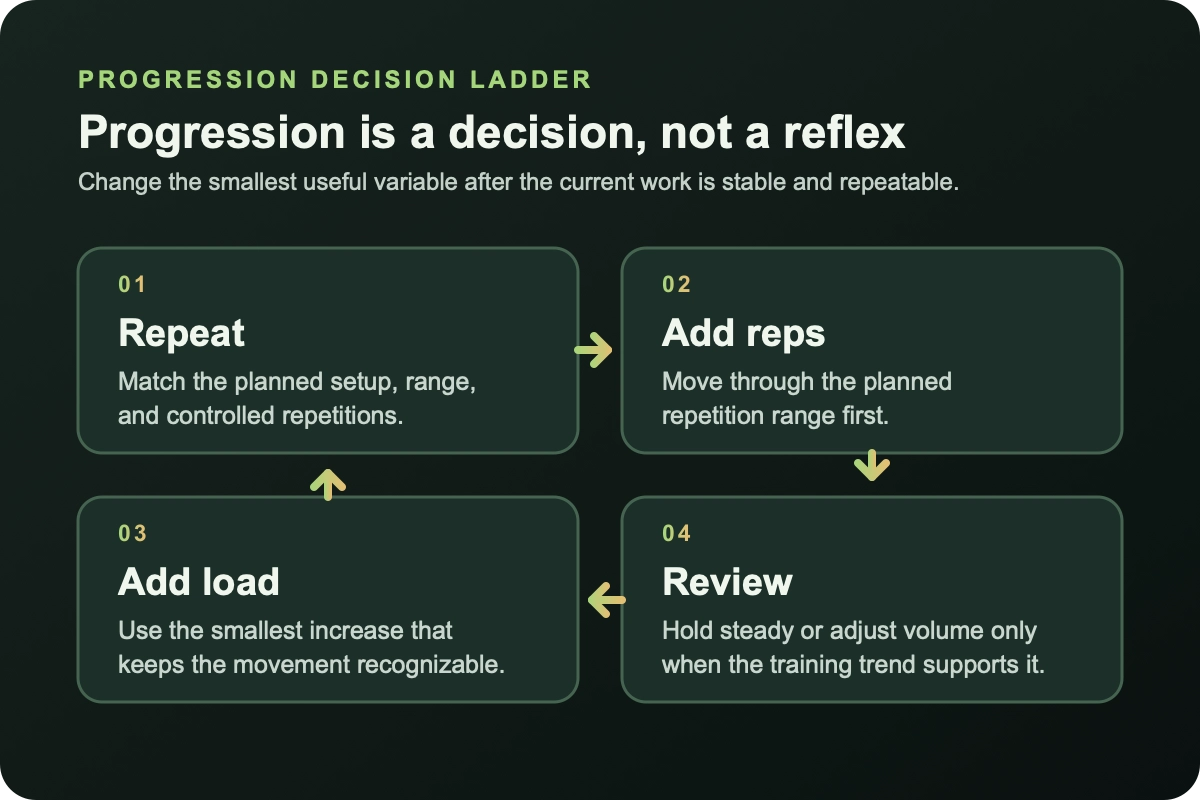
For many machine, dumbbell, and barbell exercises, a repetition range is a calm way to organize progression. Choose a range that fits the movement, for example six to ten or eight to twelve repetitions. Start with a load you can control. Add repetitions across comparable sessions until the planned sets reach the upper end of the range. Then use the smallest available increase and work back up through the range.
This is often called double progression, although the label matters less than the record keeping. You are improving one variable at a time: first the number of good repetitions, then the load. It avoids the false choice between adding weight every session and never changing anything.
Higher loads can be important for strength, particularly when a person wants to become stronger in a specific lift. A 2023 systematic review and network meta-analysis compared common resistance-training prescriptions in healthy adults and reported the largest strength gains for higher-load approaches in its network estimates. That result does not require every exercise to become heavy. It supports choosing load deliberately for the goal, while using other variables to build the work that makes heavier practice sustainable.
Small load jumps help. Fractional plates, lighter machine increments, or an extra repetition can all bridge the gap between “easy enough to control” and “too large a jump today.” If the equipment only offers a big increase, progress may arrive as more clean reps at the current load, a more repeatable setup, or another controlled set when recovery supports it.
Volume is a tool, not the automatic next move
Adding a set can increase useful practice or provide more work for a muscle group. It can also add fatigue without solving the actual problem. Before adding volume, ask whether the existing sets are consistent, whether you are resting enough to perform them well, and whether the exercise has been in the plan long enough to show a trend.
An extra set makes more sense when you are recovering well and the current dose is clearly modest for a movement you want to prioritize. It makes less sense when performance is slipping, sessions are already too long, or every new set turns into hurried work. Our article on why more training is not always more progress is a useful companion here: volume is valuable only when it remains recoverable and produces a signal you can use.
The systematic review and meta-analysis of resistance-training loads also illustrates why one number cannot summarize a program. Different loading approaches can support muscle growth when sets are performed with sufficient effort, while strength outcomes tend to favor heavier practice. Volume, load, and specificity should therefore be chosen together, not escalated in isolation.
Range, control, and assistance can be measurable progress
Not every useful change has to increase the external load. A beginner may make a squat more consistent by reaching the same comfortable depth each time. A lifter may progress a push-up by using a lower incline. A pull-up progression may reduce band assistance. A row may improve when the torso stays stable and the intended range is repeated without turning the last reps into a swing.
These changes count only when they are defined. “Better form” is too vague for a log. “Three sets of eight to ten box squats to the same box with a one-second pause” is trackable. “Ten controlled incline push-ups with hands on the second bench setting” is trackable. Once the constraint is written down, you can see whether it changed before you add another challenge.
Do not make every set slower or every range deeper simply to create a progression marker. A tempo, pause, or range should have a reason connected to the exercise and the person. If a change produces sharp pain, makes the setup unreliable, or only makes the session feel harder without helping the goal, it is not automatically a better prescription.
Sometimes the right progression is to hold steady
A repeat week is not a failed week. It can confirm that a successful session was repeatable, give a new movement more practice, or keep a plan moving during a demanding period outside the gym. A single poorer session can reflect sleep, timing, stress, or ordinary variation. It does not always justify more weight, more volume, or a new program.
Use a short decision sequence. First, did you complete the planned work with a comparable setup? If not, repeat it. If yes, did you move closer to the top of the planned repetition range? If not, add a repetition before changing the load. If you already own the top of the range, make the smallest practical load increase. Review volume, frequency, or exercise selection only after the basic progression signal has had time to emerge.
For a fuller framework on stable beginner practice, read why a boring first strength program works. The goal is not to make every week look more impressive. It is to build a sequence of training decisions that you can perform, recover from, and explain.
Build progress you can recognize
Progressive overload works best when it is specific enough to measure and flexible enough to fit real training. Add weight when it is the smallest useful next step. Add repetitions when the current load still has room. Add volume only when it addresses a clear need and your recovery supports it. Improve range, control, or assistance when those changes make the exercise more productive.
The bar does not have to be heavier every week for training to move forward. It has to ask a little more of the right thing over time.
Continue with a related guide
For the next practical step, read The Anatomy of a Great Strength Program. For a second perspective from the same topic cluster, continue with Your First Strength Program Should Be Boring — That’s Why It Works.