

Lee Haney’s place in bodybuilding history begins with a number that is easy to repeat and difficult to understand: eight consecutive Mr. Olympia titles. The run lasted from 1984 through 1991. One win can describe a peak. Eight wins describe an era in which a champion had to return to the same stage, against changing fields and expectations, and remain the result to beat.
Haney’s record is often used as a shorthand for “size and shape.” That phrase has some value, because physique competition is judged through visual comparison. But it should not turn a historical athlete into a universal template for a reader’s body or training. The more useful story is about repeated preparation for a specific competitive test, and about how a sequence of results can change the way a sport remembers a period.
This article is a historical profile. It does not prescribe a contest diet, a training volume, or a body-composition target. Professional physique competition has its own rules, resources, pressures, and tradeoffs. Everyday training is allowed to have a different goal and a different measure of success.
- The eight-title record
- Why a long run means more than a peak
- How size, shape, and presentation became an era
- What the history does not ask modern lifters to copy
- What a repeatable standard can mean outside a contest
Eight titles, one unbroken sequence
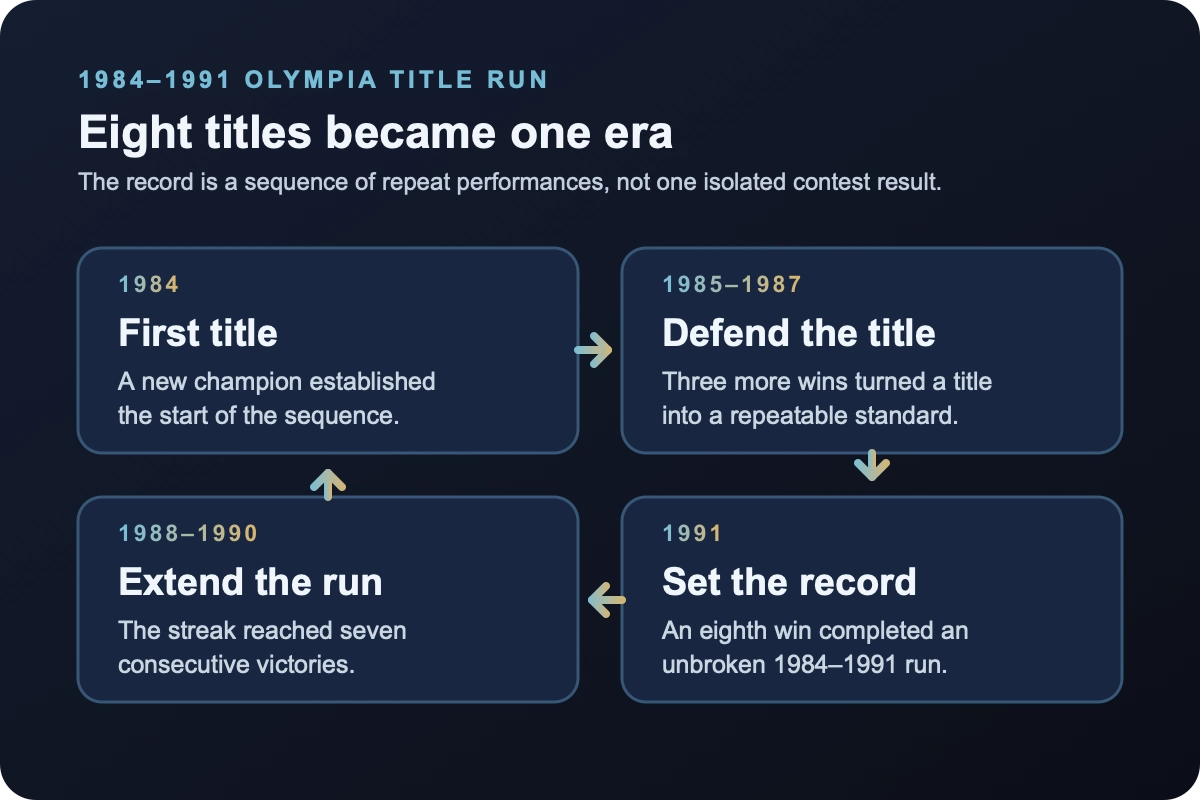
The factual core is unusually clear. The Olympia winners archive lists Lee Haney as winner each year from 1984 to 1991. Haney’s own career biography records the same eight-title sequence and describes the 1991 result as his eighth consecutive win. The Guinness World Records listing also identifies the 1984-1991 span as eight Mr. Olympia victories, a total later equaled by Ronnie Coleman.
Those sources give the profile a firm boundary. The achievement is not an impression created by a single famous image. It is an uninterrupted series across eight annual contests. That is why the record retains its force even as bodybuilding audiences debate eras, judging, and aesthetics.
Why a streak changes the story
A title defense asks a different question from a first win. The first result establishes that a competitor can be the best in one field, on one night. The next result asks whether the preparation can be repeated. By the middle of a long run, the athlete is not only defending a trophy; the field is preparing against a standard that has become familiar.
That does not mean each year was identical or that the judging environment stood still. Contests, rivals, presentation, and public expectations all move. The value of the Haney record is that it survived those moving parts. The record is therefore less about one supposedly perfect physique than about sustained competitive execution across nearly a decade.
This is a useful distinction for any sport. Highlights are memorable because they compress achievement into one moment. A long sequence carries more context. It implies return, preparation, comparison, and enough consistency to make the outcome meaningful again.
Size, shape, and the competitive language of an era
Physique sport is visual by design. Size, proportion, condition, posing, and stage presence are part of the task. Haney’s run became associated with a particular competitive package because the same qualities were presented successfully year after year. The phrase “size and shape” is best understood as a description of that contest language, not as a technical formula anyone can follow from a photograph.
That boundary is important. Stage images leave out the details behind a professional result: training history, coaching, contest rules, travel, financial support, and the pressures of being judged. They also invite comparisons across decades that ignore changes in the sport itself. A historical profile should show why a champion mattered without pretending that an old image supplies a complete lesson in health or training.
Haney’s eight wins also came at a point when bodybuilding was increasingly visible through magazines, video, and gym culture. Repeated victories gave audiences a stable reference point. A competitor who wins once may represent a moment. A competitor who wins eight times helps define the vocabulary people use for an entire period.
What this history does not require you to imitate
The simplest mistake is to turn admiration into imitation. A reader does not need to pursue professional size, train for appearance alone, or organize life around a contest calendar to respect a record. The conditions that produce elite physique competition are specific. Borrowing the visible outcome without the context can create unrealistic expectations and an unhelpful relationship with training.
The same caution applies to old routines and quotations. Historical champions can offer ideas, but an idea should still be tested against the reader’s equipment, schedule, recovery, experience, and goal. A program that makes sense for a professional competitor in one era may be unnecessary or unsuitable for someone building a sustainable habit today.
The wider site has practical alternatives. The Anatomy of a Great Strength Program explains how to connect a goal, exercise choice, dose, and review process. Why More Training Isn’t Always More Progress covers the equally important question of whether a training dose can be recovered from and repeated.
A better use for a championship record
Haney’s story can still be useful outside bodybuilding because it makes consistency visible. Eight wins were not eight versions of the same day; they were eight successful returns to a defined test. Most readers do not need that kind of stage. They can create a modest equivalent: complete a planned block, return to a movement with better control, keep a training log for a season, or maintain a routine through a demanding month.
The lesson is not to chase a record. It is to make progress something that can survive time. Clear goals, reasonable review points, and a plan that fits ordinary life may look less dramatic than a championship photo. They are also the things that let training continue long enough to become meaningful.
Lee Haney’s eight-title run remains important because it joined a distinctive visual presence to a repeated competitive result. Read the “size and shape” of the era as sporting history. Read the eight titles as the record. Then choose a standard of progress that belongs to your own life.
Continue with a related guide
For another profile from a different Olympia era, read Frank Zane: How Aesthetics Became a Different Kind of Dominance. For the wider cultural context, continue with Pumping Iron: The Film That Took Bodybuilding Out of the Gym and Into Pop Culture.