Calisthenics is simply resistance training where bodyweight is the main source of resistance. That definition is useful because it removes much of the noise. You do not need to begin with a handstand, a muscle-up, or a social-media-worthy routine. You need a small set of movements that you can perform with control, recover from, and make gradually more demanding.
For a healthy beginner, a bodyweight plan can be a sensible entry point to strength training. The ACSM position stand on resistance-training progression is not a calisthenics program, but its practical principles still apply: train the major movement patterns, begin with a manageable dose, and progress only when the current work is controlled. The World Health Organization physical-activity guidelines likewise make room for muscle-strengthening activity on two or more days each week.
This guide is for adults who can exercise without individual restrictions and want a practical place to start. If you have acute pain, a recent injury or surgery, dizziness, neurological symptoms, or a condition that changes how you should exercise, get individual guidance from a qualified clinician or coach before trying to work around it.
- What a beginner routine should include
- How to choose versions you can control
- A simple two- or three-day schedule
- How to progress without guessing
- What not to make a priority yet
Start with movement slots, not a list of tricks
The most useful beginner plan covers four broad jobs: push, pull, legs, and trunk. The exercise inside each slot can change with your equipment and current ability. A wall push-up, an incline push-up, and a floor push-up are all versions of the same broad push pattern. A doorframe row is not an appropriate setup, but a stable low bar, rings, or a well-secured row station can provide a pulling option. If you have no safe pulling setup, use a resistance band row until you do.
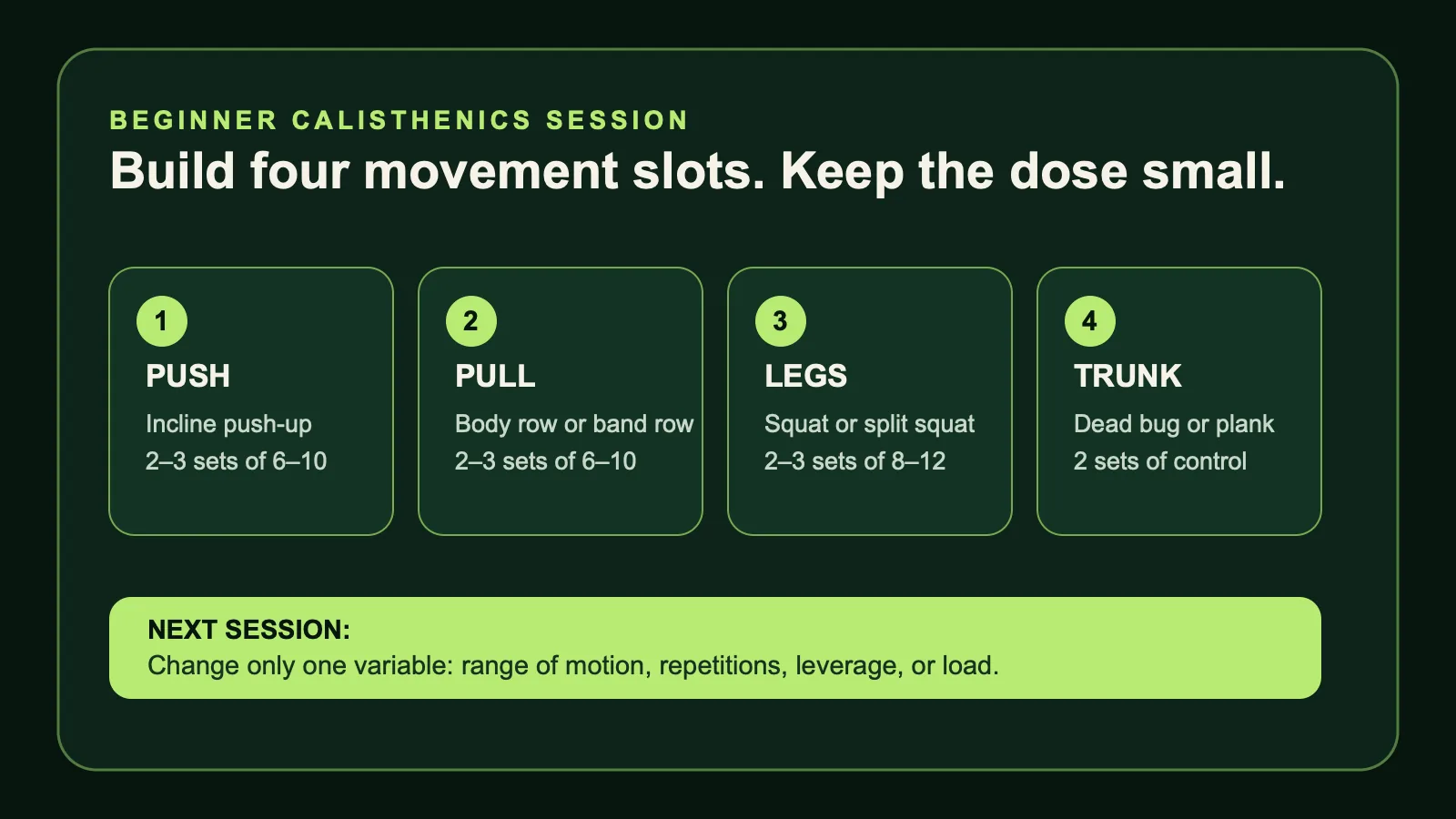
Choose a version that lets you keep a steady position for most of the set. That may mean hands on a kitchen counter rather than the floor, a chair-assisted split squat instead of a pistol squat, or a raised bar row instead of a low ring row. Regressions are not a failure. They are how you create enough quality repetitions to learn the movement.
For the push pattern, our guide to push-up progression explains how leverage changes the difficulty without changing the basic skill. For the bigger question of whether bodyweight can keep challenging muscle over time, continue with Can You Build Muscle With Bodyweight Training?.
A routine that fits a real week
Train two full-body sessions per week at first. Put at least one day between them. If that becomes easy to repeat for several weeks, a third session can be useful, but it is not required for the plan to count. Consistency is more valuable than a schedule that looks ambitious on paper and repeatedly disappears when work or family life gets busy.
Use this as a starting template:
| Movement | Choose one version | Starting dose |
| — | — | — |
| Push | wall, incline, or floor push-up | 2-3 sets of 6-12 controlled reps |
| Pull | body row, ring row, or band row | 2-3 sets of 6-12 controlled reps |
| Legs | squat, split squat, or step-up | 2-3 sets of 8-15 controlled reps |
| Trunk | dead bug, side plank, or front plank | 2-3 controlled sets |
Rest long enough that the next set still looks like the first. There is no special benefit to rushing when a little more rest would allow better positioning and a more repeatable effort. Leave a little room before the point where form collapses. A beginner does not need every set to become a test of toughness.
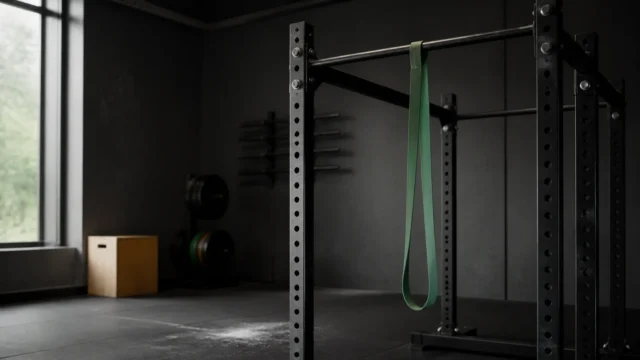
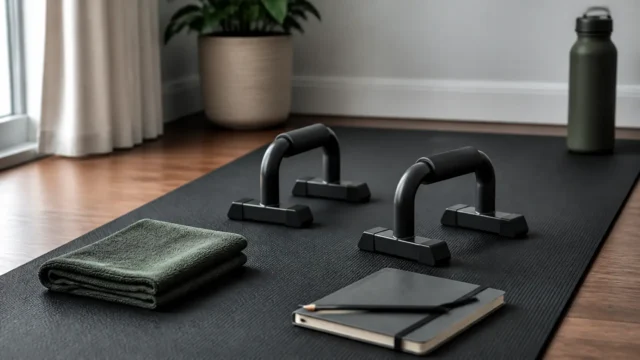
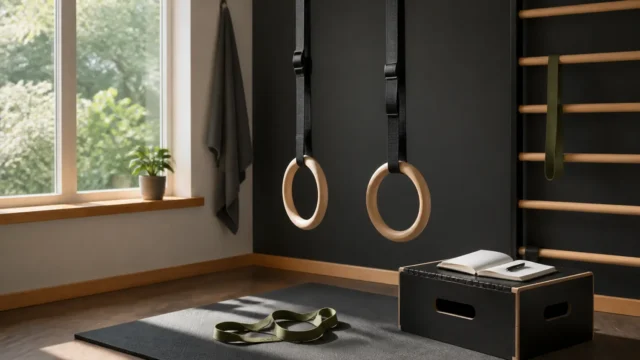
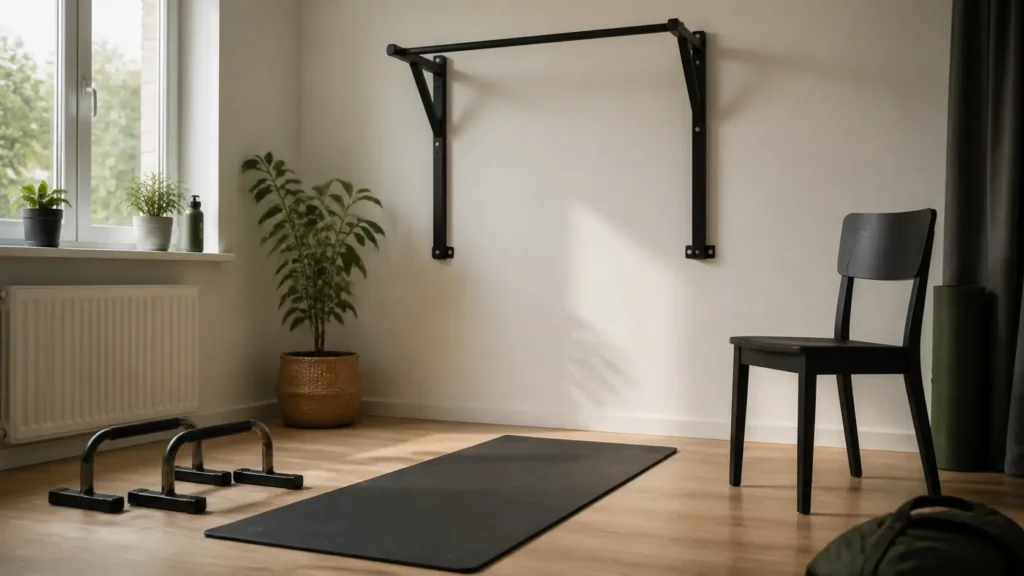
Equipment is optional, but it changes your options. A pull-up bar, rings, a stable bench, or resistance bands can expand the exercise menu. They are not mandatory purchases on day one. Build a routine around what you can set up safely and consistently. If a home setup feels improvised or unstable, choose another variation rather than trying to make it work through confidence alone.
Progress one variable at a time
Bodyweight training has more progression options than simply adding a plate to a bar. You can add a repetition, use a slightly deeper range of motion, lower the incline, reduce assistance, add a set, or eventually add external load. The rule is to change one variable at a time and observe what happens.
For example, if you perform two sets of eight incline push-ups with clean control, do not immediately add reps, a third set, and a lower surface. First try to make the same version easier to repeat: perhaps two sets of nine, then ten. When the upper end of your chosen range is stable, lower the surface a little. This is the same calm decision-making described in Your First Strength Program Should Be Boring – That’s Why It Works.
Write down the variation, sets, reps, and setup. “Push-ups” is not enough information if one week your hands are on a wall and the next week they are on a low bench. A short log lets you see actual progress rather than relying on a vague memory of whether a session felt hard.
What beginners can ignore for now
Advanced calisthenics skills are impressive, but they are not a checklist for a new trainee. Do not make a freestanding handstand, a full planche, a human flag, or a muscle-up the entry requirement for training. Those skills ask for specific strength, coordination, joint tolerance, equipment, and often coaching feedback. A stable push, pull, squat, and trunk routine is not a lesser version of training. It is the foundation that makes later specialization easier to judge.
You can also ignore the idea that soreness proves progress. New exercises often create soreness, but it does not tell you whether your dose was appropriate. A productive session is one you can repeat with decent movement quality and ordinary recovery. If fatigue starts degrading your setup from set to set, reduce the dose or choose an easier version rather than trying to earn the workout through exhaustion.
A useful first-month target
For the first four weeks, aim to complete eight total sessions, not to master a signature skill. That target is concrete enough to guide you and modest enough to survive an imperfect calendar. When you can complete the sessions, record the work, and make one small progression without losing control, you have built the part of calisthenics that matters most: a system you can keep using.
Continue with a related guide
Learn how to build a broader routine in The Anatomy of a Great Strength Program. Then use Push-Ups: The Exercise Most People Stop Progressing Too Soon to apply the same progression logic to a single movement.