Push-ups are often treated as an entry-level exercise that stops being useful as soon as someone can complete a few sets on the floor. That is a poor way to look at them. A push-up is a pressing pattern with several adjustable variables: leverage, range of motion, repetitions, tempo, weekly volume, and external load. If the current version is too easy, the answer is not automatically to abandon it. The answer is to make the next version meaningfully harder while keeping the movement recognizable.
The ACSM resistance-training progression position stand describes progressive resistance exercise as an adjustment of variables such as load, volume, rest, frequency, and exercise selection. A push-up fits that model even when no barbell is involved. The point is not to turn a bodyweight movement into a laboratory project. It is to give yourself a repeatable way to decide what changes next.
- Why the floor push-up is not the only benchmark
- How leverage changes difficulty
- What quality repetitions look like
- Four ways to progress after the floor variation
- How often to practice without turning every set into a test
Start at the version you can own
The best starting variation is not the hardest one you can grind through once. It is the one you can repeat with a stable body position, a controlled descent, and a consistent depth. For many beginners, that will be a high-incline push-up with hands on a wall, counter, or sturdy elevated surface. From there, gradually lower the hand position until a floor version makes sense.
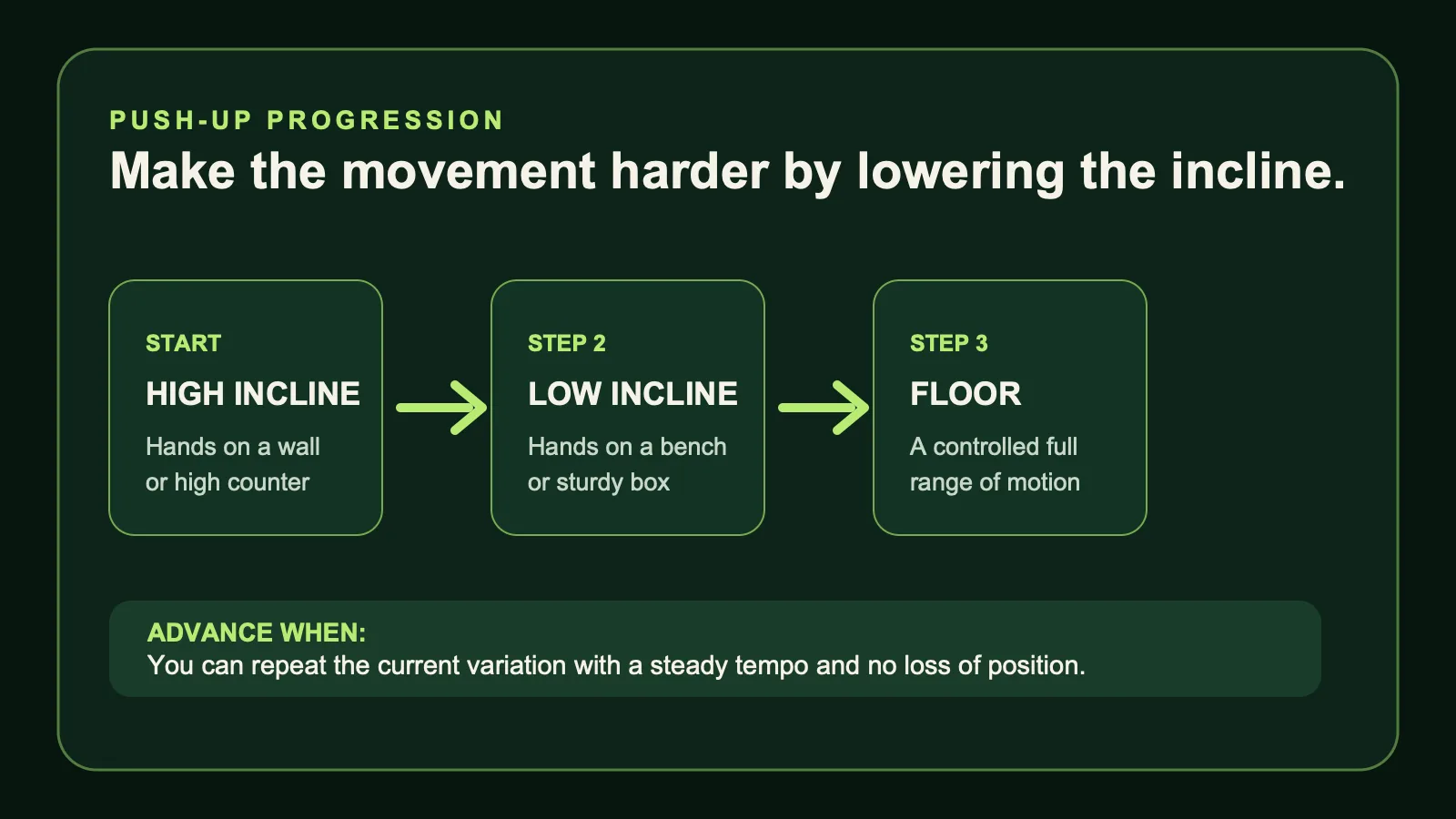
Use the version that lets you keep a long, connected line from shoulders through hips, without the lower back sagging or the hips rising early to escape the bottom. Your elbows do not need a universal angle, but they should travel in a path that feels controlled and comfortable at the shoulders. Lower only as far as you can maintain that position. More range is useful when it is stable; forcing a deeper rep that changes the whole shape is not automatically better.
If you are starting bodyweight training from scratch, begin with Calisthenics for Beginners: Where to Start. It places push-ups inside a complete routine instead of making one exercise carry the entire plan.
Progress beyond the first floor push-up
Once you can repeat floor push-ups with control, do not rush into a random collection of advanced variations. Pick one clear progression route and hold the others steady long enough to learn from it.
Add repetitions first. Choose a range, such as six to twelve. When you can complete the current number of sets at the upper end with a steady pace and sound position, you have evidence that the current variation is becoming easier to manage.
Change leverage. Elevating the feet makes the upper body support a different share of the movement. It is a real progression, but it also changes the feel at the shoulder. Use a modest elevation, then assess whether your position and range remain solid.
Add a set. A third or fourth quality set can increase the total work without turning each set into an all-out attempt. The practical question is whether the extra work still fits your recovery and the rest of your training week.
Add external load carefully. A weighted vest or securely loaded backpack can be useful only once the unweighted setup is stable. The load should not shift during the set, and the change should be small enough that you can still control the descent and bottom position. External load is an option, not a graduation requirement.
The network meta-analysis of resistance-training prescriptions reinforces the practical idea that multiple resistance-training approaches can improve strength. There is no single magic push-up rep range. Your progression needs to be challenging enough to matter, simple enough to repeat, and compatible with your other pressing work.
Keep the set honest
Most push-up stalls are not caused by a lack of exotic exercise variations. They come from doing the same number of loose repetitions every week and calling it maintenance. Before changing the movement, check what changed inside the set:
- Did the chest reach the same controlled depth?
- Did the hips stay connected to the torso until the final rep?
- Did the tempo become much faster to finish the set?
- Did rest times become shorter or longer?
- Did you add other pressing work that now affects the session?
Those details matter because “three sets of ten push-ups” can describe very different training. A log with the variation, sets, reps, and a brief note on control is enough. You do not need complicated readiness scores to notice whether the same version is becoming easier or your position is starting to fade.
A practical weekly dose
For most people, two or three exposures per week are plenty. Treat one or two sets as practice when you are learning a new variation, and add a little work only when you can recover and repeat it. Doing push-ups every day is not inherently wrong, but it is not automatically better. More frequent practice should solve a clear problem, such as building comfort with a basic pattern, rather than becoming a punishment for missing a session.
Push-ups also need balance. If your plan includes pressing, include pulling work and leg training. A row, pull-down, or ring-row variation is not a cosmetic add-on; it gives the week another major movement pattern. The broader structure in The Anatomy of a Great Strength Program helps prevent a push-up challenge from becoming a pressing-only routine.
When to step back
Do not force a harder variation through sharp pain, a new pinching sensation, numbness, dizziness, or a clear loss of shoulder control. Return to an easier leverage, reduce the range temporarily, or seek individual assessment if the issue persists. Training discomfort and effort are expected; symptoms that feel sharp, escalating, or unusual deserve a different response.
The useful long-term view is simple: a push-up continues to be useful when you can make it gradually more demanding and still repeat it well. You do not outgrow the movement when you complete your first clean floor rep. You outgrow a version only when you stop giving it a reason to challenge you.
Continue with a related guide
Build the surrounding routine with Calisthenics for Beginners: Where to Start. Then see how to make bodyweight work harder over time in Can You Build Muscle With Bodyweight Training?.