

A deload is easy to misunderstand. Some lifters treat it as a reward they have to earn by running themselves into the ground. Others treat any tired workout as proof that they need one immediately. Neither approach is especially useful.
A deload is a planned, temporary reduction in training cost. It gives you a window to keep the routine, preserve familiar movement practice, and stop asking for more adaptation than the current week can support. It is a programming decision, not a test of toughness and not a diagnosis.
The useful question is not, "Am I tired today?" It is, "Has a pattern emerged that says the current training dose no longer fits what I can recover from and repeat?" When the answer is yes, a lighter week can be the cleanest way to keep a good program useful.
- What a deload is and is not
- The trends that make one worth considering
- What to reduce without losing the routine
- How to return without immediately repeating the problem
- When a deload is not the right answer
A deload is a temporary change to the program
The goal of a deload is not to do nothing. It is to make the training week cheaper for a short period. That can mean fewer hard sets, a little more distance from failure, fewer demanding accessories, or fewer sessions.
That distinction matters because training is more than one workout. A good program is a sequence of exposures you can perform with enough quality to make the next exposure worthwhile. Recovery Is Part of the Program makes the larger point: rest and adjustment are part of the design, not empty time left over after hard work.
The research is not a reason to promise a magical reset. In a 2024 trial, trained participants who took a full week away from resistance training in the middle of a nine-week program did not gain a clear advantage over the group that trained continuously. Read the one-week deload trial and its methods before turning that result into a rule. Its practical value is more modest: a lighter period should have a purpose in the program, rather than being sold as a guaranteed shortcut to new gains.
Look for a pattern, not one disappointing session
One difficult workout is normal. A bad night of sleep, travel, a work deadline, or a missed meal can make warm-ups feel heavier and a familiar load feel strange. That is information, but it is not enough information to redesign the week.
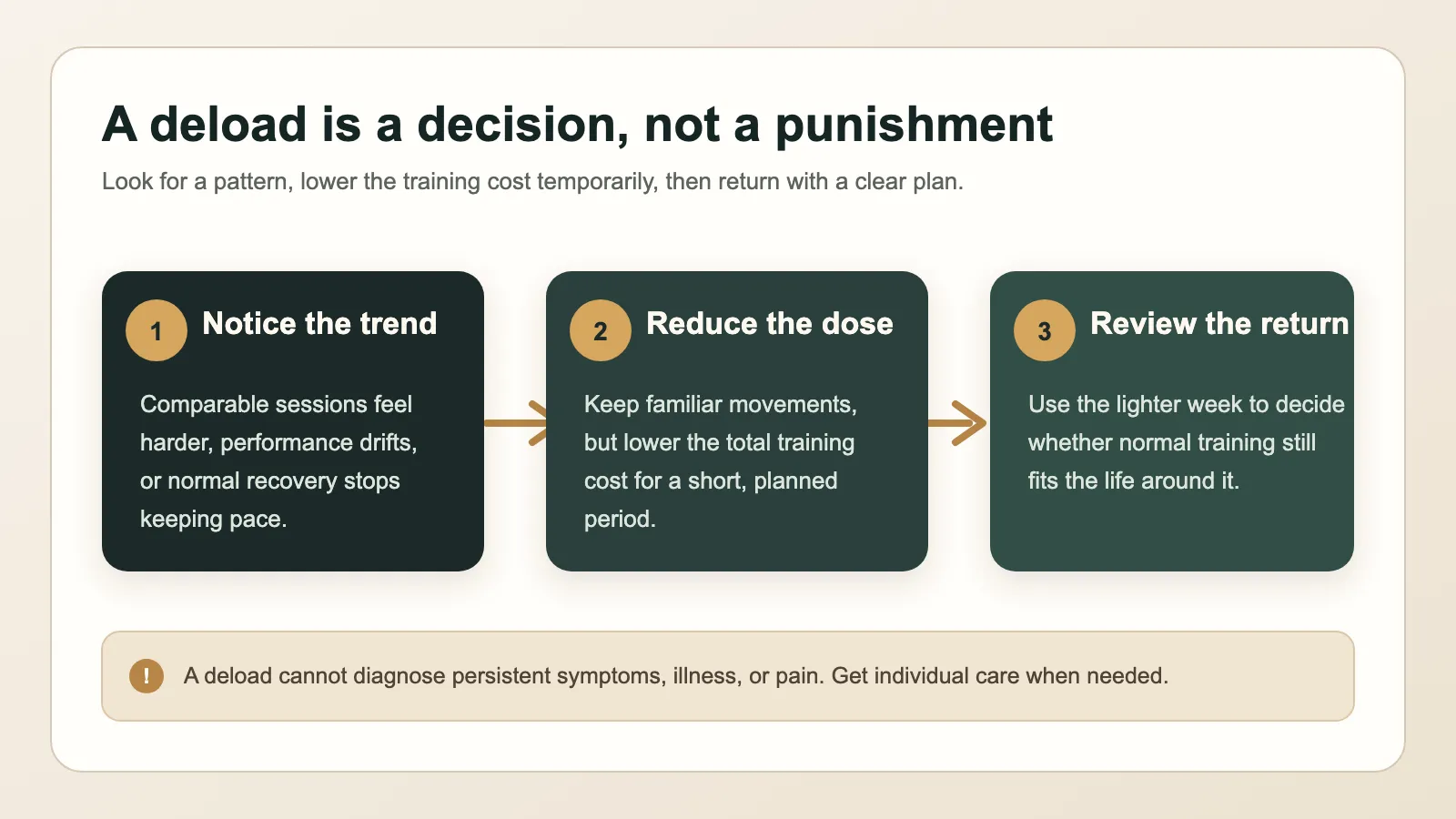
A more useful signal is a repeated trend across comparable sessions. The same planned work keeps feeling harder than expected. Repetitions that were stable start to drift. You need more effort to hit ordinary targets. Warm-ups feel unusually expensive more than once. Sleep, general stress, or motivation are also moving in the wrong direction. Notice whether several observations are telling the same story.
The difference is important when people use words such as fatigue, overreaching, and overtraining interchangeably. They are not interchangeable. Fatigue, Overreaching and Overtraining Are Not the Same Thing explains why a normal short-term dip and a prolonged decline call for different responses. A deload can be a reasonable response to a training-cost problem. It cannot confirm the cause of persistent symptoms or turn a serious issue into something to self-manage.
Reduce the cost before you remove the habit
For most recreational lifters, the first adjustment is usually not a complete week away from the gym. It is a smaller version of the same program. Keeping a familiar squat, press, pull, or hinge in the week can preserve rhythm and technique while removing the part that has become too expensive.
Start with the variable most likely to be driving the fatigue. If the week has accumulated lots of hard sets, reduce the number of sets. If the final repetitions of every exercise have become a grind, stop earlier and leave more room before failure. If the session is bloated with accessories, keep the main work and trim the pieces that add time without serving the immediate goal. If busy life has made every session hard to place, reducing frequency for a week may be more useful than cramming the same workload into fewer days.
This is not an argument that volume is bad. It is an argument that the dose has to fit. In a 2025 systematic review of resistance-training fatigue, set duration, total volume, and proximity to failure were among the variables most consistently tied to short-term performance and fatigue responses. The review of resistance-training variables and fatigue symptoms is about acute responses in particular settings, not a personal formula for every program.
Change enough to make the week manageable, but not so much that you cannot tell what changed. A deload does not need novelty. It needs a smaller bill.
If you cannot explain what you reduced and why, you are probably taking a vague break rather than learning from a programming adjustment.
Do not turn the deload into another hard project
The common mistake is replacing hard lifting with a new list of demanding recovery tasks. Long conditioning sessions, unfamiliar mobility challenges, extra steps taken as a competition, or a dozen new supplements can all create more variables than the week needs.
Easy activity can be fine if it feels good and fits your normal life. A walk, ordinary errands, a little easy cycling, or simply leaving the gym earlier can all be compatible with a lighter week. The standard is not whether the activity looks productive online. It is whether it leaves you better prepared for the next planned session.
Keep the basics stable: normal meals, enough sleep opportunity, familiar movement, and a clear training log. If the plan needs a temporary reduction, the point is to reduce the stress of the plan, not to make the rest of life more complicated.
The choice to train to failure can be one variable worth reviewing. A 2022 meta-analysis found greater acute fatigue after resistance-training sets taken to failure than after non-failure work, although the studies varied in design and the result does not make failure training inherently wrong. The useful takeaway from the systematic review of training to failure and acute fatigue is contextual: hard effort has a cost, and a deload is a reasonable time to decide whether that cost still earns its place.
Use the lighter week to review the return
A deload works best when it has an exit. Before the week begins, write down what you expect to return to and what would make you change that plan. You might expect your normal weights to feel more familiar after a few lower-cost sessions. You might also discover that the problem was not the training block itself, but a work deadline, poor sleep, or an unrealistic session length.
That information matters more than forcing a dramatic rebound. A taper study in strength-trained participants found that reduced volume could support performance during the taper, but the tested group, protocol, and goal were specific. The strength-training taper study is useful evidence that less volume is not automatically lost progress; it is not a template for every gym program.
When you return, resist the temptation to repay every omitted set in one session. Resume the normal plan if the trend has improved. If the same warning signs return immediately, inspect the block: are the hard sessions placed too close together, or has life changed enough that the old schedule no longer fits?
The progression question belongs here too. Progressive Overload Is Biology, Not Just More Weight is a useful reminder that more work is only productive when it can be recovered from and repeated. A deload is not the opposite of progress. It can be the adjustment that makes future progress possible.
When a deload is not the right answer
A lighter week is not a substitute for individual assessment. New or worsening chest pain, fainting, severe shortness of breath, sudden weakness, significant swelling, or sharp and persistent pain should not be handled by changing sets and reps. Stop the activity and seek appropriate medical advice.
The same caution applies when fatigue, sleep disruption, low mood, or a drop in everyday function is prolonged or unexplained. Training may be part of the context, but it is not automatically the explanation. A program can be adjusted; it cannot diagnose what is happening outside the gym.
That boundary does not make training fragile. It makes it easier to use training responsibly. A deload is a useful tool for a recoverability problem. It is not a label to apply to every health concern.
Conclusion
Your program is asking for a deload when the cost of ordinary training stays high across more than one comparable session and the rest of your life is no longer supporting the same dose. Notice the trend. Reduce the cost deliberately. Keep enough structure to learn from the week. Then return with a plan instead of a need to prove something.
The goal is not to avoid every tired day. The goal is to keep training hard enough to matter and manageable enough to repeat.
FAQ
How long should a deload last?
There is no universal length. A short planned reduction can be enough for some situations, while a more complicated training or life-stress problem may need a different change. Set the duration around the reason for the adjustment, then review the trend before returning.
Should I stop lifting completely during a deload?
Not necessarily. Many lifters benefit from keeping familiar movements while reducing total work or effort. Complete time away can also be reasonable when it fits the context. The key is to choose the option that lowers the relevant cost rather than following a ritual.
Can I use a deload after one bad workout?
Usually, one poor session is not enough evidence by itself. Look for a repeated pattern across comparable work and consider sleep, stress, travel, food, and recent changes to the program before changing the whole week.