

A good rest day is usually less impressive than people expect. It is not a full-day recovery protocol, a contest to hit a step target, or an excuse to make up every missed training detail. It is a day that takes a planned workout off the table and leaves enough room for ordinary life to support the next one.
That can look almost boring: work, meals, errands, time with people, a little fresh air if it sounds pleasant, and a reasonable opportunity to sleep. For a lifter who likes structure, that simplicity can feel incomplete. But the point of a rest day is not to demonstrate commitment. It is to remove a demand from the week so that the sessions that matter can keep their quality.
This is a general training guide, not a medical plan. A rest day is not a way to self-manage chest pain, fainting, severe shortness of breath, sudden weakness, significant swelling, sharp persistent pain, illness or unexplained fatigue that affects daily life. Stop activity and seek appropriate individual guidance when those situations apply.
- What a rest day is for
- The three parts of a useful rest day
- How light movement can fit without becoming training
- Common ways to turn rest into another job
- How to use the day to protect tomorrow
A rest day is space in the program
The word “rest” can sound passive, but in a training plan it is a programming choice. It creates distance between demanding sessions and gives you a chance to arrive at the next one with attention, time and willingness to train. It also leaves room for everything outside the gym that can affect how a session feels: work, travel, family, sleep, meals and plain old logistics.
That does not mean every rest day produces a dramatic feeling of renewal. Training and recovery vary from person to person and week to week. A review of resistance-training microcycles notes that volume, frequency, proximity to failure, exercise selection and individual circumstances can all alter recovery demands. The point of the review of recovery in resistance-training microcycles is practical: your weekly structure should be adjustable, not treated as a fixed test of character.
The broader principle is covered in Recovery Is Part of the Program. Recovery is not the space left over after a hard plan. It is one of the conditions that lets the plan continue to work.
Remove the workout demand first
The first job of a rest day is straightforward: do not schedule another hard training task inside it. You do not need to prove that you are still disciplined by doing a hard conditioning session, an all-out mobility challenge or a long walk that becomes a step-count project. Those activities may have a place in training, but they should be counted honestly if they add meaningful effort.
This is especially useful after a difficult lower-body session, a long week or a day when the rest of life is already demanding. Taking a planned session away is not losing momentum. It is how you avoid forcing every day to look like a training day.
A complete rest day does not have to mean sitting perfectly still. It means there is no performance requirement attached to movement. You can walk to the store, do normal chores or meet a friend without turning any of it into a score. If you prefer a structured easy activity, keep its role clear and modest. Active Recovery vs Doing Absolutely Nothing covers that separate decision: light movement is useful only when it stays easy enough to support the next session rather than becoming bonus training.
Keep ordinary basics ordinary
Rest days are often overbuilt because basic habits do not feel specialized enough. A good rest day does not require a new supplement stack, a strict sequence of contrast showers, hours of mobility or a perfect meal schedule. If any of those things are familiar, enjoyable and genuinely low-cost for you, they can stay. They do not need to become the price of having rested correctly.
Keep food simple. Eat normal meals that fit your routine and make it easier to return to training without scrambling. A rest day is not a reason to under-eat to “earn” the break, and it is not a reason to turn every meal into a reward for having trained hard. The useful target is regularity, not a special recovery menu.
Give sleep a practical chance as well. That does not mean you can command perfect sleep on demand. It means avoiding the easy mistake of using the night before a hard session as the place to catch up on everything else. If sleep is repeatedly poor, the training plan may need to be less expensive for a while. Sleep and Strength: Why Your Bed Might Be Your Best Recovery Tool explains how to make that adjustment without selling sleep as a guaranteed performance hack.
Use one small option, not a recovery checklist
If you want the day to feel intentional, choose one optional low-effort action and stop there. It could be a short easy walk for fresh air, a few minutes of familiar movement after sitting at a desk, getting groceries ready for tomorrow, or simply packing your gym bag. The option should reduce friction, not create another standard to meet.
The useful question is, “Will this make tomorrow easier?” Packing the belt you plan to use, checking the session once, or preparing a practical meal can be helpful because each action removes a small decision. Spending two hours researching recovery methods usually does not. The same applies to complex stretching routines or a long list of tools. More inputs do not automatically make the day more restorative.
This is where many rest days quietly fail. The lifter is technically out of the gym but is still chasing proof that they are working hard enough. They compare step counts, add a punishing bike ride, scroll for a new program, or worry that a relaxed day is lost progress. None of that is a moral failure. It is simply a sign that rest has been turned into another performance category.
Protect the next session, not the last one
A rest day should point forward. The hard session that already happened is done; there is no need to compensate for it. Instead, look briefly at the next planned workout. Do you know when it fits? Are the shoes, water bottle or belt easy to find? Is there anything small you can prepare now that will prevent a rushed decision tomorrow?
Keep that review short. You are checking the runway, not rebuilding the program. A minute with the training log is enough to confirm the main lift, the intended work and any simple note from the last time you performed it. Then leave it alone until the session begins.
The recovery-and-performance consensus statement emphasizes that training demands and recovery responses are shaped by more than a single intervention. Read the consensus statement on recovery and performance as support for a broad idea, not a command to monitor everything: life demands and training demands interact, so a useful plan makes room to notice both.
If the next session keeps looking hard before it starts, do not assume a more elaborate rest day is the answer. A repeated pattern may mean the training dose needs changing. When Your Program Is Asking for a Deload explains how to reduce a whole week’s cost when normal work stays expensive across several comparable sessions.
A good rest day can look different every week
One rest day might be genuinely quiet. Another might include a busy work shift, travel, housework or a social plan. The exact appearance is less important than the role it plays in the week. It should not add a session’s worth of training stress, and it should not make the next session harder to begin.
That flexibility matters for people who train around real lives. A three-day program may have several rest days; a five-day program may have only one or two. Neither structure is automatically more serious. The schedule has to leave enough space for the work you want to repeat. For help choosing a weekly rhythm, see Three, Four or Five Days? Finding the Training Frequency That Fits Your Life.
The rest day has done its job when you return to the gym without feeling as though you need to repay it. You do not need an ideal routine. You need a routine that leaves the next training decision clear.
Conclusion
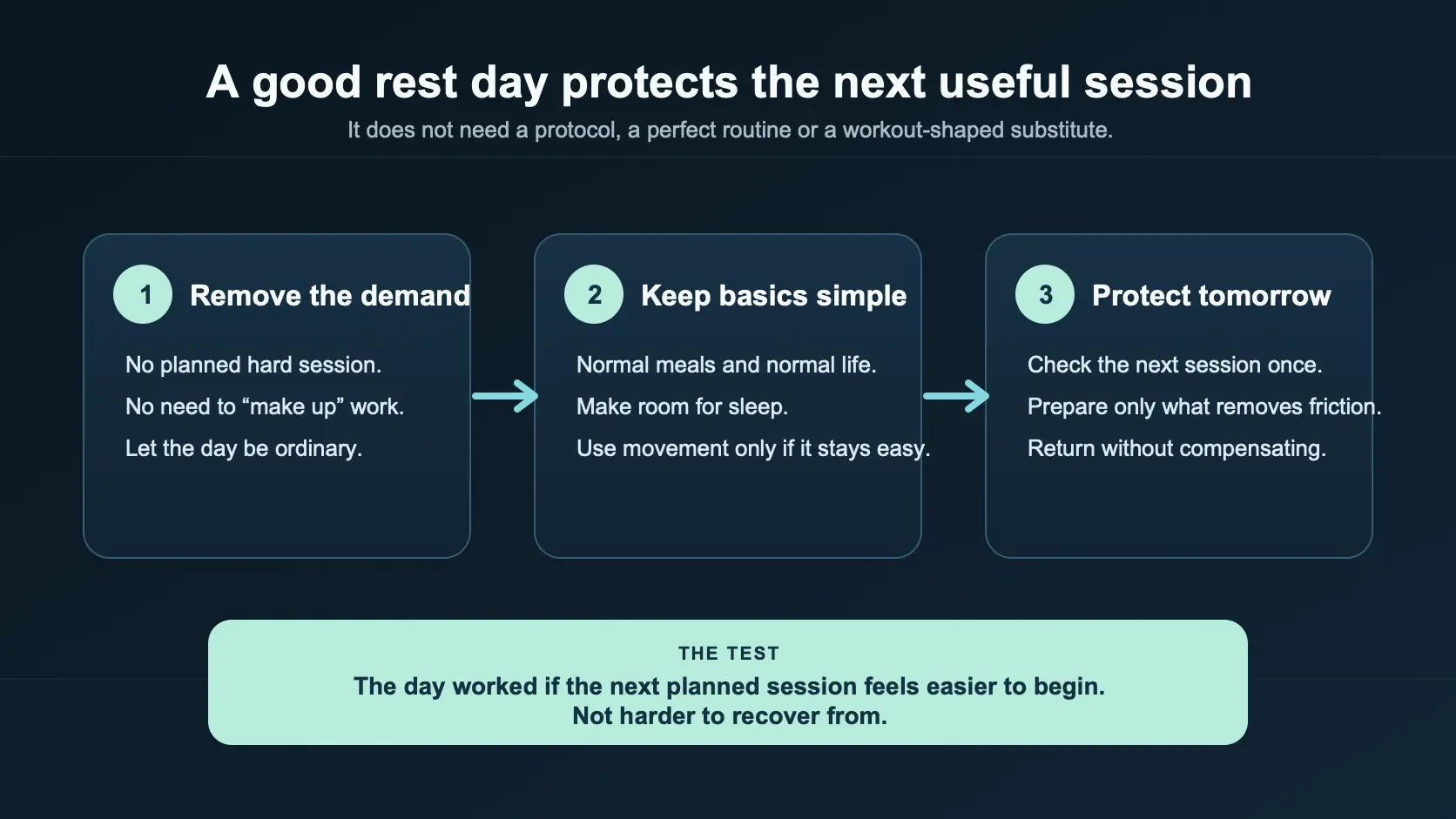
A good rest day is ordinary on purpose. Remove the planned workout demand. Keep meals, sleep opportunity and life logistics simple. Move lightly only if it remains low-cost. Prepare one small thing for the next session, then let the day be a day.
The strongest sign that it worked is not a smartwatch score or a complicated ritual. It is a next session that feels easier to start, easier to organize and worth doing well.
FAQ
Should I do nothing at all on a rest day?
Not necessarily. Normal life, errands and easy movement can fit perfectly well. The useful boundary is that there is no training-performance task attached to the day.
Is it bad to feel sore on a rest day?
Ordinary soreness can happen after training, but it does not require a special protocol. Keep choices low-cost and avoid pushing through sharp, worsening or concerning symptoms. Seek individual advice when symptoms do not fit an ordinary training response.
Should I eat less on a rest day?
Do not use the rest day as a reason to punish or reward yourself with food. Normal meals that fit your routine are usually more useful than turning the day into a compensation exercise.
Continue with a related guide
For the choice between easy movement and complete rest, read Active Recovery vs Doing Absolutely Nothing. If the whole training week is repeatedly too demanding, continue with When Your Program Is Asking for a Deload.