

Jay Cutler’s first Mr. Olympia title is often told as a clean underdog moment: he kept showing up until he finally beat Ronnie Coleman. The outline is true, but it leaves out what made the result unusual. Cutler was not an unknown challenger who appeared once at the right time. He had already spent years near the top of the sport, won other major contests and finished runner-up to Coleman four times before winning the Olympia in 2006.
That longer view makes the story better. It is not proof that persistence automatically earns a title. Sport does not work that way. It is a record of repeated contention: an athlete staying visible in the same difficult contest while the reigning champion set an extraordinarily high reference point.
This is a historical profile, not a training prescription. Professional bodybuilding involves contest-specific preparation, resources and tradeoffs that do not translate into a normal gym program. The useful lesson is about time, competitive context and keeping one result from becoming the whole story.
- The runner-up years behind the headline
- Why other wins still mattered
- What it meant to challenge an eight-title champion
- Why 2006 was a change of era, not a shortcut
- The useful lesson for ordinary lifters
The first close result did not end the story
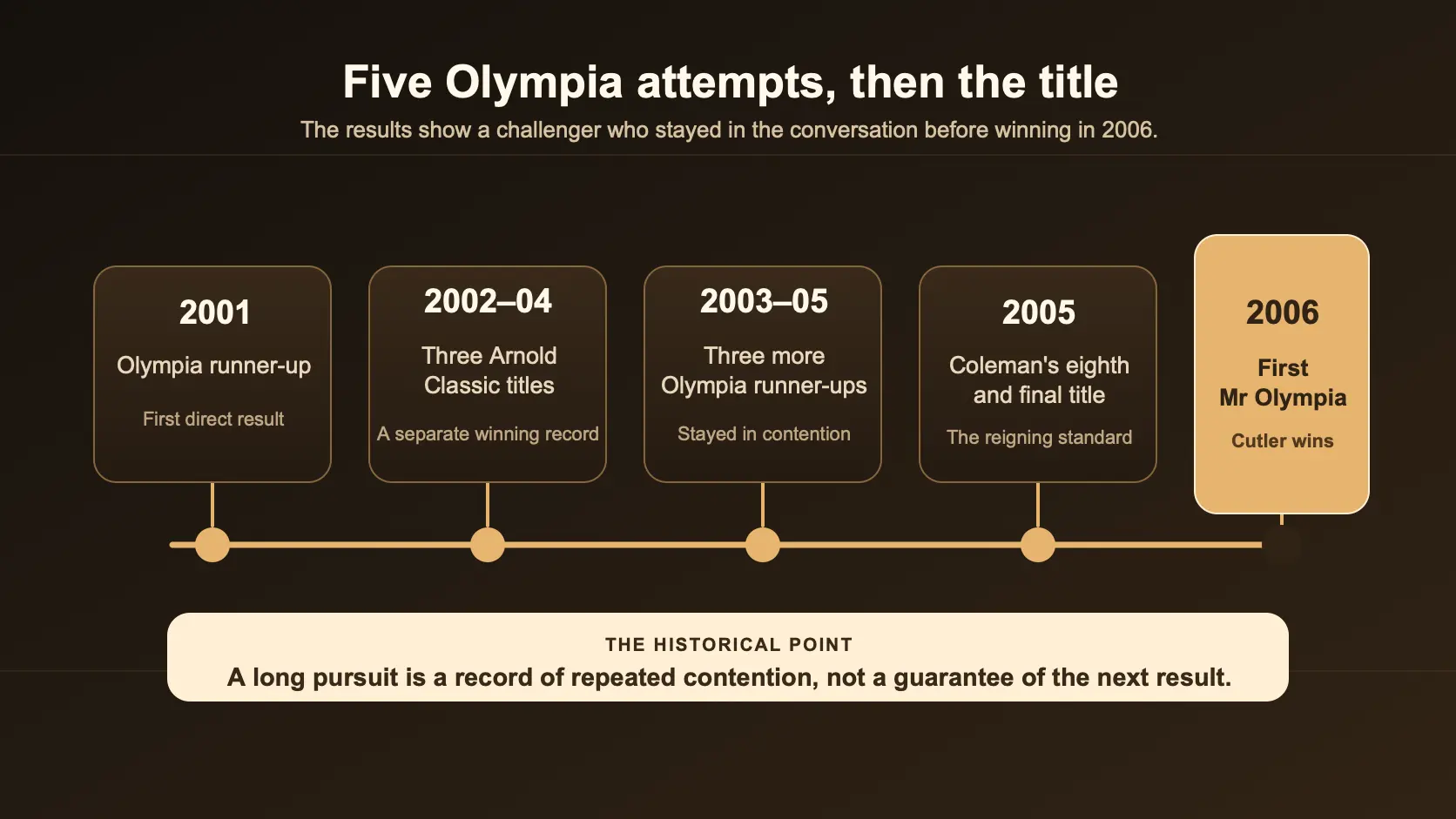
Cutler finished second at the 2001 Mr. Olympia behind Coleman. That result was important because it placed a rising competitor beside a champion who had already won three consecutive Olympia titles. It did not make Cutler the automatic next winner. It made him part of the contest’s central conversation.
The important part is what followed. Muscle & Fitness records Cutler as runner-up at the Olympia in 2001, then again in 2003, 2004 and 2005, before the 2006 win. Four second-place finishes can sound like one repetitive statistic. In practice, they show a competitor returning to the same visible test across several seasons instead of disappearing after a near miss.
That is why the phrase “it took years” is more accurate than a simple defeat-and-revenge story. A runner-up result records where an athlete finished on one day; the longer sequence shows Cutler remained a serious challenger.
The Arnold wins kept the record from becoming a waiting room
Cutler’s career between Olympia challenges was not defined only by second place. His official biography lists Arnold Classic titles in 2002, 2003 and 2004, alongside his 2006, 2007, 2009 and 2010 Olympia titles. Those Arnold wins are a separate part of the competitive record. They show that the years before his first Sandow included major victories, not simply a long pause before one breakthrough.
That distinction matters for any sports story. A narrow view treats only the biggest contest as real progress and everything else as failure. A better view notices the full record: the athlete was winning high-level events while still trying to clear the sport’s highest bar. The Olympia title changed his place in history, but it did not create the entire career from nothing.
Coleman was not an ordinary standard to chase
To understand the length of Cutler’s pursuit, you also have to understand the opponent. The official Mr. Olympia winners archive lists Ronnie Coleman as champion every year from 1998 through 2005. By the time Cutler won in 2006, Coleman had completed an eight-title run, tying Lee Haney’s all-time record for consecutive Olympia victories.
That does not require a verdict on who had the better physique or which Olympia result was “most deserved.” Those arguments belong to fans, and they usually turn a complex judging process into a definitive ranking. The factual point is enough: Cutler spent the early 2000s competing against a champion whose repeated wins had become the sport’s immediate reference point.
For Coleman’s side of the era, read Ronnie Coleman: From Police Officer to Bodybuilding Icon. The article explains why the eight-title record is bigger than a collection of famous training clips. For the champion who came before him, Dorian Yates: How Blood and Guts Changed the Bodybuilding Standard shows how one long reign sets up the expectations faced by the next.
2006 changed the title holder, not the past
The official winners archive identifies Cutler as the 2006 Mr. Olympia winner and Coleman as the 2005 winner. That sequence is the reliable foundation for the headline: Cutler finally won the contest after years of competing against Coleman at its center.
The 2006 result did not erase Coleman’s eight titles, and it did not turn Cutler’s earlier runner-up finishes into wasted seasons. It did something more interesting. It changed the person holding the title while making the years before that change matter even more. The long pursuit became part of the achievement because the contest record gives it a beginning, a middle and a clear outcome.
Cutler defended the title in 2007, then later added titles in 2009 and 2010, according to his official biography. That later record prevents another shortcut in the story: 2006 was not merely one lucky night after a famous rival declined. It began Cutler’s own four-title Olympia chapter.
Cutler’s contest record documents a long competitive pursuit. It does not prove that repeating the same training plan, ignoring feedback or waiting long enough will guarantee anyone else’s breakthrough.
What ordinary lifters can take from a professional rivalry
The practical lesson is not “never quit” in the abstract. Persistence without reflection can become stubbornness, and professional contest history is not a template for everyday training. The useful idea is narrower: do not judge a multi-year goal entirely through one result.
For a recreational lifter, that might mean looking at the training log instead of one bad session. You may be getting more consistent with a program, setting up a lift more reliably or recovering better between sessions even if the bar has not moved dramatically this month. Those smaller indicators are not equivalent to winning a title, but they are the kind of information that helps you decide whether the process is working.
The program still needs a structure you can repeat. The Anatomy of a Great Strength Program provides the practical counterweight to a story about elite sport: select movements with a purpose, use a manageable amount of work, progress with context and leave room to adapt. That framework is less cinematic than an Olympia stage, but it is useful in a real week.
Conclusion
Jay Cutler’s 2006 victory matters because it came after a visible, documented pursuit. He placed second to Ronnie Coleman four times, built a separate record with three Arnold Classic wins, and eventually became the new Mr. Olympia after Coleman’s eight-year reign.
The story is not a promise that effort always produces the desired ending. It is a reminder that a long record can contain more than one meaningful result. Sometimes the most accurate way to understand a breakthrough is to look at all the work and all the placings that came before it.
FAQ
How many times did Jay Cutler finish second to Ronnie Coleman at the Olympia?
Four times: 2001, 2003, 2004 and 2005. Cutler then won his first Mr. Olympia title in 2006.
Did Jay Cutler win major shows before his first Olympia title?
Yes. His official biography lists Arnold Classic titles in 2002, 2003 and 2004 before his first Olympia win in 2006.
Did Jay Cutler only win the Olympia once?
No. His official biography lists four Mr. Olympia titles: 2006, 2007, 2009 and 2010.
Continue with a related story
For the reign Cutler ended, read Ronnie Coleman: From Police Officer to Bodybuilding Icon. For another long title era and the standard it created, continue with Lee Haney: The Era of Size, Shape and Eight Olympia Titles.