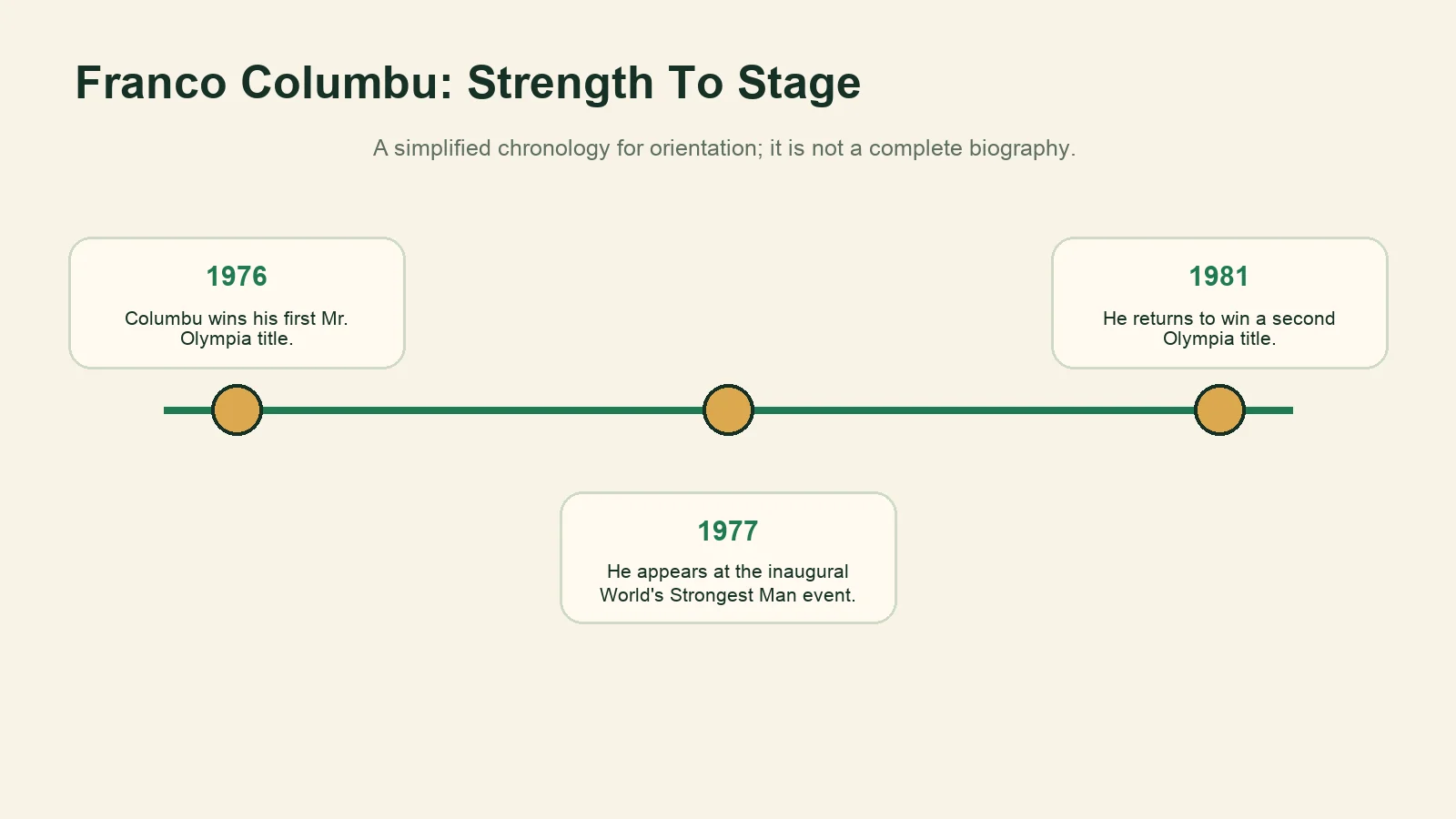
Franco Columbu is often introduced through contrast: compact next to larger rivals, a strength athlete in bodybuilding, a longtime figure in the golden-era story, and a champion whose second Olympia win arrived years after his first. The contrast is real, but it can turn a complicated career into a motivational poster. The factual core is more useful: Columbu won Mr. Olympia in 1976 and 1981, and he also appeared in the inaugural World’s Strongest Man contest in 1977.
That combination makes his history interesting because it connects several strands of physical culture without confusing them. Bodybuilding, strongman-style events, and general strength training overlap in tools and communities, but they demand different things. Columbu’s story is an opportunity to keep those distinctions visible.
- The two-title record
- Why crossover is not sameness
- The return in 1981
- How to use the story responsibly
Two Olympia wins, five years apart
The official Mr. Olympia winners archive lists Franco Columbu as winner in 1976 and again in 1981. The spacing is part of the story. The first win places him at the end of one competitive sequence; the second places him after several seasons in which other champions held the title. It is a genuine return, not a continuous reign.
The Muscle & Fitness retrospective recounts Columbu’s early background in Sardinia and his movement through boxing and strength-oriented activities before bodybuilding. The page is a retrospective, so it should be read as historical context rather than as a complete primary record. The contest dates are therefore anchored by the official Mr. Olympia winners archive rather than by memory or later promotional copy.
What the record does establish is that Columbu was not only remembered for association with a famous era. He had two specific contest wins, separated by time and changing competition conditions. That is enough to justify the title "champion" without inventing a more dramatic version of the path.
Why the strength crossover matters
Columbu appeared in the inaugural World’s Strongest Man event in 1977. That fact is often used to imply that every kind of strength is interchangeable. It is not. A bodybuilding stage rewards a judged presentation. Strongman-style events test particular tasks under particular rules. Powerlifting tests a different set of lifts. General strength training can support all of them while still being its own practice.
The better lesson is that a serious athlete can move between adjacent cultures when they have enough relevant skill, preparation, and opportunity. It does not mean that a lifter should add every discipline to a program or mistake novelty for versatility. The demands should drive the plan.
This distinction is especially important online, where clips of unusual feats travel faster than information about preparation and risk. Historical stories can inspire curiosity, but an unfamiliar event is not automatically a sensible session for a reader. Choose training that matches your equipment, experience, recovery, and desired outcome.
The value of a return narrative
The 1981 win is compelling because return stories always are. They suggest persistence, adaptation, and unfinished business. But a responsible version has to leave room for uncertainty and context. A comeback is not a guarantee that effort alone produces the same result for everyone. Elite competition also involves access, timing, judging, injury history, support, and circumstances that an audience may never see.
That does not make the result less meaningful. It makes it more credible. Columbu’s two Olympia titles are a better story because they are separated by real time. Instead of forcing a smooth rise, the record shows a career with distinct chapters.
What everyday lifters can take from it
First, specify the discipline before you specify the exercise. "Getting stronger" is not wrong, but it is incomplete. Are you training for a lift, a sport, a physique goal, daily capability, or a competition? The answer changes what good practice looks like.
Second, appreciate crossover without chasing every challenge. A broader strength culture can make training more interesting, but good programs are selective. The best exercise is not the most dramatic one. It is the one that helps the current goal while you can execute it safely and recover from it.
Third, treat comeback stories as context rather than pressure. A training interruption does not erase a person’s identity. Returning can be worthwhile, but it should start from present capacity, not from a demand to recreate an old performance immediately.
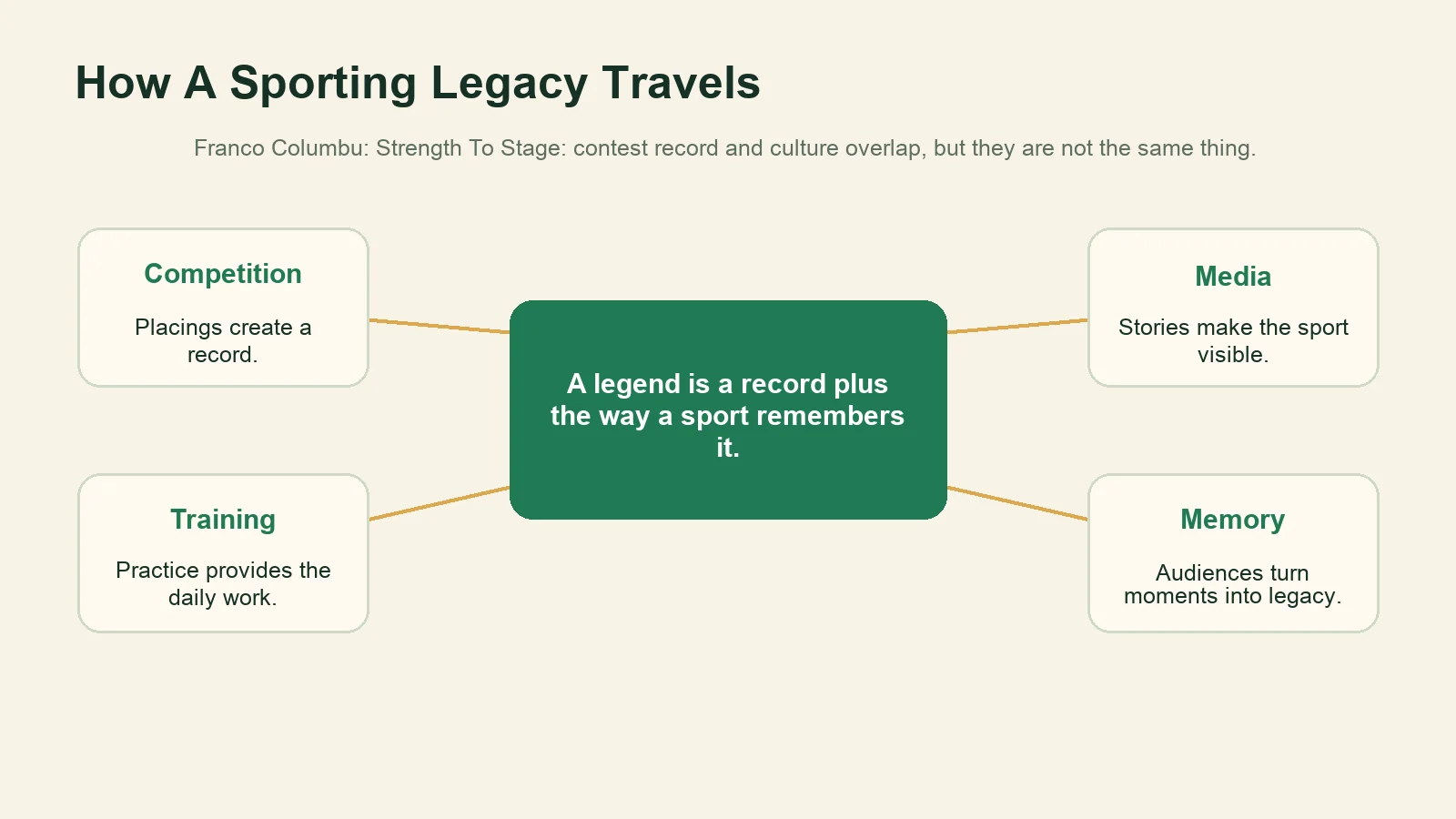
The word "unlikely" in a sports title should not mean that a champion was a novelty. It should point to the shape of the career: a person whose story does not fit one clean category and whose two wins were separated by time. Columbu’s record is useful precisely because it makes simple comparisons less satisfying. A competition result can be real without proving that one body type, one sport, or one training culture is superior to every other.
That is also why the story works best when it avoids a catalogue of spectacular claims. The lasting facts are enough: two Olympia wins, a documented appearance in a different strength event, and a career remembered across several parts of physical culture. Readers do not need a fabricated program or a superhuman moral to learn from that. They need a reminder that good training questions begin with the task in front of them, not with the most dramatic story they have seen.
In that sense, the career is a prompt for precision. Name the task, respect its demands, and let progress be measured by work that fits the task. That is more durable than treating any famous athlete as a universal answer.
Continue with a related guide
For the next practical step, read Frank Zane: How Aesthetics Became a Different Kind of Dominance. For a second perspective from the same topic cluster, continue with From Muscle Beach to Gold’s Gym: Where Modern Gym Culture Took Shape.
Conclusion
Franco Columbu’s story is compelling because it contains more than one category: strength culture, bodybuilding, competition, interruption, and return. The two Mr. Olympia wins in 1976 and 1981 remain the fixed points. Everything else should be read around them with care.
The practical lesson is not to imitate a legend’s career. It is to understand that adjacent disciplines can inform one another while still requiring their own standards, preparation, and patience.