

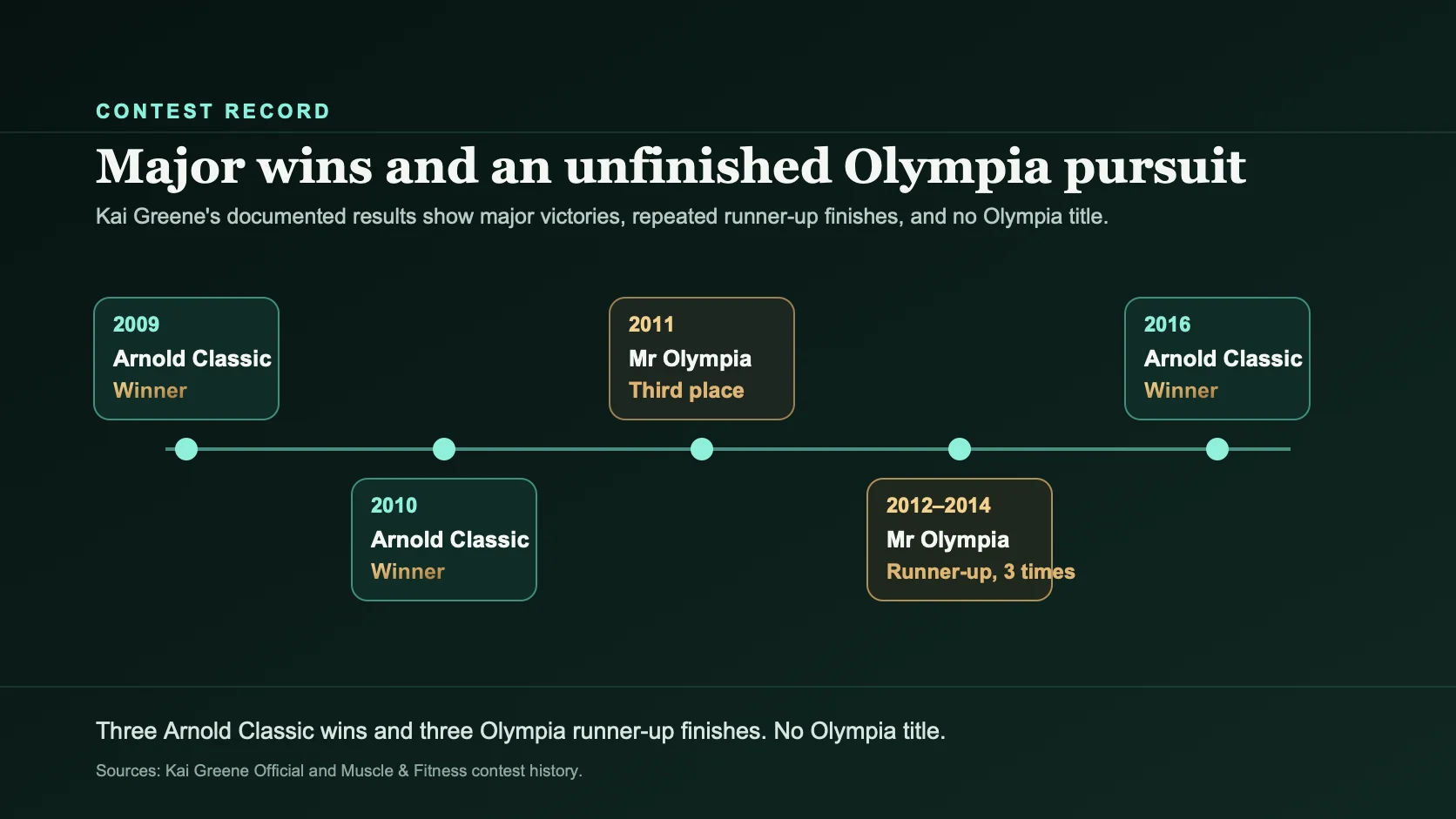
Kai Greene never won the Mr. Olympia. That point should not be softened, because it is central to his record. It is also not the whole record. He won the Arnold Classic three times, placed third at the Olympia in 2011, and finished runner-up in three consecutive Olympia contests from 2012 through 2014.
That combination explains the title of this story. Calling Greene a champion does not mean rewriting him into an Olympia winner. It means reading the career he actually had: a decorated professional record with major wins, repeated proximity to the sport’s most visible title, and one clear line he never crossed.
This is a historical profile, not a guide to contest preparation. Professional bodybuilding involves conditions, resources, training histories, and presentation demands that do not translate neatly to a normal gym program. The useful part for most readers is learning how to read a competitive record without reducing it to one missing trophy.
- The major wins behind the label
- An honest Olympia record
- Why three runner-up finishes matter
- The limit of the comparison
- A smaller lesson from a large career
The major wins behind the label
Greene’s official biography lists Arnold Classic victories in 2009, 2010, and 2016. The official Kai Greene site is the right source for that career summary because it is presenting his own professional record. Three wins at that contest are substantial results in their own right. They are not a substitute for an Olympia title, and they do not need to be treated as one.
The distinction matters because bodybuilding history often gets compressed into title counts. That makes the Mr. Olympia the obvious reference point, but it can erase the difference between an athlete who never reached the top level and one who repeatedly won major contests while competing near the top of the Olympia field. Greene belongs in the second group.
His results also show why one word can cause confusion. “Champion” describes somebody who has won meaningful championships. “Mr. Olympia champion” describes a more specific result. Greene was the first; he was never the second. Keeping those labels separate is more respectful to the record than trying to inflate one into the other.
An honest Olympia record
The contest history collected by Muscle & Fitness lists Greene third at the 2011 Mr. Olympia, then second in 2012, 2013, and 2014. Those are the placements that frame the question around his career. He was close enough to the title to make the absence notable, but the result never changed to first place.
There is no need to turn those finishes into an alternate history. Contest results tell us who won each year, not what a different judging panel might have decided or what an athlete deserved in a hypothetical contest. Greene’s three second-place finishes are meaningful because they were recorded at the highest-profile contest in the sport. They are still second-place finishes.
That balance is harder to hold than it sounds. A profile can flatten the record into “he never won,” or it can treat runner-up results as though they were a title in disguise. Neither reading helps. The first ignores major victories and a sustained run near the top. The second erases the exact result that makes the story distinctive.
Why three runner-up finishes matter
Three consecutive runner-up results suggest more than one unusually good night. They show that Greene returned to the same stage and stayed in serious contention across successive seasons. That is a historical observation, not a prescription for how anyone should train. It says nothing by itself about the best split, diet, supplement plan, or training volume for a recreational lifter.
The timing also gives his record context. Phil Heath won the Mr. Olympia in 2011 and then defended the title through 2017. Phil Heath: The Rise of The Gift covers the documented seven-title run that overlaps Greene’s runner-up years. The comparison should remain narrow: Heath won those specific Olympia contests, while Greene placed second in 2012, 2013, and 2014.
This is where long records are useful. A single placing can invite endless argument. A sequence of results gives history a firmer shape. Greene’s career contains a run of Arnold wins, a third place at the Olympia, and three runner-up finishes. Those facts can coexist without one cancelling the others out.
The limit of the comparison
Olympia history is full of careers that are remembered through a single number. Seven titles define Heath’s era; eight titles define the records held by Lee Haney and Ronnie Coleman. Lee Haney: The Era of Size, Shape and Eight Olympia Titles and Ronnie Coleman: From Police Officer to Bodybuilding Icon show how title runs become the short form for a wider body of work.
Greene’s story does not need to imitate that pattern to matter. His record is useful precisely because it has a different shape. Major contest wins and repeated near-misses at the Olympia show an athlete who was not defined by one breakthrough title, nor erased by its absence.
It is tempting to convert that into a universal lesson about persistence always being rewarded. Competitive sport does not support such a clean promise. Results depend on the contest, the field, the judging, and circumstances that cannot be controlled from one season to the next. The more honest point is smaller: a career can be significant even when it falls short of its most visible goal.
A top professional result can explain why an athlete is remembered. It does not make elite contest preparation a model for an ordinary gym routine.
A smaller lesson from a large career
For everyday training, Greene’s results are not a reason to copy a professional bodybuilder. They are a reminder that progress is better judged as a sequence than as one all-or-nothing moment. A productive program is usually built around work you can repeat, review, and adjust, rather than a single session designed to prove something.
That is a modest comparison, but it is the useful one. The aim is not to turn an ordinary training block into a contest season. It is to notice whether your choices create continuity. The Anatomy of a Great Strength Program explains how clear goals, manageable volume, and deliberate progression make that continuity easier to evaluate.
Kai Greene’s career remains notable because the record is specific. Three Arnold Classic wins. A third place at the 2011 Olympia. Three runner-up finishes from 2012 through 2014. No Mr. Olympia title. The final line does not diminish the rest. It gives the rest of the story its honest shape.
FAQ
Did Kai Greene win Mr. Olympia?
No. Kai Greene never won the Mr. Olympia title.
What were Kai Greene’s best Mr. Olympia results?
Greene placed second at the Mr. Olympia in 2012, 2013, and 2014. He also placed third in 2011.
How many Arnold Classic titles did Kai Greene win?
Kai Greene won the Arnold Classic three times: 2009, 2010, and 2016.
Continue with a related story
For the champion who won the Olympia during Greene’s runner-up run, read Phil Heath: The Rise of The Gift. For another career shaped by a long pursuit of the title, continue with Jay Cutler: The Years It Took to Finally Beat Ronnie Coleman.