Hook grip has an unusual reputation: useful, secure and memorable for all the wrong reasons. The basic idea is simple. Your thumb goes around the bar first, then your fingers close over it. The bar is held against the thumb rather than relying only on the fingers to stay closed.
For some lifters, the limiting factor is not understanding the grip. It is the first few sessions of contact between a knurled bar and a thumb that is not yet used to it. That is where thumb tape can earn its place. It is a small, inexpensive detail that may make practice more tolerable, especially while the grip is new. It is not a promise that hook grip will feel comfortable, and it is not a substitute for building exposure gradually.
- What thumb tape is actually for
- What a simple wrap should and should not cover
- How to test tape before heavy work
- When tape is not the answer
The tape protects a contact point, not the whole lift
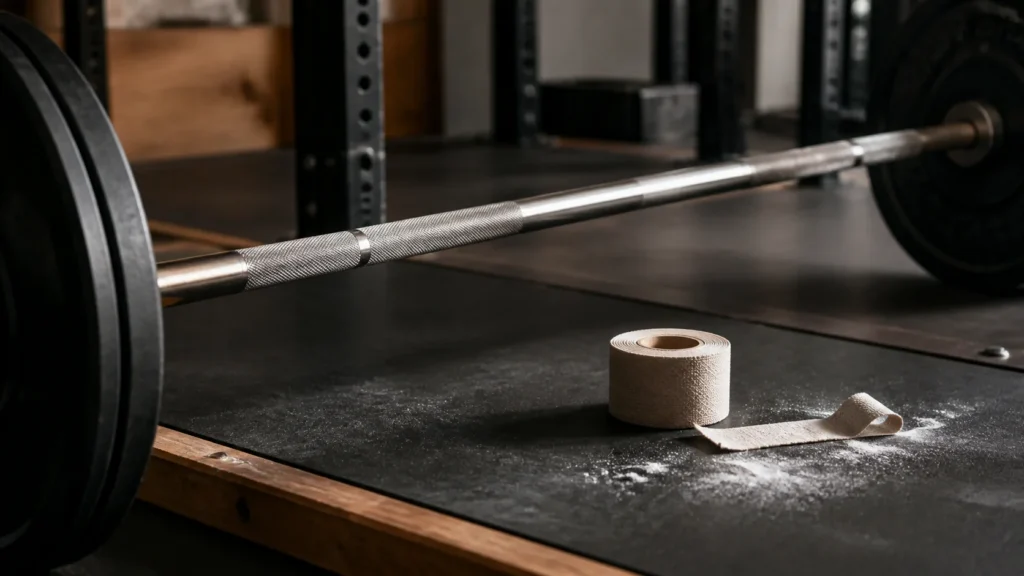
Thumb tape is usually athletic tape, cut or torn into a narrow strip and wrapped around the part of the thumb that sits under the fingers and against the bar. Its practical job is modest: reduce the direct rubbing and help the skin tolerate repeated contact. It does not make the thumb stronger overnight, correct a loose setup or guarantee that the bar cannot move.
That distinction matters. Hook grip itself changes how the hand interacts with the bar. In a small study of resistance-trained athletes, researchers compared hook, mixed and double-overhand grips during deadlifts at several loads. The grip-type study found differences in forearm muscle activity and perceived technical difficulty, while bar velocity was not significantly changed by hand orientation. It is useful context for learning the grip, not evidence that every lifter should switch or tape their thumbs.
If you are interested in the deadlift as a skill rather than just a test of hand tolerance, start with The Big Three: Why the Squat, Bench and Deadlift Still Rule Strength Training. Grip is one part of a lift that also depends on setup, bracing, bar position and a load you can control.
Use enough tape to protect the bar contact area
The best tape job is usually less dramatic than the first one you see online. You want enough coverage over the thumb pad and the area where the fingers pinch the thumb, but not so much bulk that you create a slippery, oversized handle.
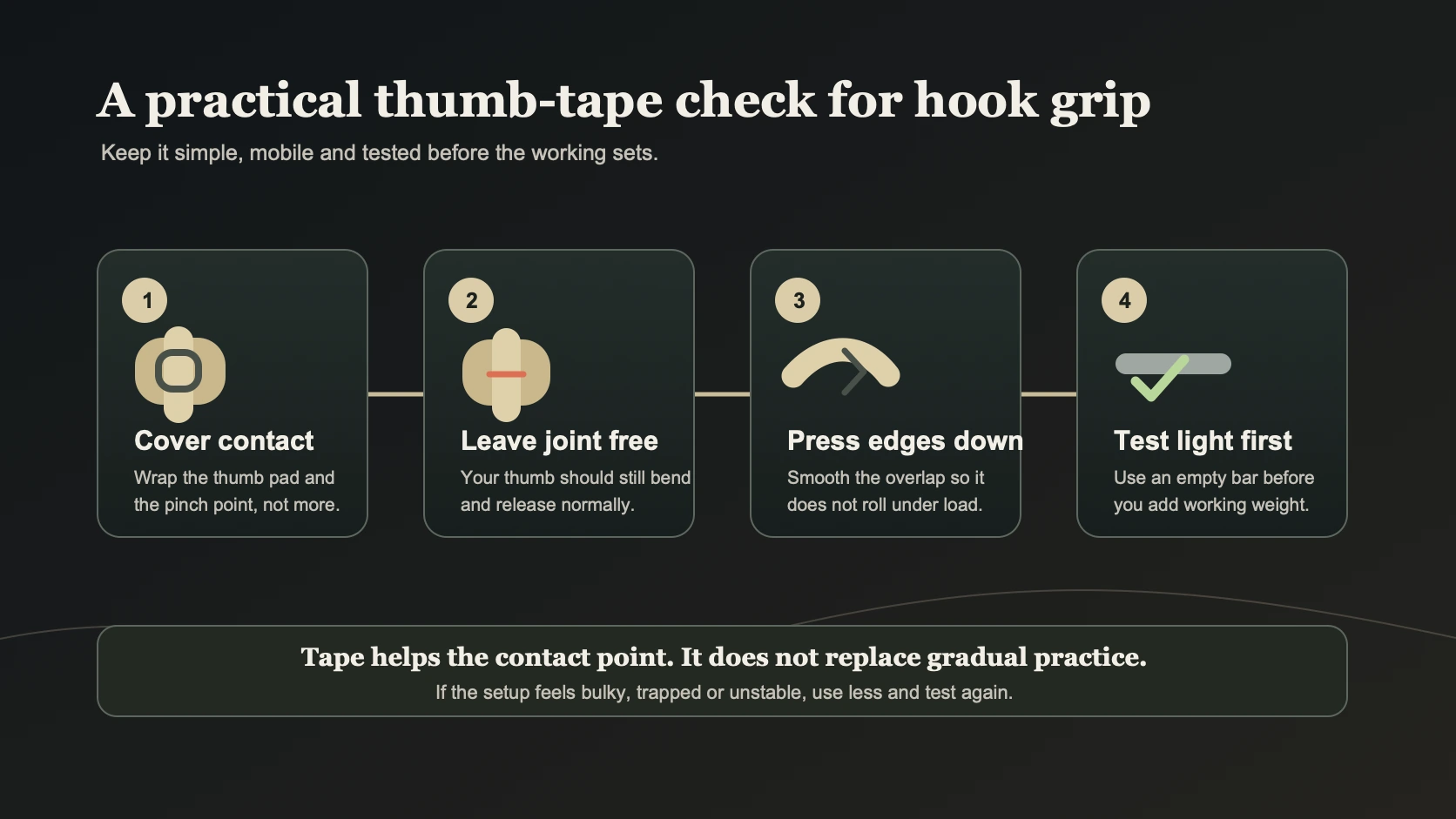
Start with a narrow strip. Wrap it snugly around the lower and middle part of the thumb, smooth the edge down, then close your hand as if you were taking the bar. The thumb should still bend and you should still be able to feel whether the bar is sitting where you expect. If the tape bunches at the thumb joint, unwrap it and use less.
Some lifters prefer rigid tape because it stays in place well. Others prefer a slightly more flexible option when they want the thumb to move more freely. There is no universal best brand or width. The useful choice is the one that stays put for your planned work, does not create a new pressure point and can be removed without turning post-training cleanup into a project.
Test the setup with an empty bar first
Do not discover that a tape edge is peeling during a heavy top set. Wrap the thumb before the session, then take a few empty-bar or light warm-up reps. Notice three things:
- Does the tape stay flat when the fingers close over the thumb?
- Can you release the bar normally after each rep?
- Does the bar sit in the same place on both hands?
If the answer is no, change the tape before adding weight. A smaller strip, a slightly different starting point or a cleaner overlap is usually more helpful than adding another full layer. The goal is not to armour the thumb. It is to make a repeatable grip feel less distracting.
This trial-and-adjust approach fits the wider principle in The Powerlifter’s Gear Guide: gear earns its place when it makes a known task more repeatable or more compatible with a rule set. Thumb tape is useful when it lets you practise a grip you have already chosen, not when it becomes a reason to jump to a load your technique has not earned.
Check the rules if you compete
For ordinary training, your gym’s rules and your own comfort are the immediate concerns. For a sanctioned meet, equipment rules are more specific. The International Powerlifting Federation’s current technical rulebook states that the deadlift may be gripped with an optional grip, but meet-day rules also cover equipment, inspection and execution. Read the rulebook for your own federation rather than assuming that a training habit is automatically allowed in competition.
That is the same reason to treat any accessory as a small logistical detail before a meet. Your First Powerlifting Meet: The Gear That Actually Belongs in Your Bag is a better place to build the full checklist. Tape belongs in the bag only after you know that it is permitted and you have already used it in training.
When tape is not the answer
Tape cannot make a grip ready before the hand is ready to practise it. If hook grip feels completely unfamiliar, begin with a few light warm-up sets or a controlled accessory pull rather than using it for every heavy set on day one. You can also use double-overhand grip for lighter work and decide where hook grip belongs in the session.
Stop and reassess if you feel sharp pain, unusual loss of sensation, or a problem that does not settle after training. For persistent or concerning symptoms, get advice from an appropriately qualified clinician. A grip experiment should never turn a routine session into a reason to ignore a problem.
Mixed grip, straps and hook grip all solve different practical problems. None of them is a badge of seriousness. Choose the option that matches the lift, the context and the rules you are training under. If thumb tape helps you learn hook grip without making it the center of the workout, it has done enough.
FAQ
Should beginners use thumb tape for hook grip?
They can, but beginners do not need hook grip to make progress. Start with manageable loads and a simple grip setup. Add tape only if you are deliberately learning hook grip and it helps the contact point feel manageable.
How tight should thumb tape be?
Secure enough that the edge does not roll when you close your hand, but not so tight that the thumb feels trapped or the joint cannot move normally. Test it with an empty bar before working sets.
Does thumb tape make hook grip pain-free?
No. It may reduce rubbing for some lifters, but it does not erase the pressure of the grip. Treat it as a practical comfort detail, not a cure.
Continue with a related guide
For the movement behind the grip, read The Big Three: Why the Squat, Bench and Deadlift Still Rule Strength Training. For a broader framework for choosing lifting accessories, continue with The Powerlifter’s Gear Guide.