

You do not need to love every workout. That sounds obvious until a bad session arrives. Then many people start questioning the whole plan. If training feels boring today, maybe the program is wrong. If the gym feels heavy, maybe discipline is gone. If the workout is not enjoyable, maybe fitness is not for them.
That is too much meaning to put on one session. Long-term training includes great workouts, ordinary workouts, frustrating workouts, and workouts that are simply completed. Enjoyment matters, but it does not have to be present at maximum volume every time.
The healthier goal is to build a training relationship you do not resent. Some sessions can be satisfying. Some can be neutral. Some can be shortened. All of them can still teach you something about the plan.
- Why enjoyment matters
- Why every workout cannot feel great
- How to handle neutral and bad sessions
- When lack of enjoyment is a warning sign
Enjoyment helps, but it is not the only measure
Enjoyment is not shallow. If you hate every part of your training, consistency becomes harder. More autonomous reasons for exercise are generally linked with better exercise behavior, according to a systematic review on self-determination theory and physical activity. People tend to do better when activity connects to values, competence, and choice rather than pure pressure.
But enjoyment is not the same as entertainment. A workout can be meaningful without being exciting. Strength training often includes repetition: similar movements, gradual progress, rest periods, and technique practice. Some of that work is rewarding because of what it builds, not because every minute is fun.
Think of training like brushing teeth, cooking, studying, or saving money. It is better if the process is not miserable, but the value is not erased when the task feels ordinary.
Normal sessions are allowed to feel neutral
A neutral workout is not a failed workout. It is a session where you show up, do the work, and leave without fireworks. Many useful sessions feel like this.
Neutral days are important because they lower the emotional requirement for consistency. If every session must feel inspiring, you will need a lot of emotional fuel. If a session is allowed to be plain and useful, training becomes easier to repeat.
This matters for beginners especially. Early on, people often expect a dramatic feeling after every workout. Sometimes that happens. Sometimes the reward is quieter: you learned the movement, kept the appointment, and made next week more likely.
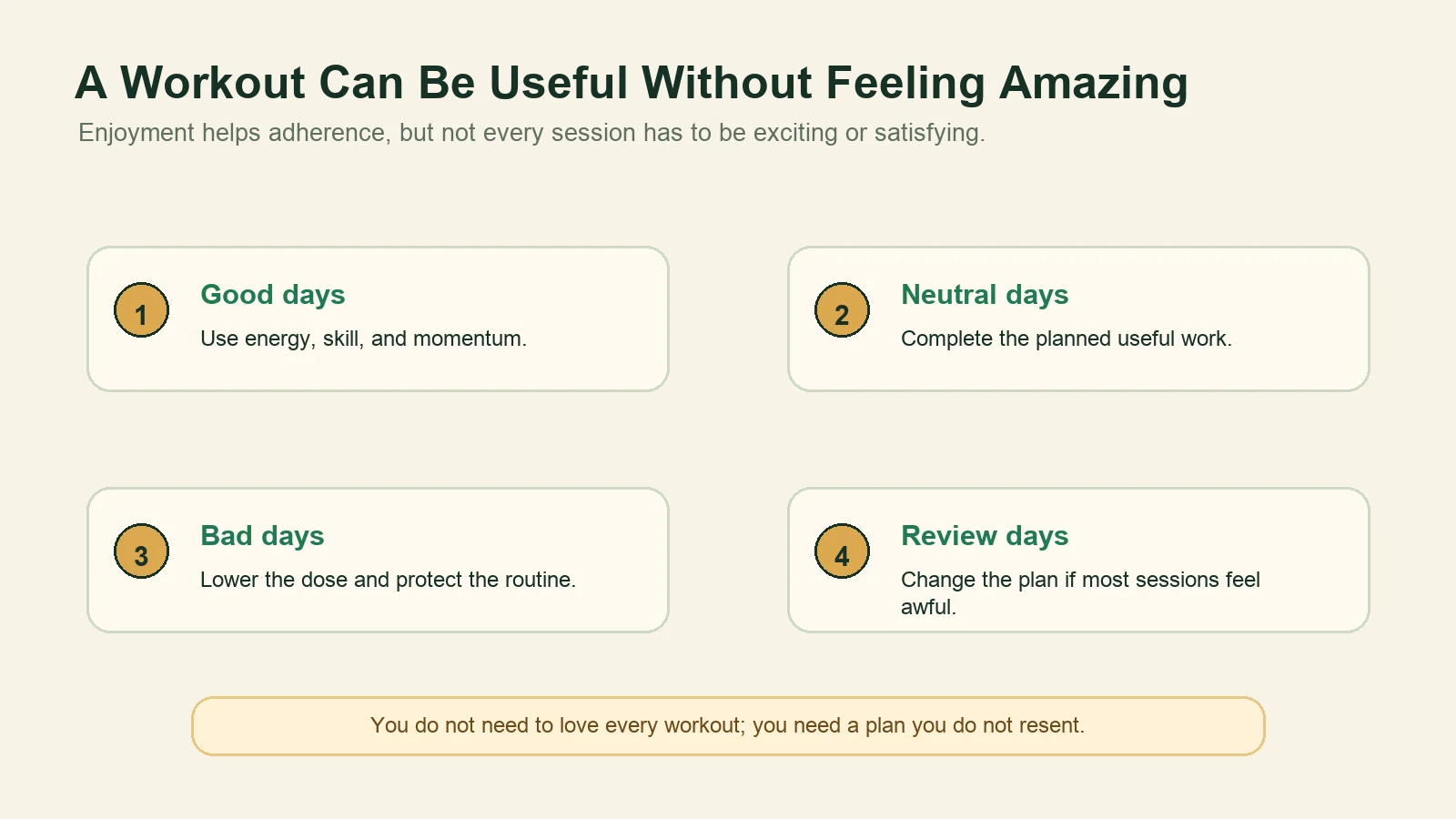
Bad sessions need adjustment, not identity crisis
A bad workout can happen for simple reasons: poor sleep, stress, hunger, a crowded gym, a rushed warm-up, soreness, or a program that is currently too demanding. Do not turn one bad session into a referendum on who you are.
Instead, review it like data:
- Did I sleep enough?
- Did I eat normally?
- Was the load too heavy for today?
- Did I rush the warm-up?
- Is this the third bad session in a row?
- Is there pain or a safety concern?
If it is one bad day, adjust and continue. If it is a pattern, the plan may need changing. You might need less volume, different exercise choices, more recovery, a better training time, or a clearer goal.
The CDC physical activity guidance gives broad weekly movement targets, but it leaves room for many formats. That flexibility is useful. You do not have to force one version of training if another safe version fits your life better.
Make workouts less miserable before demanding more discipline
If you regularly dread training, do not jump straight to self-criticism. Look at the design.
Common fixes include:
- reducing session length;
- choosing exercises that fit your body better;
- training at a less stressful time;
- using a beginner-friendly progression;
- leaving one or two reps in reserve instead of turning every set into a battle;
- adding a form of cardio or movement you actually tolerate;
- training with someone supportive if that helps.
These changes are not cheating. They are ways to make the plan more repeatable. Habit formation is easier when the behavior has a stable cue and a realistic size. A real-world habit formation study found that automaticity developed gradually with repeated behavior in consistent contexts. A plan you dread is less likely to get enough repetitions to become familiar.
Use satisfaction after, not excitement before
You may not feel excited before training. That is fine. A better question is how the session feels afterward. Do you feel steadier? More capable? Relieved that you kept the promise? Proud in a quiet way? Less tense?
That after-session satisfaction can be enough. It is not cinematic, but it is reliable. Many long-term routines are built on the feeling of being glad you did it, not the feeling of wanting to begin.
To support that, finish sessions cleanly. Record what you did. Notice one useful thing. Leave before unnecessary extra volume turns the workout into resentment.
You do not need to love the session. You should be able to respect the plan and understand why the work belongs there.
Know when not loving it is a signal
There is a difference between normal resistance and a plan that is harming your relationship with movement. If training is tied to punishment, body shame, obsessive compensation for food, or constant anxiety, that is not just a mindset issue. It may require support from a qualified professional.
Also pay attention to physical signals. Persistent pain, unusual fatigue, dizziness, or worsening symptoms are not solved by trying to enjoy the workout more. Stop, reduce, or seek appropriate help.
The goal is not blind positivity. The goal is an honest training routine that can include effort, boredom, progress, adjustment, and rest.
Design for more tolerable sessions
You can make training more enjoyable without turning every workout into entertainment. Start by removing avoidable irritation. If you hate crowded evenings, try a different time. If a movement always feels awkward, use a variation that trains the same pattern more comfortably. If long sessions make you dread the gym, build shorter sessions and progress them slowly.
Small positive details also help. Use a playlist, train with a supportive friend, choose a gym route that does not add stress, or end with one movement you usually like. These choices are not superficial if they make the habit easier to repeat.
The goal is not to chase pleasure at every moment. The goal is to build enough satisfaction, autonomy, and comfort that training remains a relationship you can maintain.
Continue with a related guide
For the next practical step, read Your PR Is Someone Else’s Warm-Up – So What?. For a second perspective from the same topic cluster, continue with Consistency Beats Intensity: The Case for Showing Up.
Conclusion
You do not need to love every workout. Enjoyment helps, and a plan should not be miserable, but ordinary sessions are part of long-term progress. Some workouts feel great. Some feel neutral. Some need to be shortened or changed.
The question is not whether every session is exciting. The question is whether the plan is useful, repeatable, recoverable, and respectful of your life. Build that, and training no longer has to win a popularity contest every day.
FAQ
Should I change programs if I do not enjoy training?
Maybe, especially if you dread most sessions. First check whether the problem is exercise choice, volume, timing, recovery, or unrealistic expectations.
Is it bad if workouts feel boring?
Not necessarily. Some productive training is repetitive. Boring becomes a problem when it makes the plan unsustainable or removes all sense of purpose.