The useful amount of gym gear is usually smaller than the amount people imagine before they start. A crowded room can feel like commitment, but a room that makes it hard to begin, set up, or put equipment away is not automatically a better training environment. The purpose of equipment is to support a repeatable training plan. It is not to represent every exercise you might do someday.
This article is a planning guide, not a product review. It does not argue that everyone should train at home or that commercial gyms are unnecessary. It helps you choose a small setup around the movements, schedule, space, and progression method that make sense for you. If pain, balance concerns, medical conditions, or a recent injury affect your choice of exercise or equipment, seek individual professional guidance.
- Build around movement patterns
- Choose versatile equipment deliberately
- Delay upgrades until a real limit appears
- Make the space easy to start and reset
- Audit the gear you already own
Build around movements, not shopping categories
Start by writing the training you want to repeat for the next eight weeks. A general strength plan often includes a lower-body knee-dominant movement, a hinge or hip-dominant movement, an upper-body push, an upper-body pull, and an easy way to log repetitions and load. One piece of equipment can serve several of those tasks. Dumbbells can support squats, split squats, hinges, presses, rows, carries, and accessory work. A resistance band can support rows, pulldowns, presses, and easier or harder movement variations. A bench can be useful, but it is not mandatory for every beginner program.
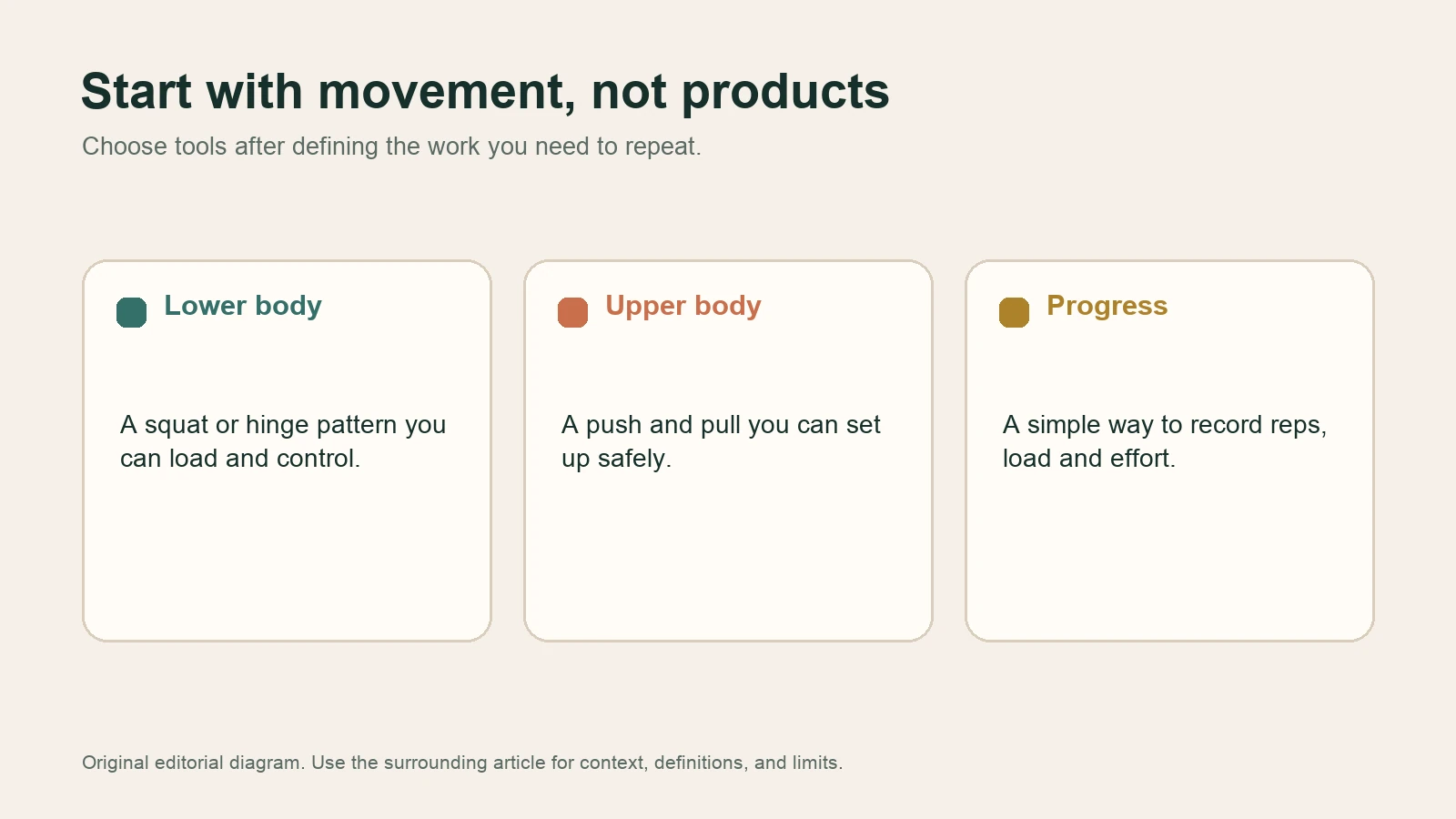
The ACSM position stand on progression models in resistance training is useful because it centers training variables and progression, not a mandatory shopping list. Training status, goals, frequency, load, and volume can be adjusted with many equipment choices. The tool is only useful if you can set it up, use it with control, and progress it in a way that fits your circumstances.
This is why a minimal setup can be valid. You do not need a separate machine or specialty attachment for every muscle group to begin making meaningful training decisions. You need enough options to train the main patterns consistently, adjust the challenge over time, and avoid pretending that novelty is a form of progression. For a broader structure, start with the first 100 days of strength training and choose equipment that matches the plan, not an aspirational catalog.
Use a three-part equipment filter
Before buying, ask whether the item is versatile, usable, and maintainable. Versatile means it serves more than one movement, progression path, or person in the household. Usable means it fits your space, your current ability, and your available time. Maintainable means it can be stored, cleaned, inspected, and kept ready without creating a second project.
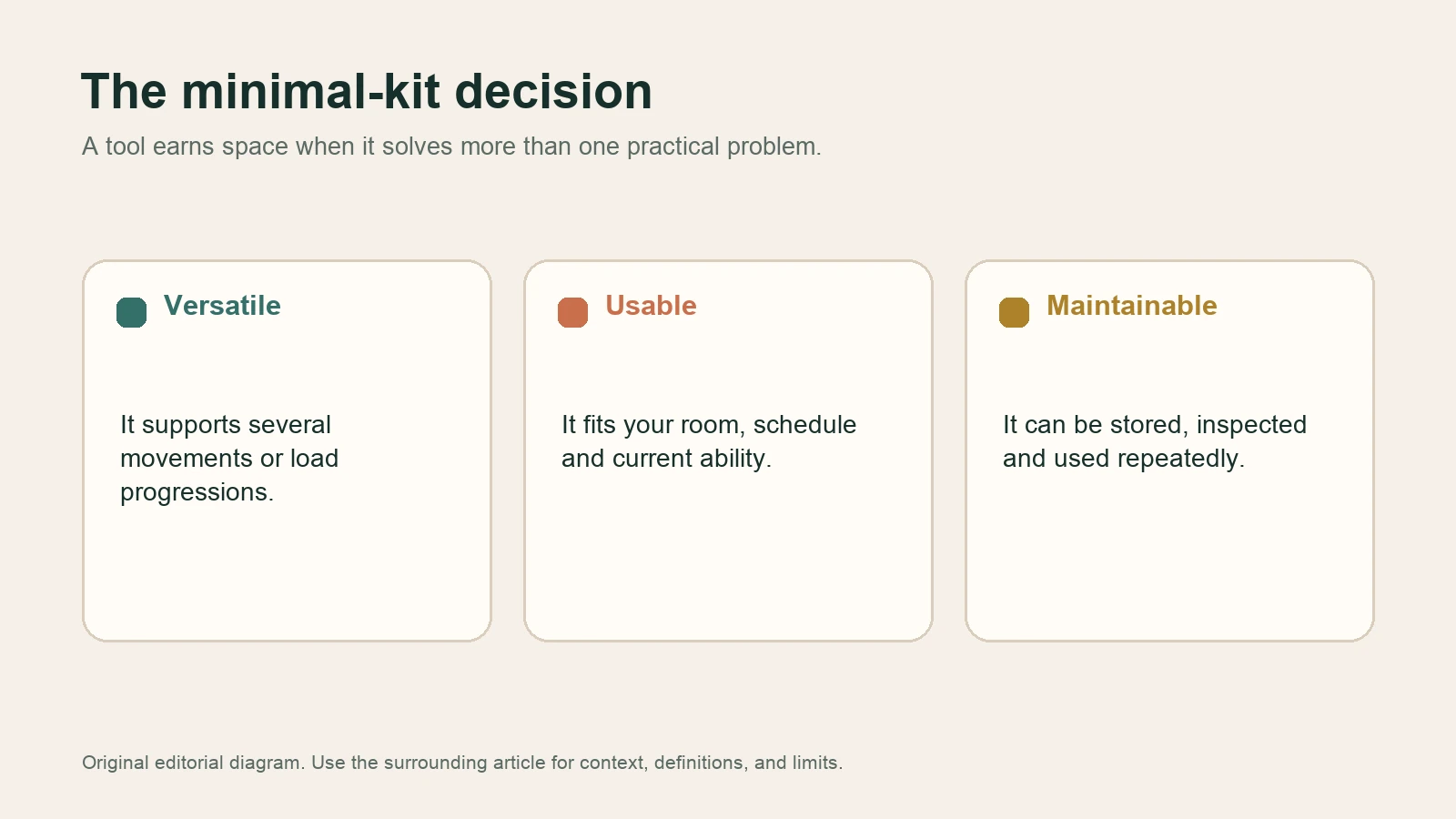
Consider an adjustable dumbbell set. It may be versatile because it covers many exercises and load increments. It may be unusable if changing the load is so slow that it disrupts every session, or if its maximum load ends the progress path for your main lower-body movements immediately. A barbell and rack may be excellent tools, but they may not be maintainable in a small rental, a shared room, or a schedule that requires frequent setup and teardown. There is no universal winner outside the context of the plan.
The 2023 network meta-analysis of resistance-training prescriptions found that multiple prescriptions can improve strength in healthy adults. That does not mean equipment is irrelevant; it means the program is not limited to a single ideal setup. Pick the setup that lets you complete useful work consistently enough to learn from it.
Let the first block reveal the next purchase
The fastest way to accumulate clutter is to solve problems you have not encountered. Instead, choose a basic setup, run it for a training block, and record where it actually becomes limiting. A real limit has a sentence behind it: “I cannot progress this row because the available resistance ends before the target range becomes challenging,” or “I skip sessions because setting up the equipment takes too long.” Those statements lead to a useful comparison.
Compare the smallest change that removes the limit. It may be an additional plate, a more stable bench, a pull-up bar that can be installed safely, a heavier band, or a change in exercise selection. It may also be a different program structure. If sessions run long, adding equipment may not help as much as simplifying the session. If the goal is general strength, your next upgrade does not need to imitate a commercial gym.
Frequency is another place where equipment purchases can become a distraction. The three-versus-six-days resistance-training study found no additional strength benefit from the higher frequency when volume and intensity were equated in trained men. More equipment and more available days do not automatically create a better dose. The plan needs to fit your week first.
Make the space reduce friction
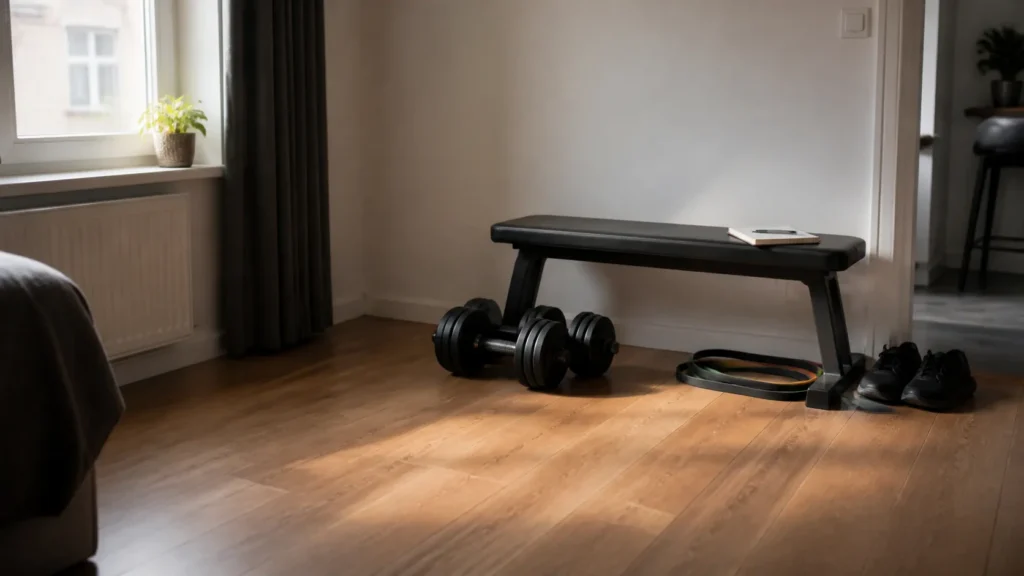
Space changes whether an item gets used. A minimal home setup should leave a clear area to move, a safe surface for the planned exercises, and an easy reset. If equipment must be moved from three closets, assembled, and rehidden before every session, the practical cost is high. If the gear is accessible and the session begins with a short warm-up rather than a long setup ritual, the setup is doing its job.
Think in sequences. Where do you place the training log? How long does it take to get the first exercise ready? Where do weights go after the final set? What happens when another person needs the room? A good setup has boring answers to these questions. The work begins without drama and the room returns to normal without an argument with your future self.
Do not compromise safety to preserve a minimal aesthetic. Equipment needs stable placement, appropriate load limits, and adequate clearance. Follow the manufacturer’s installation instructions for wall- or door-mounted items. Do not improvise anchors, stack unstable surfaces, or assume a floor or furniture piece is designed for impact. Minimal does not mean careless.
Audit what you already own
Once each training block ends, review equipment before buying more. Keep items that had a clear role in the planned sessions. Store items that are genuinely occasional, seasonal, or needed for a known variation. Skip or sell the items that were bought for an imagined routine and never found a place in the actual program. The goal is not purity; it is a space where every visible object has a job.
The best minimal setup is not the same for every person. It is the smallest reliable collection of tools that supports your current program, your current space, and the next sensible progression. Start with movements, let real limits guide upgrades, and give each item a reason to stay. That leaves more attention for the work that equipment was supposed to make possible.
Continue with a related guide
For a practical equipment decision, read Lifting Belts 101: What They Do, What They Don’t and How to Choose One. Then continue with The Belt Question: When Does It Actually Make You Stronger?.