

A lasting training habit is not a workout you perform without thinking. It is a reliable way to begin, even when motivation is ordinary. The habit sits around the session: a cue that reminds you, an environment that makes starting easy, a plan you understand and a response for days when the full workout does not fit.
This distinction matters because strength training is too complex to become completely automatic. Loads, technique and recovery still require judgment. The useful automatic part is arriving and starting the first safe action. Once that happens, the written plan can guide the rest.
- Choose a behavior, not an identity
- Attach it to a stable cue
- Reduce setup friction
- Create a minimum session
- Recover from missed workouts
- Review the habit monthly
Choose a behavior you can observe
“Become disciplined” is not a behavior. “Start my warm-up at 18:30 on Monday and Thursday” is. Build the habit around something you can see and record. The first target might be changing clothes, arriving at the gym or completing five minutes of movement. It should be small enough that you can repeat it while the larger routine is still unfamiliar.
The NIDDK guide to changing health habits describes behavior change through preparation, action and maintenance, and explicitly includes setbacks. That is a better model than waiting to become a person who never hesitates. Habits grow through repeated responses to real conditions.
Do not choose the entire outcome as the habit. You cannot make a personal record automatic, and you cannot guarantee a perfect session. You can make opening the log and beginning the planned warm-up more consistent.
Attach the action to a stable cue
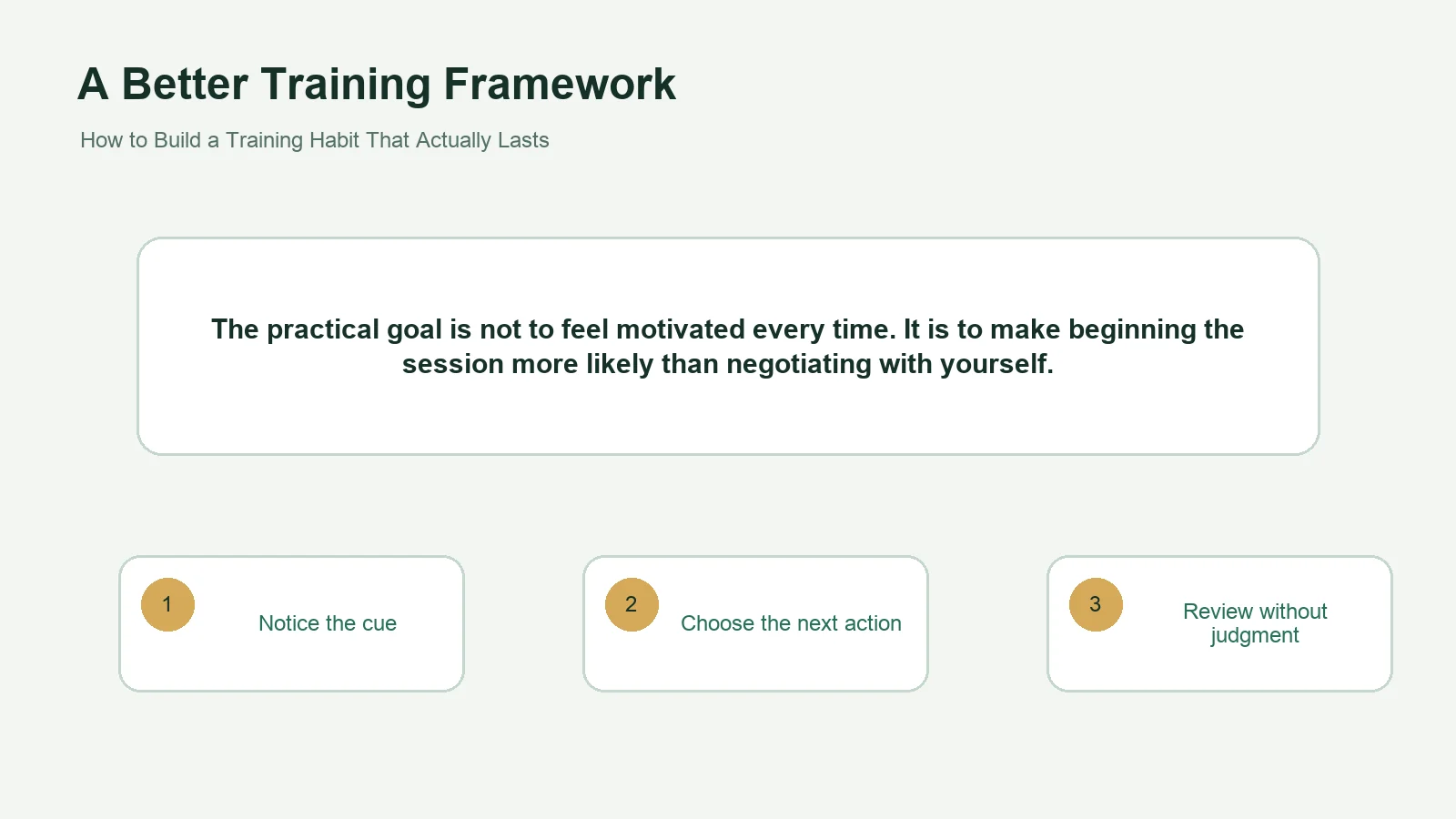
A cue answers “when does this start?” It can be a time, a location or an event that already happens: after the work laptop closes, after the school run or immediately after Saturday breakfast. Choose a cue that is stable enough to recur and specific enough to notice.
The CDC activity-planning worksheet recommends placing activity on the calendar and using a consistent time or place. For shift workers or parents, clock time may be unreliable. In that case, attach training to a sequence: after waking on the first day off, or after handing over childcare.
Use one cue for several weeks before deciding it failed. Changing the cue every few days prevents you from learning whether it fits. If the context truly changes, choose a new cue deliberately rather than hoping the old schedule survives.
Reduce friction before asking for willpower
List every step between the cue and the first exercise. Finding clothes, packing food, driving across town and deciding what to do can each become an exit. Remove one obstacle at a time. Keep the bag visible, store the program on one page and choose a gym or home setup compatible with your week.
Friction can also be emotional. A plan that begins with an intimidating lift or a crowded area may make starting harder. Use a familiar warm-up and know the first alternative before you arrive. The goal is not to avoid challenge. It is to place challenge after the routine has begun.
Create a minimum session
Your normal program might take an hour. Your minimum session should be much smaller: one main movement and two supporting patterns, or a 20-minute home session using exercises you already know. Decide the minimum while calm, not after a difficult day.
The minimum is for scheduling pressure and low motivation, not a way to train through illness, sharp pain or concerning symptoms. Those situations need rest or appropriate individual guidance. On an ordinary busy day, completing the minimum preserves the relationship between cue and action.
Do not compensate by turning the next session into punishment. Resume the plan at the next reasonable point. A habit becomes durable when one reduced day does not create a debt.
Recover from a missed workout
Missing once is normal. The important response is practical: identify why it happened and schedule the next opportunity. Avoid moral language. “The meeting ran late and the gym closed” contains information. “I am lazy” does not.
If the same barrier appears three times, redesign the system. Move the session, shorten it or change the location. Repeated misses are often evidence that the plan and life are mismatched. Discipline includes changing a plan that cannot be executed.
Research does not support a universal number of days for automaticity. A systematic review of health habit formation reported wide variation across people and behaviors. Stop counting toward a magical finish line. Measure whether starting is becoming more reliable in your actual context.
Review the habit, not your personality
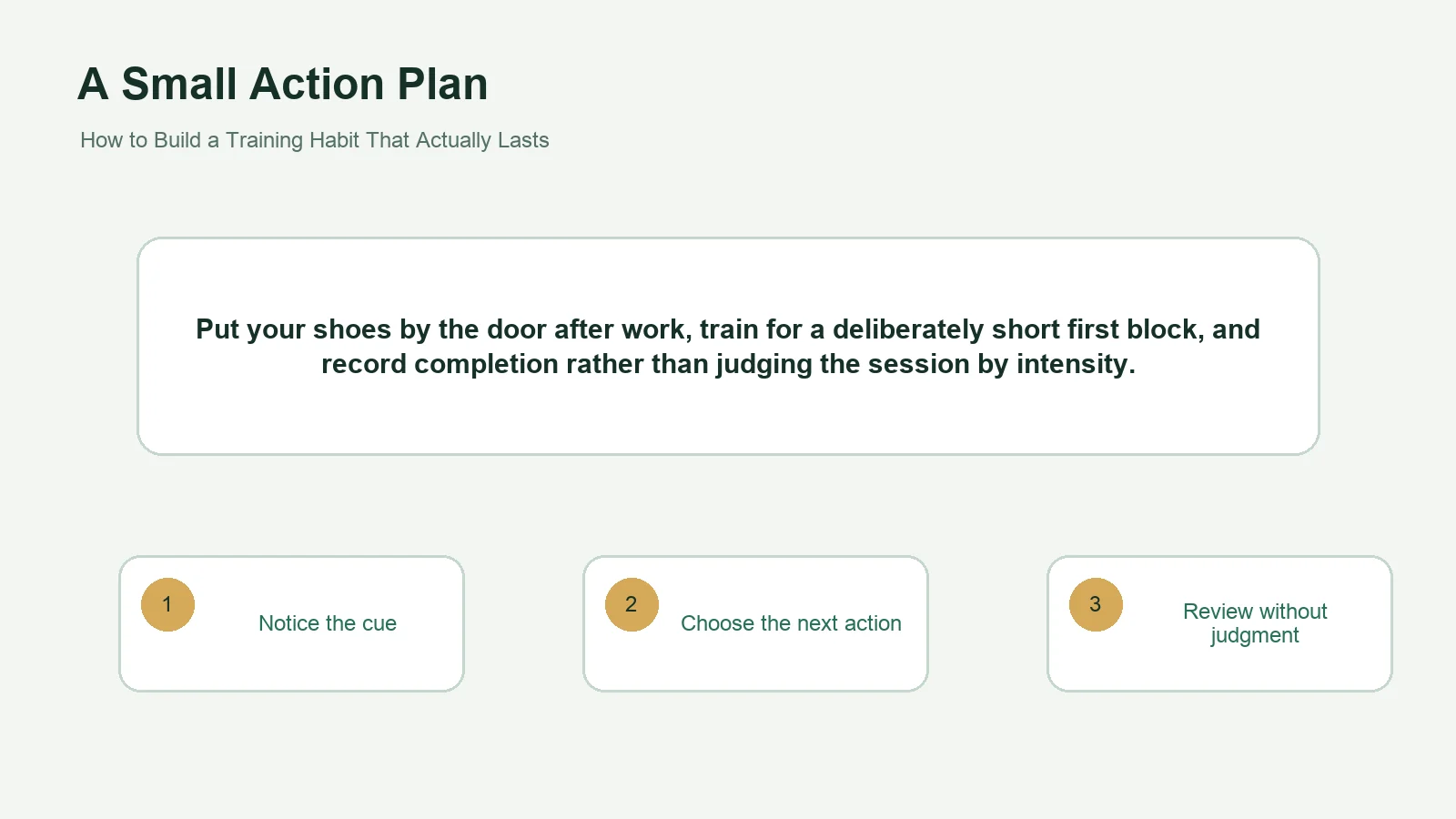
Once a month, check four things: how often the cue occurred, how often you started, which barrier repeated and whether the minimum session helped. Change one variable. You may discover that Tuesday works and Thursday does not, or that home training removes more friction than another motivation strategy.
Keep the review neutral. The purpose is not to prove you are disciplined. It is to make training easier to begin and sensible to continue. A lasting habit is a system you can return to after travel, deadlines and imperfect weeks. Build the cue, simplify the first action and protect the next opportunity.
Design the first five minutes
Many plans describe the whole workout but leave arrival to chance. Define the first five minutes so precisely that you do not need to negotiate with yourself. That might mean changing clothes, filling a bottle, opening the log and completing the first warm-up movement. The goal is not to trick yourself into training. It is to remove avoidable decisions from the transition.
Prepare the environment before the cue occurs. Put shoes where you will see them, keep the program accessible offline and decide which gym you will use when the usual one is crowded. For home training, clear the floor and set out the first implement before the scheduled time. These details feel small because each one is small; together they determine whether starting requires one action or twelve.
Measure repetitions of the habit
Track attendance separately from performance. A session can preserve the habit even when loads remain unchanged, while a single excellent workout does not prove that a routine is stable. Review four weeks at a time and ask whether the chosen schedule survived work, travel and low-motivation days.
Do not turn the streak into a trap. Missing once is information, not a broken identity. Resume at the next planned opportunity and note why the session was missed. If the same reason appears repeatedly, change the system: move the time, reduce the minimum or choose a closer location. Discipline becomes durable when feedback changes the plan instead of becoming evidence for self-criticism.
Make progression compatible with consistency
A habit should eventually support useful training, not attendance for its own sake. Keep a stable exercise menu long enough to learn it, add load or repetitions gradually and schedule easier work when accumulated fatigue makes the normal target unrealistic. If a movement produces sharp or worsening pain, stop and seek appropriate individual guidance rather than protecting a streak at the expense of judgment.
The lasting version is rarely the most demanding version you can complete once. It is the version that gives you enough practice to progress, enough flexibility to recover from disruption and a clear next action when enthusiasm is absent.
Continue with a related guide
For the next practical step, read Your PR Is Someone Else’s Warm-Up — So What?. For a second perspective from the same topic cluster, continue with How to Train When You Don’t Feel Like Training.