

The first weeks of strength training can feel almost unfair. A beginner may add weight to a lift several sessions in a row, make a movement look calmer, and feel much more capable before their body looks dramatically different. That early run of progress is real, but it is not a shortcut around biology and it is not proof that every workout must become harder forever.
Part of the explanation is that strength is a skill. Before a new lifter has built much additional muscle, the nervous system is learning how to organize the muscle already available for a particular task. A squat becomes less like a list of instructions and more like a coordinated action. A press becomes more stable. A hinge stops feeling like a puzzle.
This article explains what that early learning can look like, what the evidence can and cannot tell us, and how to use beginner momentum without turning it into a race to heavier weights.
- Why early strength can rise before visible size
- What the nervous system learns in a new lift
- What research says about neural adaptation
- Why the effect is movement-specific
- How to train through the beginner phase
The rapid start is not a muscle-growth shortcut
Muscle tissue matters for strength. Over time, hypertrophy can raise the amount of contractile tissue available to produce force. But visible muscle growth is only one contributor to a lift, and it usually does not explain every early improvement by itself.
A strength test asks the whole system to solve a task. You need to choose a stable position, produce force in the right direction, keep the bar or handle on a consistent path, and coordinate the muscles that move and stabilize the joints. A beginner is learning all of those things while also learning how hard a productive repetition should feel.
That is why early progress should not be translated as “my nervous system is now fully optimized” or “I do not need to build muscle.” It is better understood as improved force expression. The available muscle is being used more effectively in the exact movement that has been practiced.
The broader guide to how muscle gets stronger covers the long-term relationship among neural adaptation, practice, and tissue remodeling. Here, the narrower point is that a beginner’s quick improvement often starts with learning how to perform one task more efficiently.
The first lesson is the movement itself
The nervous system does not learn "strength" as one generic ability. It learns patterns. A goblet squat, a barbell squat, a leg press, and a split squat share some muscles, but they ask for different positions, balance demands, ranges of motion, and timing.
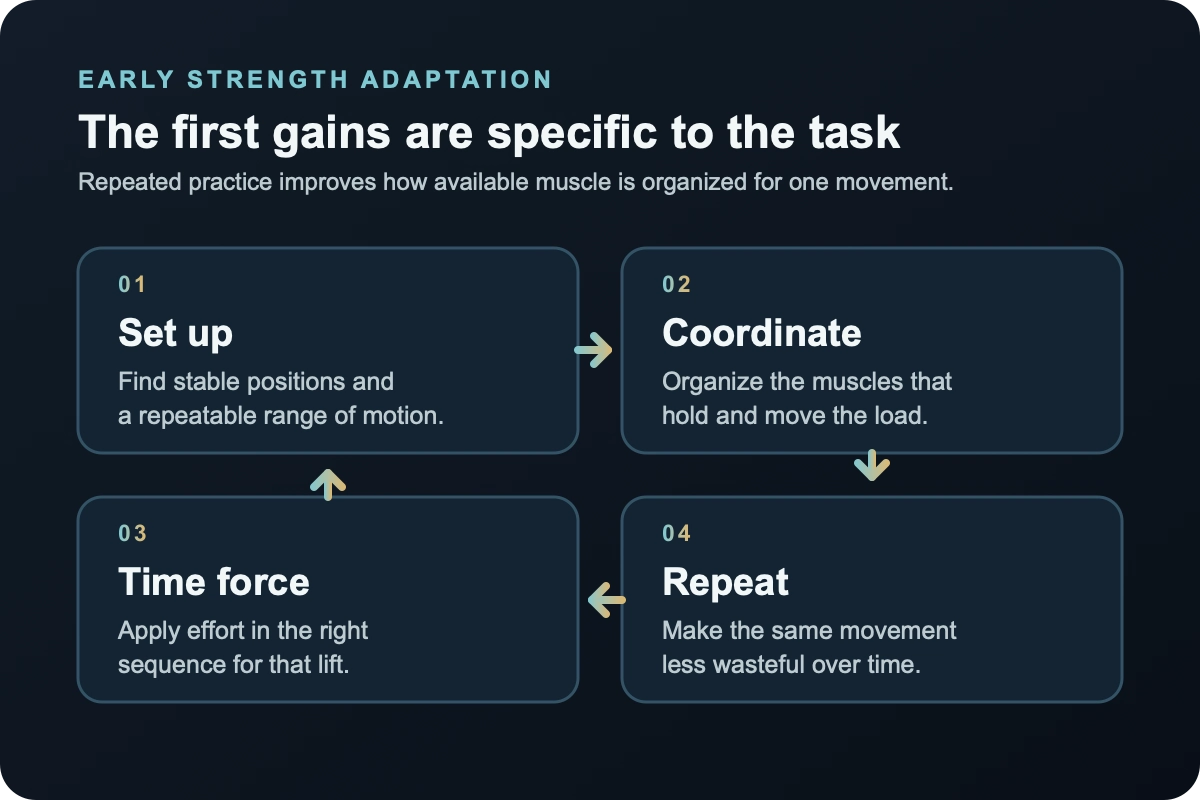
At first, a new squat can consume a surprising amount of attention. Where do the feet go? How much should the knees travel? When should the hips move? How is the torso kept steady? With repeated exposure, the setup becomes more consistent and less mental effort is spent on basic decisions. The movement becomes easier to reproduce.
That does not mean there is one perfect technique for every body. It means the lifter develops a repeatable solution that fits their anatomy, equipment, range of motion, and goal. If that solution changes every session, the nervous system has less consistent information to work from.
Better coordination can look like more strength
One practical change is intermuscular coordination: the muscles needed for the task work together with less wasted motion. In a squat, that includes the muscles producing the movement, the trunk muscles that help maintain position, and the smaller stabilizers that keep the joints organized. In a press, it includes a stable base, an efficient bar path, and timing between the shoulder and elbow contributors.
The 2021 review of motor-skill and resistance-training adaptations argues that early strength increases may be driven substantially by improvements in intermuscular coordination rather than a large immediate change in the muscle’s force-generating capacity. This is a useful interpretation for beginners, not a license to describe every change as purely neurological.
It also explains why familiar work can be so productive. Keeping a main movement stable for several weeks lets a lifter notice the same setup, range, and effort under slightly different loads. Random exercise changes may be fun, but they can hide whether the person is actually becoming better at the task that matters.
What the research can and cannot show
Scientists can study parts of neural adaptation with measures such as motor-evoked potentials, reflex responses, electromyography, and voluntary activation tests. These methods are useful, but none is a complete window into a real barbell lift.
In 2020, Siddique and colleagues pooled 30 randomized controlled trials with 623 participants. They reported strength gains alongside subtle cortical and subcortical changes after resistance training. Their conclusion is appropriately measured: these adaptations likely contribute to greater motor-neuron activation, but their precise sites and magnitude remain uncertain.
That uncertainty matters. It is tempting to say a lift improved because you recruited more motor units, fired them faster, reduced inhibition, or changed a particular spinal pathway. Those may be plausible pieces of the picture, but a single gym result cannot identify which mechanism caused it.
A 2022 systematic review of motor-unit firing properties reaches a similar practical conclusion: neural changes are thought to support early strength gains, while the exact changes in firing behavior are not fully settled. Science supports the broad model more confidently than it supports a simple one-mechanism story.
The effect transfers best to what you repeat
If a beginner becomes better at a barbell squat, some of that development can carry over to other lower-body exercises. Stronger legs, a better sense of effort, and more confidence under load can help elsewhere. The carryover is incomplete, though, because each exercise asks a slightly different question.
That is why a program does not need twenty movements to be complete. It needs enough variety to build the relevant muscles and avoid grinding the same joints, plus enough repetition to learn the lifts that define the goal. The case for a deliberately boring first strength program is really a case for giving practice time to work.
Specificity also explains why an early increase on one lift can slow down without meaning the program has failed. The easiest coordination gains may already have happened. At that point, progress may depend more on patient practice, muscle growth, recovery, or a smaller adjustment in load and volume. That is normal. A beginner phase is not supposed to remain an explosion forever.
Use the momentum to build a base
The most useful response to early strength gains is to make the process repeatable. Use a small exercise menu. Keep the main movement in the program long enough to learn it. Write down the load, repetitions, and any setup change that materially altered the set.
Progress does not have to mean adding weight every time. A cleaner rep at the same load, a more consistent depth, a steadier bar path, or one additional repetition within the planned range can all be useful changes. These are not consolation prizes. They are evidence that the task is becoming more controlled.
For a beginner, leaving a little room before technical failure is often more informative than chasing a maximum. It gives more repetitions to practice the pattern and makes it easier to distinguish normal effort from a breakdown in position. Hard training still has a place, but it should serve practice instead of replacing it.
When load goes up, avoid also replacing the exercise, doubling the sets, cutting every rest period, and testing a maximum that week. A stable plan makes the response easier to interpret.
Do not confuse quick progress with unlimited capacity
The beginner phase can make almost any added effort feel rewarding. That creates a predictable trap: add more sessions, more exercises, more weight, and less rest all at once because the first changes came easily. The result is usually a noisy program that is harder to recover from and harder to evaluate.
Instead, protect the conditions that made the early gains possible. Keep sleep and food reasonably consistent. Let the next session be good enough to practice. Increase the training dose only when the current dose is being performed with stable technique and recovery remains manageable.
If a movement causes sharp or escalating pain, numbness, dizziness, or other concerning symptoms, stop that movement and seek appropriate assessment. The solution is not hidden in a neural-adaptation theory or a more aggressive progression rule.
Conclusion
Beginner strength gains are often exciting because the body is learning quickly. Better setup, coordination, timing, and task familiarity can improve how existing muscle is used before major visible changes appear.
That does not make muscle growth irrelevant, and it does not mean every improvement has one identifiable neural cause. It means the first job of a good program is to provide repeatable practice. Learn the movement, keep the dose recoverable, and let early momentum become a durable training base.
FAQ
Does early strength progress mean I am building no muscle?
No. Muscle adaptation can begin early, but it may not be the only or largest visible explanation for rapid changes in a specific lift. Early strength reflects several overlapping adaptations.
Should beginners train every lift as heavy as possible to teach the nervous system?
No. The nervous system learns from controlled, repeated practice. Use loads you can set up and move safely, then progress gradually as the movement becomes more consistent.