Every weight room has a written rulebook somewhere: posted signs, membership terms and staff instructions. Those rules vary by facility, and they always come first. But most sessions are shaped by quieter habits that are rarely explained at the front desk. “That person” is usually not the loud lifter or the person using an unfamiliar exercise; it is the person who makes a shared room harder for everyone else to use.
These are not secret tests for whether you belong. They are practical ways to make a shared room work. Good etiquette does not require you to be outgoing or experienced. It requires you to notice that other people are trying to train too.
- Why local rules come before gym culture
- How to share equipment without guessing
- Why resetting a station matters
- How to handle phones, filming and unsolicited advice
- What to do when something feels unsafe or unfair
Start with the room, not a universal rulebook
Some facilities allow chalk, some do not. Some have strict platform rules, timed equipment limits or a blanket ban on filming. A powerlifting gym may treat a loud deadlift differently from a commercial gym, and a crowded university facility can have different rules again. Read the signs and follow staff direction before relying on anything you saw online.
The overlap is still useful. For example, the UC San Diego Recreation fitness-gym rules ask members to re-rack equipment, keep walkways clear, wipe equipment and avoid photography or videography. UC Davis similarly asks members to re-rack weights, share equipment when possible and keep bags off the floor. Those are not laws of lifting; they are examples of how facilities turn a shared-space problem into clear expectations.
The point is not to memorize every rule. It is to notice the practical reason behind one: safety, access, cleanliness or privacy. When you understand the reason, you can usually make a sensible choice even in a room you have never used before.
Ask before assuming a station is free
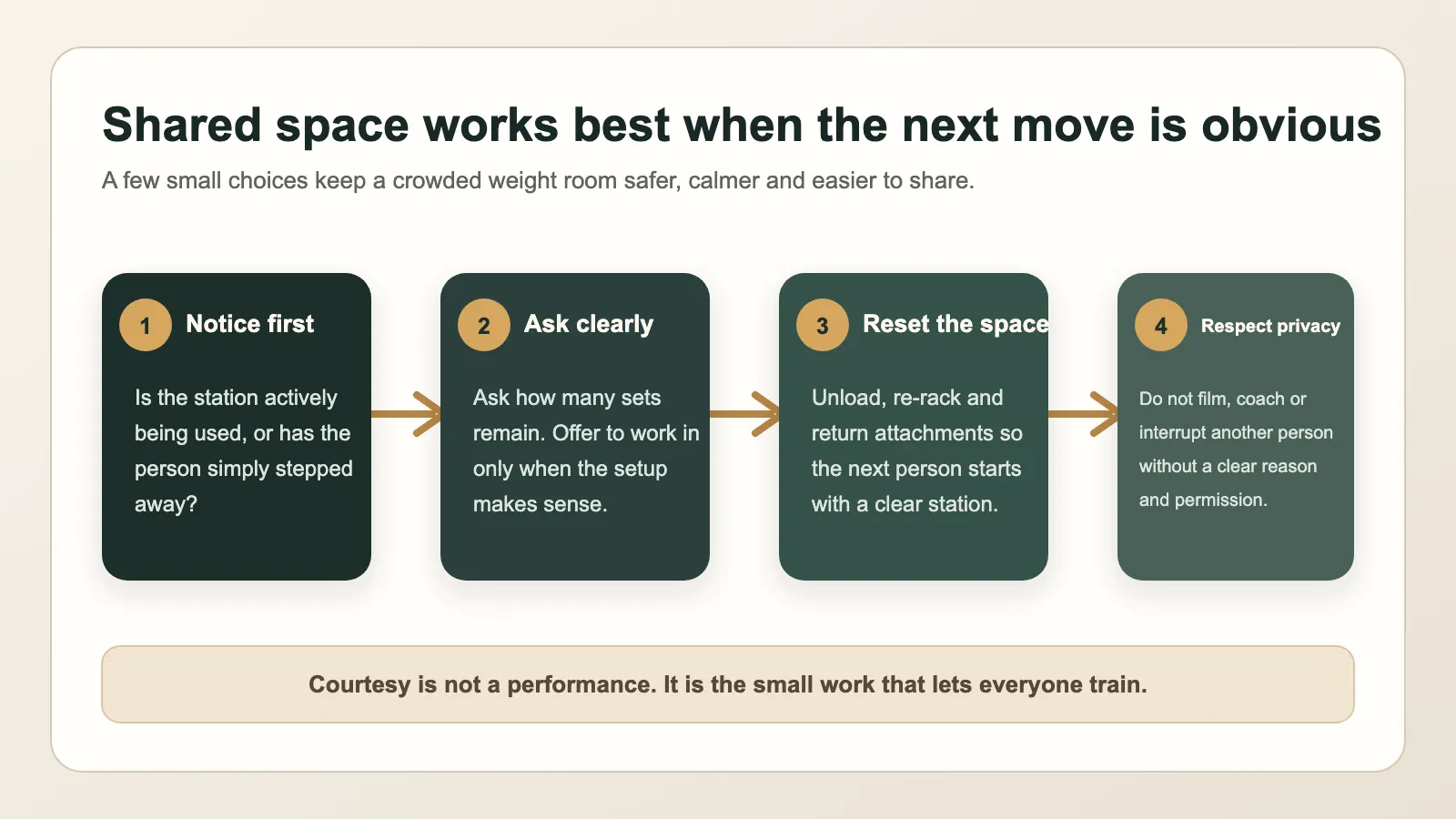
The simplest question in a busy gym is also the most useful: “How many sets do you have left?” It gives the other person a chance to explain their plan and lets you decide whether waiting or working in makes sense.
Working in is an offer, not a demand. It works well when two people can safely change a bench height, plate load or machine setting without turning each set into a long reset. It works poorly when someone is doing a short timed circuit, using unusual equipment or preparing for a heavy attempt that needs their full attention. If the answer is no, wait without making it personal.
Avoid using multiple popular stations as placeholders for a circuit when the room is crowded. It is reasonable to arrange a superset around equipment that is available; it is not reasonable to reserve half a room while other members wait. The same principle applies to rest periods. Take the time your work needs, but do not turn the bench into a scrolling chair when somebody is clearly waiting.
Reset the station for the person you cannot see
Re-racking is not a ceremonial gesture toward gym culture. It is a handoff. The next person should not have to search for plates, unload a machine or step around a bag to start their set.
That means returning dumbbells to the right place, unloading a bar, putting attachments back and taking personal items out of walkways. Wipe down shared surfaces when your gym provides the supplies and asks you to use them. If equipment is damaged or feels unstable, tell staff rather than leaving the problem for the next member.
This is one reason well-run rooms feel easier to train in. As explained in Why the Best Gyms Feel Like Communities, Not Businesses, dependable standards lower the friction between strangers. You do not need to know everyone to make their session better.
Attention and privacy are part of the equipment
Phones are normal in gyms. They can hold a program, timer, music or training log. The issue is not the device; it is whether it takes more shared space or attention than it needs to.
If you film a set, check your gym’s policy first. Then frame the shot so other people are not made into background content, and do not block a walkway or claim a station for repeated takes. Many facilities prohibit or restrict filming precisely because other members deserve a reasonable expectation of privacy.
The same restraint applies to advice. A useful spot, a quick answer to a direct question or a warning about an immediate safety issue can help. Technique lectures, comments about somebody’s body or an interruption in the middle of a focused set rarely do. The article When the Gym Becomes Your Third Place makes a related point: connection in a gym works best when it stays voluntary.
Let staff handle the problems that are not yours to solve
Not every awkward situation needs a confrontation. If someone is using equipment in a way that seems unsafe, filming people, harassing another member or repeatedly monopolizing a station, use the staff desk. That is part of their job, and it avoids turning a training session into a dispute between strangers.
You can still be direct about ordinary sharing: ask to work in, ask whether a bench is free or say that you are waiting for a rack. Keep the language neutral. “Are you still using this?” is usually enough. You do not need to win an argument to protect your time.
The rule underneath all the others
The weight room does not need perfect silence or perfect order to function. It needs people to leave enough room, equipment and attention for the next person. That is the unwritten rule underneath the rest.
Notice before assuming. Ask before taking. Reset what you used. Respect people who want to train without becoming part of your content or conversation. These are small habits, but they make a crowded room feel less competitive in the worst sense and more useful for everyone.
FAQ
Is it rude to ask someone how many sets they have left?
No. It is a normal, practical question in a busy gym. Ask between sets, accept the answer and decide whether waiting or working in is realistic.
Should I always let someone work in?
Not always. It depends on the equipment, your setup, safety and the pace of both sessions. A polite no is reasonable when sharing would create a difficult or unsafe reset.
What if I am new and do not know the local rules?
Read posted guidance, observe how staff handle the room and ask a staff member when unsure. Following the facility’s own rules is more useful than trying to copy the culture of another gym.