

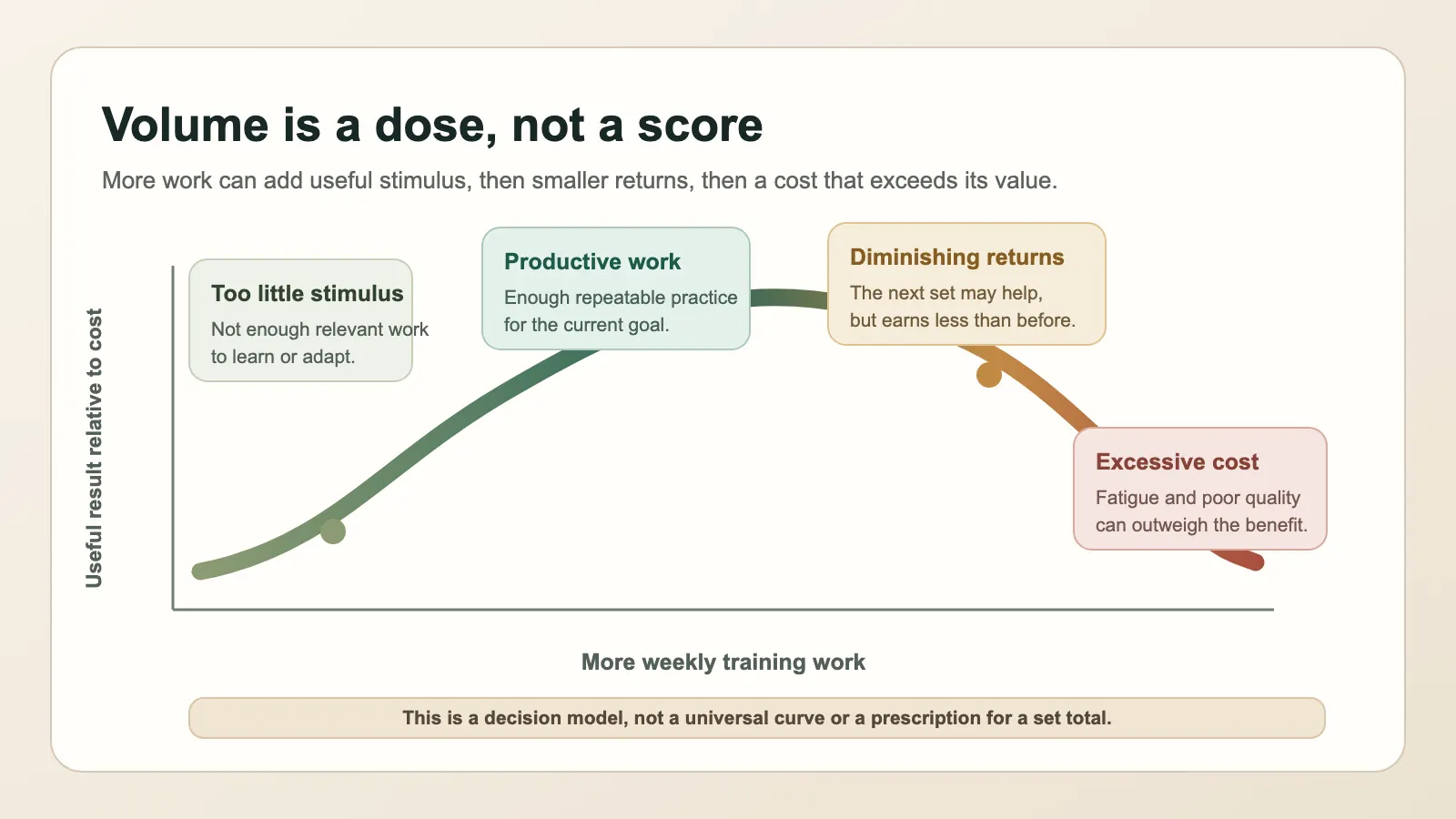
“More volume” sounds like a simple instruction: add sets, add exercises, or add another day. The science is less simple. Training volume is a dose of work, and a dose can be too small to matter, large enough to be useful, or large enough that its extra cost no longer earns its place.
That does not mean there is one ideal number of sets hiding in the research. Studies can tell us that more resistance-training work often produces more adaptation within the ranges tested. They cannot turn a group average into a personal ceiling, because the quality of a set, the exercise, the goal, prior training and recovery all change what that extra work means.
This is a science explainer for healthy adults. It does not diagnose fatigue, injury or overtraining. If pain, unusual weakness, dizziness or symptoms that change how you move are part of the picture, get individual medical or qualified coaching guidance rather than trying to solve the issue by manipulating sets.
- What researchers mean by training volume
- Why a dose-response finding is not a universal target
- Why sets are not interchangeable units
- How diminishing returns show up in practice
- What a cautious volume adjustment looks like
Volume is a measurement, not a verdict
In resistance training, volume can be counted several ways: total repetitions, repetitions multiplied by load, hard sets for a muscle, or sets of an exercise. Each method answers a slightly different question. Ten sets of technically demanding barbell squats are not the same dose as ten sets of cable curls, even if both appear as ten lines in a log.
Researchers simplify these details so programs can be compared. That is necessary, but the simplification has a cost. A study may classify weekly sets by muscle group, while a lifter is trying to improve a specific lift. Another study may measure muscle size rather than one-repetition-max strength. The same weekly total can therefore mean different things depending on the outcome.
The practical takeaway is not that counting is pointless. It is that a number is a starting description, not a quality score. When you add volume, name what it is meant to improve: a muscle group, a movement pattern, a technical skill or a specific strength test.
The evidence supports a relationship, not endless growth
A 2017 systematic review and meta-analysis of weekly resistance-training volume found a graded relationship between weekly sets and hypertrophy across the studies it included. That finding is useful because it challenges the idea that one hard set always equals a complete training plan. It does not prove that every additional set will produce the same return for every lifter.
The review drew on 15 studies and 34 treatment groups, and it evaluated muscle-size outcomes. That matters. It is evidence about the general direction of a relationship in those programs, not a promise about a particular person’s squat, shoulder comfort or work schedule. It also cannot make all sets equivalent when exercises, effort and adherence differ.
A larger 2023 network meta-analysis of resistance-training prescriptions compared combinations of load, sets and frequency in healthy adults. All tested resistance-training prescriptions improved strength and hypertrophy compared with no exercise. The top-ranked strength approaches used higher loads, while multiple-set approaches ranked strongly for hypertrophy. The result is not “more volume beats everything.” It is that volume belongs inside a prescription with load, frequency and the stated outcome.
One extra set is not always one extra unit of stimulus
Sets differ in specificity and quality. A controlled set of the lift you want to improve may offer technical practice as well as muscular work. A rushed accessory set at the end of a long session may still be useful, but it does not automatically carry the same value. The difference becomes larger when technique, range of motion, rest periods or effort change.
The exercise matters too. An extra set on a stable machine can have a different fatigue cost from an extra hard set of a free-weight compound lift. This is why a weekly set total should not be copied from someone else’s program without asking what they were doing, how hard the sets were and what the program was trying to improve.
This also explains why strength and hypertrophy do not always point toward the same addition. More direct practice with a heavy movement might serve a strength skill, while several controlled sets of a stable exercise might be a simpler way to add work for a muscle. Neither choice is automatically superior outside the goal it serves.
For the practical side of that distinction, see The Volume Sweet Spot: How Much Work Does Strength Really Require?. That guide helps turn a goal into countable work; the science here explains why the count has to stay conditional.
Diminishing returns are expected, not a failure
If the first few productive sets in a week solve a clear training problem, it makes sense that later sets may add less new value. That is a basic diminishing-returns idea. It does not mean the later sets are useless. It means their benefit should be weighed against the time, fatigue and recovery they require.
The boundary is not visible from soreness alone. You need several comparable sessions and a simple log. Are the additional sets still performed with the planned range, load and technique? Are they improving the outcome you added them for? Can you return to the next session without turning the same work into a grind? Those answers are more informative than whether a workout felt punishing.
A 2025 systematic review of resistance-training variables and fatigue symptoms identified factors including total volume, set duration and proximity to failure among variables associated with short-term fatigue responses. It does not identify a personal maximum. It does reinforce the idea that an extra set has a cost, especially when it is added to long, hard work.
Adjust one variable, then observe the dose
The cleanest volume experiment is small. Add one relevant set to one exercise or distribute a current weekly total across another day. Keep the other major variables steady long enough to observe whether the change improves performance, skill or the target muscle’s training quality.
Do not add sets, new exercises, shorter rest and more training days at the same time. If the outcome changes, you will not know why. If fatigue rises, you will not know what to remove. A small change is not timid; it is how a training log becomes useful evidence.
The recovery guide Why More Training Isn’t Always More Progress covers the warning signs that the cost is becoming too high. The key point is simple: more volume becomes useful only when it improves the next several weeks of training, not when it makes one workout look impressive.
Conclusion
Volume research gives a valuable correction to both extremes. Too little relevant work may not produce much adaptation, and more work can be useful. But the relationship is not a command to pursue the largest weekly total you can tolerate.
Treat volume as a measured dose. Define the outcome, add the smallest useful amount of work, keep the rest of the program stable and review what actually changes. The best volume is not the most dramatic number. It is the amount that continues to produce useful training you can perform and recover from.
FAQ
Does more weekly volume always build more muscle?
Not always. Research supports a general dose-response relationship within the programs studied, but the return from additional work can shrink and the recovery cost can rise. Exercise selection, effort, training history and the rest of the program all matter.
Should I add a set when progress slows?
Possibly, but first check whether the current work is comparable and well executed. Add a small amount of specific work only when it addresses a clear goal and you have room to recover from it.
Is a hard set on every exercise equivalent?
No. Exercises differ in skill, stability, load, range of motion and fatigue cost. A set count is useful only when you also know what the sets were and how they were performed.