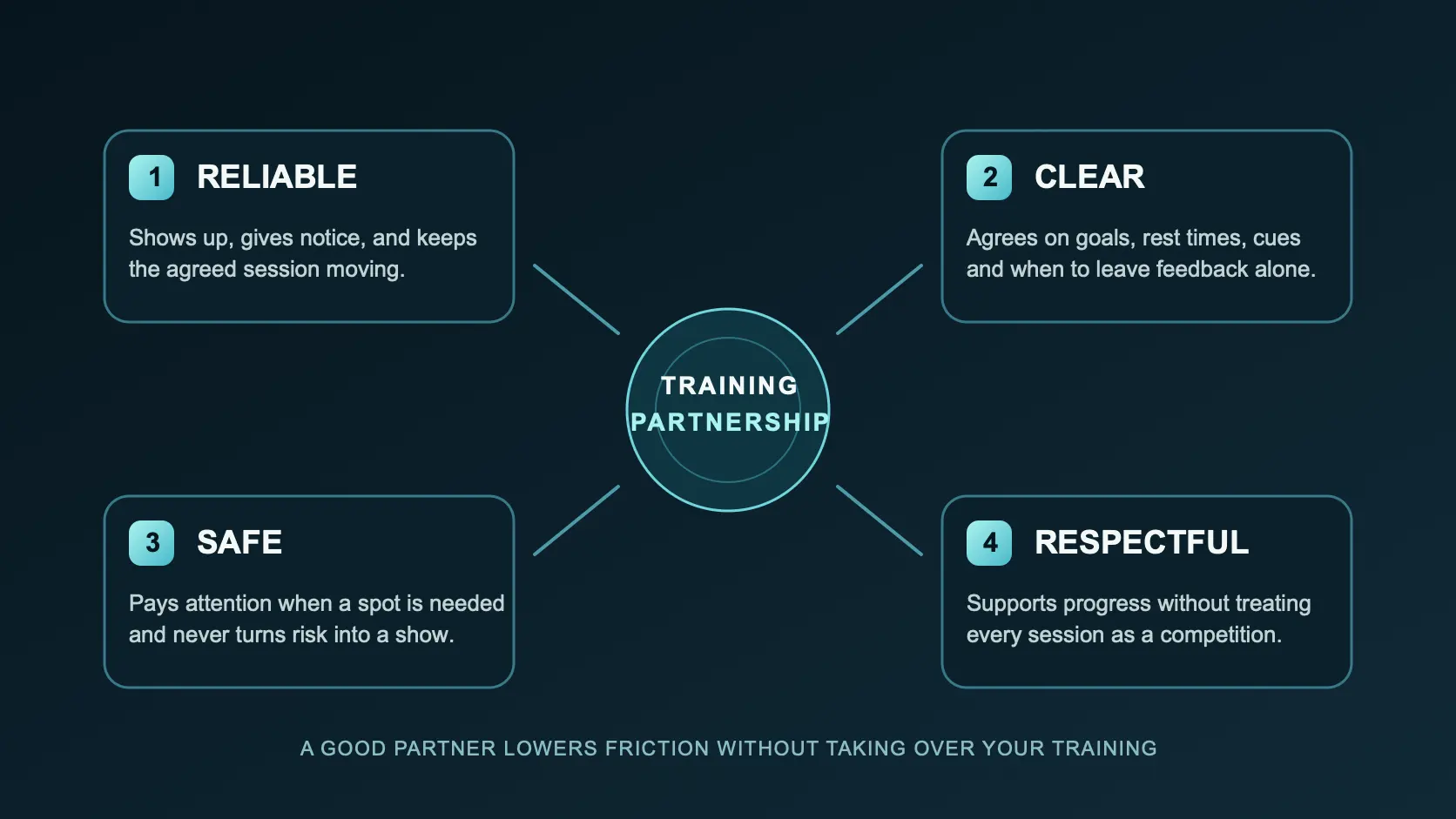
A great training partner is not the person with the biggest total, the loudest encouragement or the same program as you. They are the person who makes it easier to do the work you already intended to do. That usually looks less dramatic: they arrive when they said they would, respect the plan, pay attention when a spot matters and do not turn every set into a comparison.
Training alone is completely valid. Some people concentrate better without conversation, and different schedules can make a partnership impractical. But when you do train with someone, the right match can remove a surprising amount of friction from a week of lifting.
- Why reliability beats matching numbers
- How to agree on the job
- What safe spotting actually requires
- When a partnership is not a good fit
Reliability matters more than matching numbers
You do not need the same strength level, body size or exact goals to train well together. You do need a reasonably compatible rhythm. If one person always arrives 25 minutes late, changes the session into a new experiment or disappears before accessories, the other person ends up planning around uncertainty.
Reliability is not rigid perfection. People have work, family, travel and bad weeks. It is the habit of communicating early and treating the other person’s time as real. A quick message that says, “I am running late, start without me,” is more useful than an apology after the rack has been held empty.
This is part of why social support can help activity feel easier to sustain. The National Institutes of Health overview of being active together points to the practical value of friends, groups and classes. In a weight room, the benefit is often simple: someone is there when expected, so the session has one less decision to negotiate.
Agree on the job before the hard set
“We train together” can mean very different things. One person may want a strict powerlifting session with long rests and detailed setup. Another may want to move through a short general-strength session, talk between sets and leave on time. Neither approach is wrong, but assuming they are the same creates irritation quickly.
Have a short conversation before it becomes a problem. Are you sharing a warm-up, every work set or only a few major movements? Do you want cues, or do you prefer to review a lift after the session? How long will each person rest? If somebody needs to leave early, which part of the workout can become solo?
The same clarity makes the room easier for everyone else to use. Gym Etiquette Is Mostly About Not Being That Person covers the shared-space side of this: ask before assuming, reset your station and avoid making your routine another person’s delay. A pair that knows its plan takes up less physical and social space.
A spot is a responsibility, not a performance
Spotting is one of the clearest reasons to train with another person, especially for a bench press or a heavy set where a failed rep could leave the lifter in an awkward position. It is also a task that needs agreement, not theater.
Before the set, confirm what help looks like. Does the lifter want a lift-off? Are they using safety arms or pins? At what point should the spotter assist? A spotter who hovers over the bar, grabs it during a hard but controlled rep or looks at their phone is not making the set safer.
For movements and loads where a safe setup is unclear, reduce the load, use the available safeties or ask qualified gym staff or a coach for help. A partner is not a substitute for appropriate equipment, sound judgment or professional instruction. The goal is to make a difficult set calmer, not to create a spectacle around risk.
Support should not become a scorecard
A healthy partnership can raise standards. You may take your warm-up seriously because someone else has already started theirs. You may finish the planned sets because another person is ready for the next one. That is useful accountability.
It stops being useful when every session becomes a contest. Constant comments about bodyweight, numbers, food, missed days or who is progressing faster can make training feel smaller rather than better. The article Why the Best Gyms Feel Like Communities, Not Businesses makes a related point: good support works when it is voluntary, respectful and built on clear standards.
Encouragement should match what the other person values. Some lifters want a loud final rep. Others want a quiet “you have this” and space to focus. Ask, notice the answer and do not assume that your preferred gym culture is universal.
Know when to train separately
Not every good gym friendship needs to become a permanent training partnership. Separate sessions may be the better option when schedules rarely align, one person is preparing for a competition, rest periods are incompatible or the partnership creates pressure rather than support.
That does not have to be a falling-out. You can share a warm-up once a week, train the same program at different times or meet only for a lift that benefits from a spot. The right amount of overlap is the one that protects both people’s consistency.
If you are unsure, try three sessions with a simple agreement: arrive on time, share one main lift, state how you want feedback and reset equipment before leaving. At the end, ask whether the setup made training easier. If the answer is no, adjust the arrangement before judging the person.
The best partner respects the work
The strongest partnerships are not built on identical lifts or constant motivation. They are built on small, repeatable habits: keeping commitments, communicating plainly, taking safety seriously and leaving room for each person to own their own training.
A great training partner should make you more likely to return to the gym with a clear plan. If they do that, the relationship is doing its job.
FAQ
Do training partners need to be equally strong?
No. Different strength levels work well when both people can adjust plates, share equipment safely and respect one another’s pacing. Reliability and compatible goals matter more than matching numbers.
Is it okay to prefer training alone?
Yes. A partner is optional, not a requirement for progress. Train alone when it suits your focus or schedule, and use a partner only where the arrangement genuinely improves the session.
What should I discuss with a new training partner?
Start with schedule, goals, rest times, spotting expectations and feedback preferences. A five-minute conversation prevents most of the avoidable confusion.