

A personal record is exciting because it gives training a clean headline. The bar moved for more weight. You performed more repetitions. A movement that once felt out of reach is now routine. There is nothing wrong with enjoying that moment.
The problem begins when a PR becomes the only acceptable proof that the week worked. Then a normal week of completed sessions, cleaner repetitions, better setup, or well-managed recovery can feel like a disappointment. The training process gets judged by a result it was never designed to produce every seven days.
Progress is not a weekly vending machine. Some weeks build capacity. Some weeks teach a movement. Some let you repeat a useful load with less uncertainty. Some simply keep the habit intact while work, travel, sleep, or family demand more attention. Those weeks can be productive even when the number on the bar does not change.
This is not an argument against ambition or testing. It is an argument for giving records a job. A PR is a planned checkpoint, not the entire scorecard.
- Why a weekly PR changes the wrong scorecard
- What productive training can look like instead
- A simple weekly review
- What to do when the number does not move
- How to make a PR a planned event again
A PR is one result, not a weekly grade
A PR answers a narrow question under particular conditions: did you perform this exercise, load, repetition target, or variation better than before? That is useful information when the comparison is honest. It is not a complete summary of what training did for you this week.
When every week needs a record, the plan starts to bend around the demand for a result. A lifter may add weight before the planned work is stable, turn a final set into a grinder, or test after one good warm-up. The session becomes a referendum on the lifter instead of a piece of a longer block.
The Difference Between Training Hard and Making Every Session a Test covers the session-level version of this problem. A hard session can have a clear purpose and stopping point. A test has a different job. Requiring a test result every week blurs the two until ordinary, useful practice feels insufficient.
There is also a quieter cost: you stop noticing progress that does not produce a headline. A technically cleaner set of five, a more consistent setup, or the same work completed with more confidence may be exactly what the program was trying to build. If the only question is, "Did I PR?", those signals disappear from view.
Use a scorecard that matches the work
The scorecard should fit the phase you are in. A lifter practicing a squat pattern may care most about stable depth and bracing. Someone in a higher-repetition phase may care about one clean repetition at the same load. A busy adult might care whether two planned sessions happened without turning recovery into a crisis.
That is not lowering the standard. A broad meta-analysis of progress-monitoring interventions found that recording and reviewing progress supported goal attainment across the included behavioral studies. Read the progress-monitoring meta-analysis as general self-regulation evidence, not proof that one logging method will transform a lifting program.
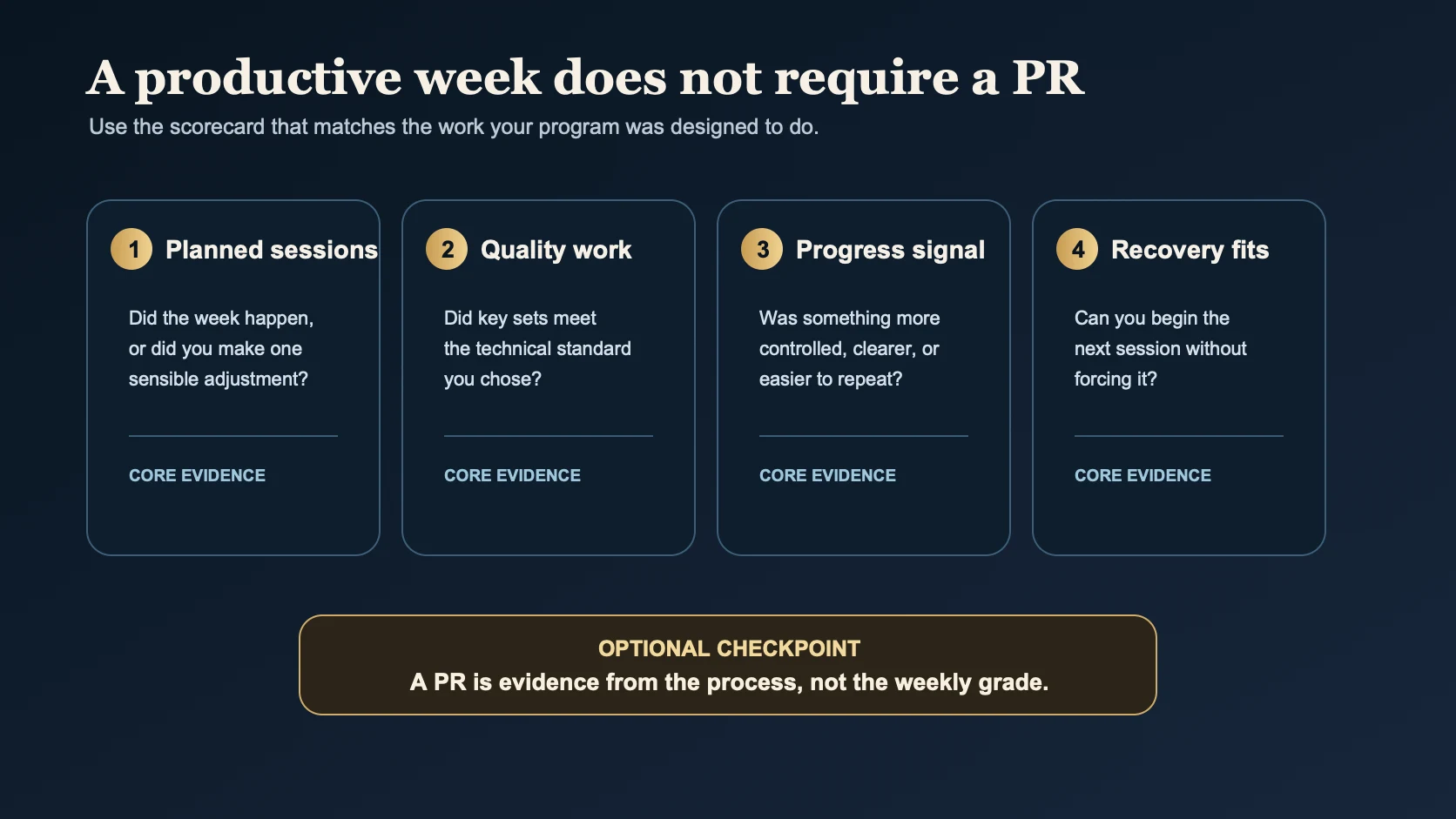
For a normal strength week, review four questions:
- Did I complete the planned sessions, or make a sensible documented adjustment?
- Did the important sets meet the technical standard I chose?
- Did I build a repeatable signal, such as a cleaner rep, a controlled extra repetition, or the same load at lower perceived effort?
- Did recovery remain good enough to begin the next planned session without forcing it?
A PR can sit beside these questions, but it does not replace them. The four questions tell you whether there is a foundation for a later test. A record without that foundation can be exciting and still tell you very little about what to do next.
The number not moving is not automatic bad news
No PR this week can mean many things. Perhaps the plan was built around volume rather than testing, the week was intentionally lighter, or the program needs a real adjustment. The number alone cannot tell you which explanation is true.
Start by checking the written target. If you completed it with stable technique, the session did its job. Log the result and let the next planned exposure happen. If the work was consistently harder than expected across several comparable sessions, review the training dose and the context around it instead of forcing a record to settle the question.
Volume or Intensity: What Should You Cut During a Deload? shows how a lighter period can lower a program’s cost when a repeated trend says the current dose no longer fits. That is a programming decision, not an admission that you lost progress because the week did not contain a PR.
Avoid the opposite mistake as well: adding a maximum attempt just to repair the feeling of an ordinary week. The 2023 review of proximity to failure found that the available evidence did not establish momentary failure as superior for hypertrophy, while it may increase fatigue and discomfort. This does not make hard work wrong. It means the extra cost of a grinder should earn its place in the plan rather than being the default way to make a week feel successful.
Review the week in five minutes
At the end of the week, open the training log and write three short lines:
- Kept: one part of the plan that was repeatable and useful.
- Changed: one adjustment you made and the reason for it.
- Next: one clear target for the next session or week.
For example: "Kept: three clean squat work sets at the planned load. Changed: removed one accessory set after a late work night. Next: repeat the same squat target before adding load." It is actionable because it tells you what happened and what comes next.
Keep the review short enough to survive a busy week. Preserve enough context to make the next decision without relying on mood or memory.
The broader review of resistance-training monitoring methods notes that practical measures such as repetitions in reserve and post-set perceived effort can help regulate training when used alongside performance. Read the review of resistance-training monitoring as a menu of tools, not a requirement to track everything. A simple log with an honest effort note is already more useful than demanding a new record from every session.
Make PRs appointments, not emergencies
A PR is most helpful when you decide in advance what it needs to answer. You may test at the end of a focused block or when a training maximum would help set future loads. Choose the movement standard, warm-up, safety setup, and what result would change next.
This makes the record easier to enjoy. You can prepare for it, record the conditions, and return to ordinary work afterward without trying to repeat the feeling immediately. Your PR Is Someone Else’s Warm-Up – So What? provides the companion perspective: the value of a record is personal and contextual, not a rank against other people.
There is no universal calendar for testing. The right timing depends on your goal, movement familiarity, recovery, and program. The test should serve the plan, not the need for a weekly headline.
Conclusion
Needing a PR every week turns a useful result into a weekly verdict. It can make ordinary training feel like failure and encourage choices that are exciting in the moment but difficult to repeat.
Use a broader scorecard. Complete the planned work, protect technical standards, record a small repeatable signal, and check whether recovery still supports the next session. Let a PR arrive as evidence from that process, not as the price of feeling that the week counted.
FAQ
Is it bad to want a PR often?
No. Wanting progress is normal. The issue is treating a weekly record as the only evidence that training worked. Give the PR a planned role and keep other useful signals visible.
What should I track if I am not testing a maximum?
Track the planned exercise, load, repetitions, technical standard, and a brief effort or recovery note. A controlled repetition increase, cleaner setup, or repeatable work set can all be useful signals.
What if I have not progressed for several weeks?
Review the pattern rather than forcing an attempt. Check the goal, program, technical consistency, recovery, and recent life constraints. Change one meaningful variable when there is a clear reason, then give that change time to produce information.
Continue with a related guide
For a practical explanation of planned hard sessions and planned tests, read The Difference Between Training Hard and Making Every Session a Test. For a second perspective on putting records in context, continue with Your PR Is Someone Else’s Warm-Up – So What?.