
A percentage-based program can look very precise: three sets of five at a stated percentage of a one-repetition maximum, followed by a calculated increase next week. An RPE-based program can sound more personal: work up to a set at RPE 8, then adjust the load based on what the set actually feels like. The argument usually starts when one is described as objective and the other as subjective.
That framing is incomplete. Both systems are useful, and both depend on a reference. A percentage is exact relative to the maximum number you chose. RPE is useful relative to your ability to judge how close a set was to another clean repetition. Neither method can remove the need to define the exercise, range of motion, technique standard and goal of the session.
The practical question is not which method wins a permanent contest. It is what decision the number is supposed to support. Percentages help you plan a load against a known reference. RPE can help you decide whether that planned load matches what is happening today.
- What percentage loading actually measures
- Why a precise calculation can still miss the day
- What RPE adds and what it cannot know
- When a hybrid approach is clearer
- How to choose the smallest useful system
A percentage is precise about its reference
Percentage-based loading starts with a one-repetition maximum, a training maximum, or an estimated maximum. If a program says to use 75%, the arithmetic is simple: multiply the reference by 0.75 and load the bar. That makes percentages easy to write, repeat and compare within a planned block.
This structure is valuable. It lets a coach or lifter map out exposures before entering the gym, distribute heavier and lighter days, and see whether a planned progression is actually being followed. The ACSM position stand on resistance-training progression includes percentage and repetition-based loading recommendations as part of a broader model of progression for healthy adults. A percentage can be a useful starting point because it gives a real session a defined task.
But the number is only as current and specific as the reference behind it. A maximum built from a high-bar squat does not automatically prescribe a low-bar squat. A test performed months ago may no longer represent current ability. An estimated maximum can be useful, but it carries the uncertainty of the repetitions, standard and equation used to create it.
This does not make percentage work bad. It explains its kind of precision. The calculation may be exact, while the real-world relationship between that calculation and today’s effort is only an estimate.
A fixed percentage cannot see the day in front of you
The same percentage can produce a different experience from one session to another. Sleep, fatigue, a different warm-up, accumulated work, stress, equipment, exercise familiarity and recent training can all change how a load feels and moves. The bar does not know why the day is different; it only tells you that the external load stayed the same.
That distinction matters because a program can be followed exactly on paper while drifting away from its intended effort. A day that was meant to be controlled practice may become a hard grind. A day that was meant to be challenging may feel unusually easy. Neither outcome automatically demands a change, but both are useful information.
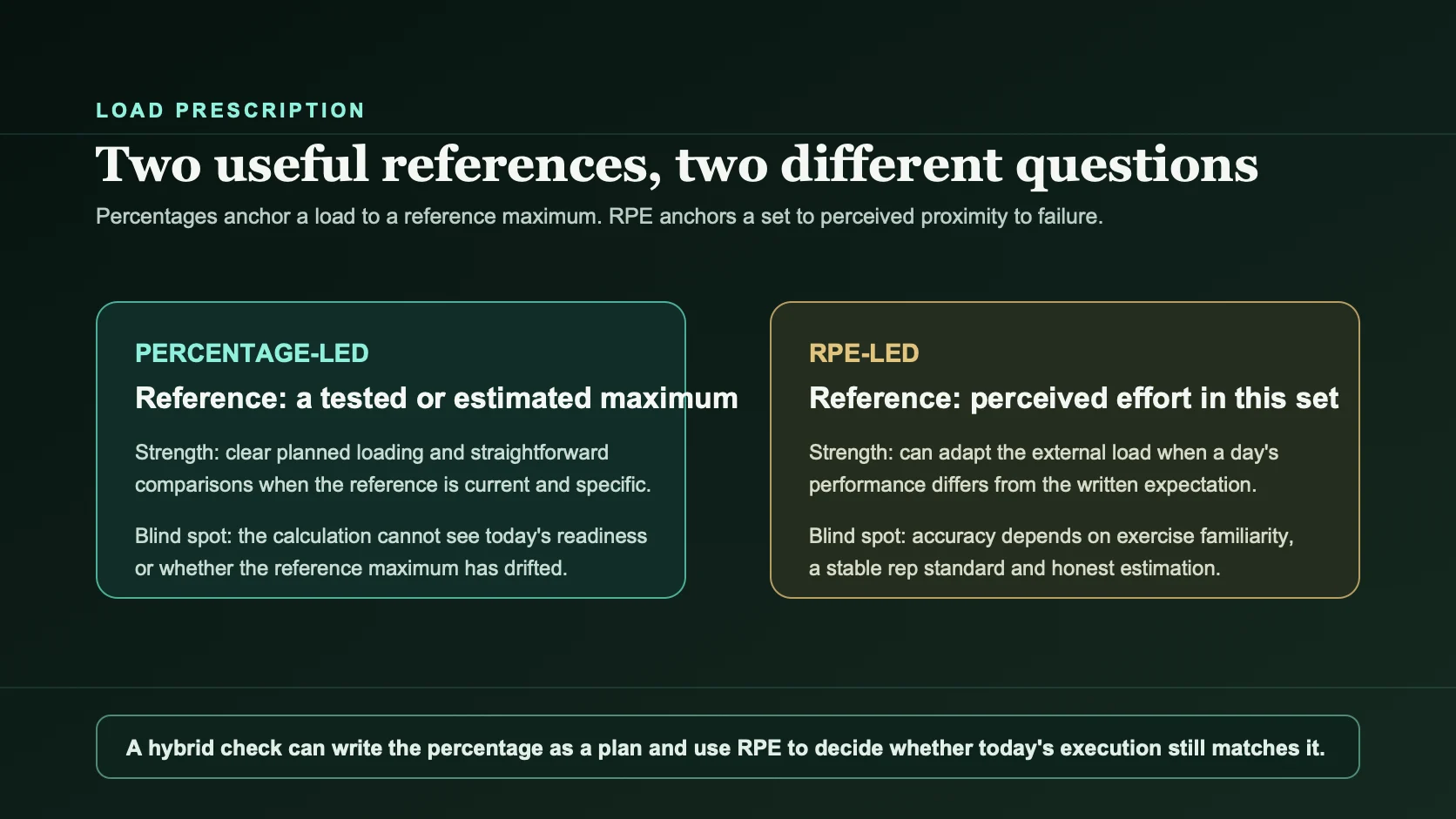
Percentages also do not promise a fixed repetition capacity. Two lifters can use the same relative load and have different numbers of repetitions available. One lifter can also have different capacities across exercises or across rep ranges. That is one reason a percentage chart should be read as a planning tool, not a guarantee of how a set will feel.
For a clear explanation of how load is only one part of the training task, read Progressive Overload Is More Than Adding Weight to the Bar. A planned percentage tells you something important about load; it does not describe technique, proximity to failure, rest, range of motion or recovery by itself.
RPE adds a practical check on effort
In this article, RPE means a resistance-training, set-level RPE scale anchored to repetitions in reserve. On that kind of scale, an RPE 8 is commonly used to mean roughly two technically acceptable repetitions remained, while RPE 10 means no additional clean repetition was expected. Session RPE, which rates the whole workout, is a different measure and should not be substituted into this comparison.
An RPE target can make a written session more flexible. Instead of treating a predetermined load as the only successful answer, you choose a load that matches the intended effort on that day. If a programmed number is unexpectedly heavy, the load can be adjusted. If it is unexpectedly easy, the set can still land near the intended difficulty without adding random work.
The original resistance-training RPE scale study established a useful way to connect set RPE with repetitions in reserve. It did not create a perfect internal sensor. RPE depends on an honest estimate, a stable technique standard and enough familiarity with the movement to judge what another good repetition would have looked like.
That is the tradeoff. RPE can see something a fixed percentage cannot: whether the planned load matches the present set. It cannot independently tell you whether your estimate is perfectly accurate, whether the reference technique drifted, or whether you selected the right long-term progression.
The limits are part of the tool, not a reason to discard it
RPE is sometimes presented as advanced because it uses a subjective judgment. In reality, the skill is simple but imperfect: complete a set, ask how many more technically acceptable repetitions were likely available, and record the estimate against the same standard next time. Beginners can learn this, but their estimates tend to become more useful as the movement and stopping point become familiar.
The same limitation applies to percentages in a different form. A newer lifter may not have a stable one-repetition maximum or enough experience to know whether a test was representative. A more experienced lifter can still use an outdated maximum and make a tidy spreadsheet describe the wrong starting point.
A 2022 systematic review and meta-analysis of load and volume autoregulation compared RIR/RPE- and velocity-based approaches with standardized percentage-based prescription in resistance-trained people. The authors found the overall effects on strength and hypertrophy unclear rather than proving a universal winner. That uncertainty is useful: the research does not support treating an autoregulation label as a replacement for good program design.
More recent synthesis needs the same careful reading. A 2025 network meta-analysis of autoregulated resistance training reported favorable rankings for several autoregulation methods in maximal-strength outcomes, but the included methods, exercises and samples varied. It supports RPE as a reasonable option, not a guarantee that every RPE-based template will outperform a thoughtfully run percentage block.
A hybrid plan can preserve clarity
Many programs do not need to choose one system exclusively. A percentage can establish the intended neighborhood of loading, while RPE acts as a check on whether the set matches the day’s goal. For example, a plan may name a percentage range for a main lift and also state a maximum intended RPE. The percentage keeps the block coherent; the effort cap reduces the chance that a routine exposure becomes an accidental test.
The value of this hybrid is not complexity. It is making the adjustment rule visible before the warm-up. If the target percentage lands at a clearly higher RPE than intended, reduce the load modestly or use the planned alternative. If it lands much lower, decide whether the program calls for a small change or simply record the result and continue. Do not add load, sets, exercises and fatigue all at once because one warm-up felt light.
RPE and RIR Are Measuring the Same Problem From Different Angles explains the important naming rule behind this approach. Record a set-level RPE or RIR with the exercise. Record session RPE separately if you use it. A log becomes more useful when each number has one job.
If a percentage and RPE disagree, the useful response is usually a proportionate adjustment or a note for the next review. It is not a demand to prove your current maximum in the middle of ordinary training.
Use the smallest system that answers the decision
Percentages are especially practical when you have a recent, relevant reference and want the predictability of a planned block. They can work well for a lift you practice consistently, for athletes following a coach’s written plan, or for lifters who prefer to decide loading before arriving at the gym.
RPE is especially practical when performance is likely to vary, when a lifter has enough experience to estimate effort honestly, or when the program needs to preserve an effort target across changing days. It can also be a useful language when a coach and lifter need to discuss why the same load felt different from the plan.
Neither system removes the need to review the trend. If a percentage repeatedly overshoots the intended effort, update the reference or adjust the plan. If RPE estimates repeatedly drift, simplify the target, review technique, or use more objective constraints for a while. The goal is a program that creates repeatable work, not a log filled with sophisticated labels.
Conclusion
Percentages offer precision on paper because they state a load relative to a named maximum. RPE offers precision in practice when it captures how close a specific set came to another clean repetition. Both are useful. Both can be misleading when the reference is stale, the technical standard is unclear, or the number is asked to answer more than one question.
Choose the method that makes the next training decision clearer. Use a percentage when planned loading is the priority. Use RPE when effort needs to be adjusted to the day. Combine them only when the added check improves the decision rather than making the program harder to follow.
FAQ
Is RPE better than percentage-based training?
Not universally. RPE can adapt effort to the day, while percentages can make planned loading clear and repeatable. The better choice depends on the exercise, goal, quality of the reference and the lifter’s ability to estimate effort.
Can beginners use percentage-based training?
Yes, but percentages are only as useful as the maximum or estimate behind them. Beginners can also use repetition ranges and simple RPE or RIR targets while they build a more stable training record.
Should I change the weight whenever RPE differs from the plan?
Not automatically. Use a prewritten adjustment rule and consider the size of the difference, the goal of the session and the trend across comparable sessions. One unusual day is information, not necessarily a reason to rewrite the block.
Continue with a related guide
For the scale behind set-level effort, read RPE and RIR Are Measuring the Same Problem From Different Angles. For a practical warning against turning normal work into a max-out day, continue with The Difference Between Training Hard and Making Every Session a Test.