Spinach has the kind of nutrition label that invites exaggerated conclusions. For very few calories, it can show meaningful amounts of vitamin K, folate, potassium, magnesium, iron and more. That makes it a useful vegetable. It does not mean every nutrient number converts directly into the amount your body absorbs or uses from that serving.
This is not a reason to avoid spinach, and it is not a reason to turn it into a superfood. It is a reminder that food labels answer one question well: what is present in a measured food. They do not answer every question about digestion, nutrient form, the rest of the meal, preparation, total diet or an individual’s nutritional status.
For someone who trains, that distinction is practical. Spinach can make meals more varied, add color and volume to a plate, and contribute useful nutrients across the week. It is not a stand-alone iron strategy, a calcium replacement, or a shortcut around a diet that lacks enough energy and protein overall.
- What a nutrition label can and cannot tell you
- Why spinach numbers look so impressive
- Where oxalates change the conversation
- How to think about spinach and iron
- How to use spinach without overthinking it
A label reports content, not your personal outcome
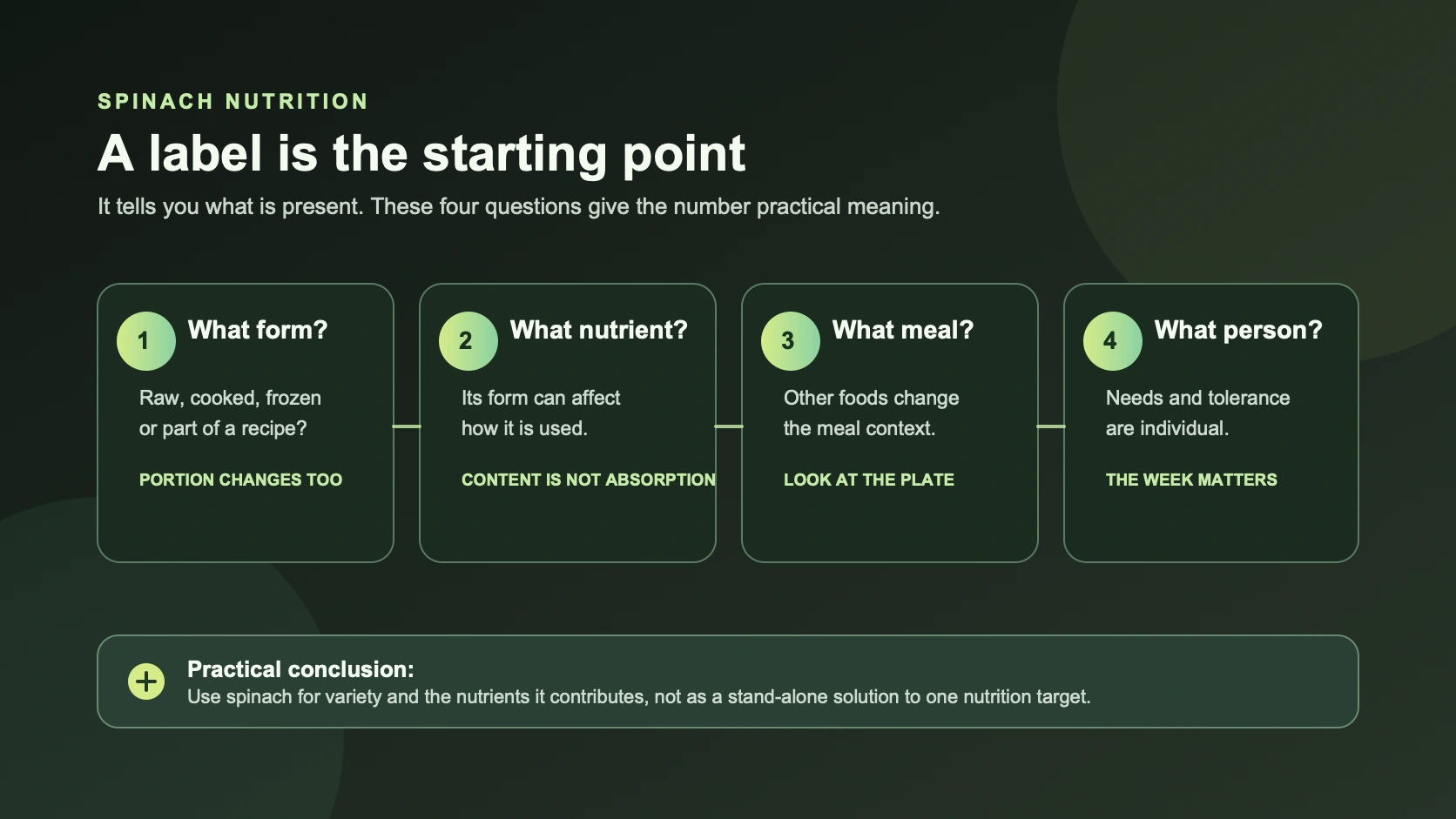
Nutrition labels and food databases are useful tools. They let you compare foods, plan meals and see why a vegetable may deserve a place in rotation. But a number on a label is not a performance score. It does not tell you exactly what portion you ate after cooking, how much of a nutrient remained in the dish, or how your body responded to the full meal.
That distinction applies to every food, not only spinach. Nutrient absorption can be affected by the nutrient’s chemical form, the amount in the meal, other foods eaten alongside it, food preparation and individual factors. The practical response is not to make eating complicated. It is to avoid building a dramatic claim around one database value.
The USDA FoodData Central entry for cooked, boiled and drained spinach illustrates why the vegetable gets attention. Per 100 grams, it lists notable amounts of vitamin K, folate, potassium, magnesium, calcium and iron. The exact comparison changes with raw versus cooked spinach, fresh versus frozen product, added fat or salt, and the portion in your bowl. A huge raw salad can cook down to a small serving; a handful added to eggs is not the same as a large side of cooked greens.
Spinach is nutrient-dense, not nutritionally complete
Spinach earns its place because it contributes several things at once. It can add folate, vitamin K, carotenoids, vitamin C, potassium and magnesium to a meal with very little preparation. It also works in formats that are easy to repeat: folded into eggs, stirred into a curry, blended into a soup, wilted beside potatoes, or added to a sandwich.
That is a better reason to eat it than the old cartoon idea that it makes you instantly strong. Spinach does not contribute much energy or protein compared with the foods that usually make a training meal substantial. If lunch is spinach, chicken and rice, spinach supports the plate; it does not replace the rice or chicken. If the meal is vegetarian, it can sit beside lentils, tofu, beans, yogurt or another protein source according to your diet.
This is why food categories should not compete for a single winner. Lentils for Lifters explains how a legume can contribute protein, carbohydrate, fiber and plant-based minerals in a different role. Spinach and lentils work well together precisely because neither has to do every job alone.
Oxalates are context, not a reason to fear greens
Spinach naturally contains oxalates. These compounds can bind with minerals in the food, which is one reason the calcium number on a spinach label should not be interpreted as equivalent to the same amount of calcium from every other food. A 2023 comparison of plant-based products found low calcium bioaccessibility for spinach and attributed that result in part to its oxalate content. Read the plant-food calcium bioaccessibility study for the methods and the specific foods compared.
The useful takeaway is modest: spinach can contribute calcium, but it is not the most dependable food to rely on if calcium is the specific nutrient you are trying to emphasize. That is not a verdict against it. The same meal can include other calcium-containing foods if they suit your diet, such as dairy, calcium-set tofu, fortified foods or lower-oxalate vegetables. Across a week, variety does more work than asking one leafy green to cover every mineral target.
Oxalate discussions can also become unnecessarily alarming. Most healthy people do not need to calculate the oxalate content of every meal. People who have been given individual dietary guidance for kidney stones, kidney disease or another medical condition should follow that guidance rather than changing their diet based on a general fitness article.
Iron content and iron absorption are not the same claim
Spinach contains nonheme iron, the form found in plant foods. That is a real contribution, but it is not absorbed in the same way as heme iron from meat, seafood and poultry. The NIH Office of Dietary Supplements iron fact sheet notes that vitamin C can improve nonheme iron bioavailability, while other dietary factors can reduce it. It also makes clear that the effects of individual foods are moderated within a typical mixed diet.
This is where the label can mislead if it is read as a promise. An iron number tells you that iron is present. It does not diagnose iron status, guarantee absorption or tell you that a spinach smoothie is a substitute for a balanced diet. That distinction matters especially for active people who see fatigue and assume a single food will solve it. Fatigue has many possible causes, and a food article cannot identify one.
It is also worth avoiding a common oversimplification: "oxalates mean spinach iron does not count at all." In a randomized crossover study, researchers comparing spinach and kale meals found that adding oxalic acid did not itself reduce nonheme iron absorption from the kale meal. Read the human isotope study of oxalic acid and nonheme iron for the details. That result does not make spinach a special iron supplement; it shows why one-compound explanations are usually too neat for a mixed meal.
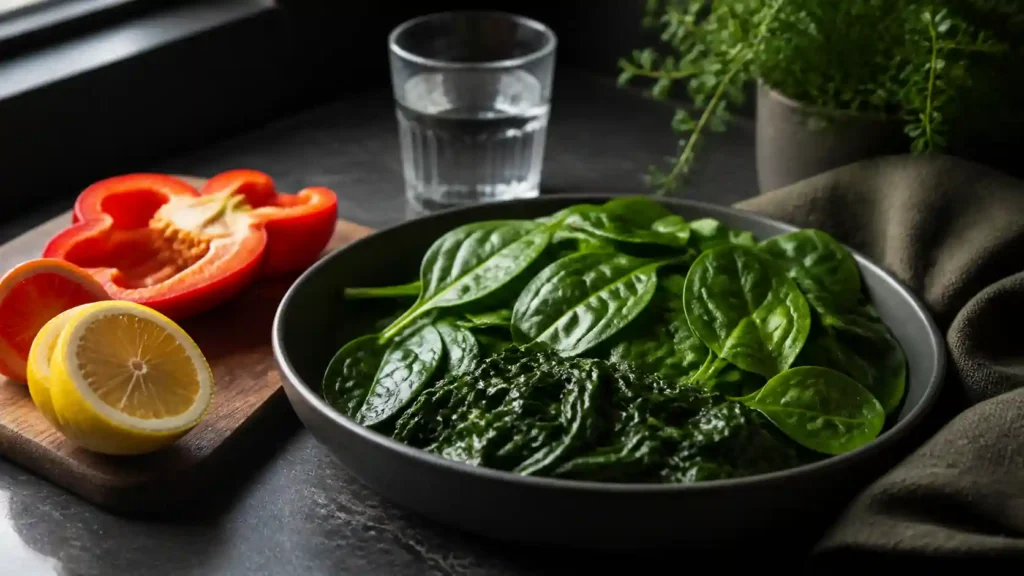
A practical meal can include spinach with foods you already enjoy, such as tomatoes, peppers, citrus, beans, eggs, fish or a protein source of choice. The goal is not to engineer every bite for maximum absorption. It is to build meals that are varied, satisfying and repeatable.
Raw, cooked and frozen each solve a different problem
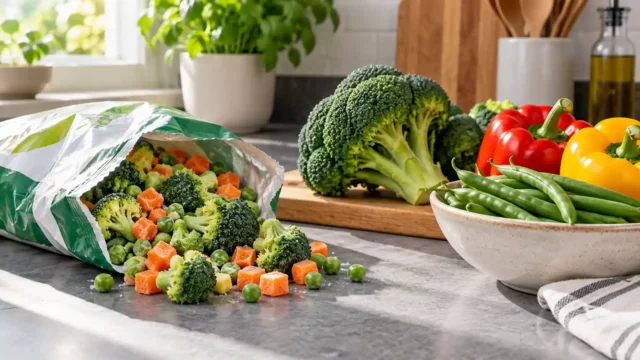
Raw spinach is convenient when you want volume and a fresh texture. Cooked spinach takes up less space and can be easier to add to a warm meal. Frozen spinach is inexpensive, keeps well and works in soups, curries and egg dishes. None is universally superior because the best choice depends on the meal and the amount you will use.
Cooking changes water content and can change what a serving looks like. Boiling and draining can move some water-soluble nutrients into cooking water; sauteing with oil changes the energy content; a prepared creamed-spinach side is not nutritionally identical to plain greens. These are ordinary recipe differences, not a reason to panic about preparation. Use the label or recipe when numbers matter, and use the form that makes spinach easier to eat regularly when they do not.
For a simple post-training meal, spinach can be one vegetable alongside a carbohydrate and protein base. Sweet Potatoes vs White Potatoes is a useful companion guide because it keeps the carbohydrate decision practical rather than turning it into a moral choice. Spinach can add color and micronutrient variety to either option without carrying the whole meal.
Make the food useful before making it impressive
Buy spinach in a form you will actually use. Keep a bag for omelets and sandwiches, add frozen spinach to a soup or pasta sauce, or make a simple side with olive oil, garlic and a protein meal. If it repeatedly goes slimy in the fridge, buy a smaller bag or choose frozen. Consistency is more useful than a perfect nutrient calculation for food you throw away.
Keep the bigger picture in view. Spinach is one useful green among many. Rotate it with kale, broccoli, peas, peppers, beans, fruit and other vegetables you enjoy. For another example of how a food’s numbers need meal context, see Chickpeas: Protein, Carbs, Fiber, Iron and Folate in One Food.
Spinach deserves its reputation as a nutrient-dense ingredient. It does not deserve the more dramatic claims made from a label alone. Use it for variety, convenience and the nutrients it contributes; let the rest of the meal and the rest of the week do the rest.
Continue with a related guide
For a practical look at plant-based minerals and meal context, read Lentils for Lifters. For another versatile legume in a training meal, continue with Chickpeas: Protein, Carbs, Fiber, Iron and Folate in One Food.