
Mechanical tension is one of the most repeated phrases in hypertrophy training, and for good reason. If muscle fibers are not challenged by force, they have little reason to grow. But the phrase is also easy to misuse. Mechanical tension does not simply mean "lift heavy." It means the muscle fibers experience meaningful force while they contract, and that signal is repeated often enough for adaptation to accumulate.
This matters because two sets can look similar from the outside but create different tension in the target muscle. A heavy sloppy rep may shift stress away from the muscle you meant to train. A lighter controlled set taken close to fatigue may recruit many fibers and create a useful stimulus. A deep range of motion may challenge a muscle differently than a short partial.
This article explains mechanical tension in practical terms. The short version: load matters, but useful tension depends on load, effort, range, technique, and progression together.
- What mechanical tension means
- Why it is central for hypertrophy
- Why heavy is not the only path
- How range and technique change tension
- How to apply the concept without overcomplicating training
Mechanical tension is force at the fiber level
When a muscle contracts against resistance, its fibers produce force. That force creates mechanical stress inside the tissue. Muscle cells can sense mechanical loading and respond through signaling pathways that contribute to remodeling.
The 2023 review on mechanical overload-induced skeletal muscle hypertrophy is a useful modern anchor because it treats overload as a complex biological process, not a single gym cue. Mechanical loading has to be detected, translated into cellular signaling, and accumulated through repeated bouts.
For lifters, the exact molecular details are less important than the training implication: the target muscle has to do real work. Not just movement. Not just sweat. Not just discomfort. Real force-producing work that can be progressed over time.
Why tension is central for growth
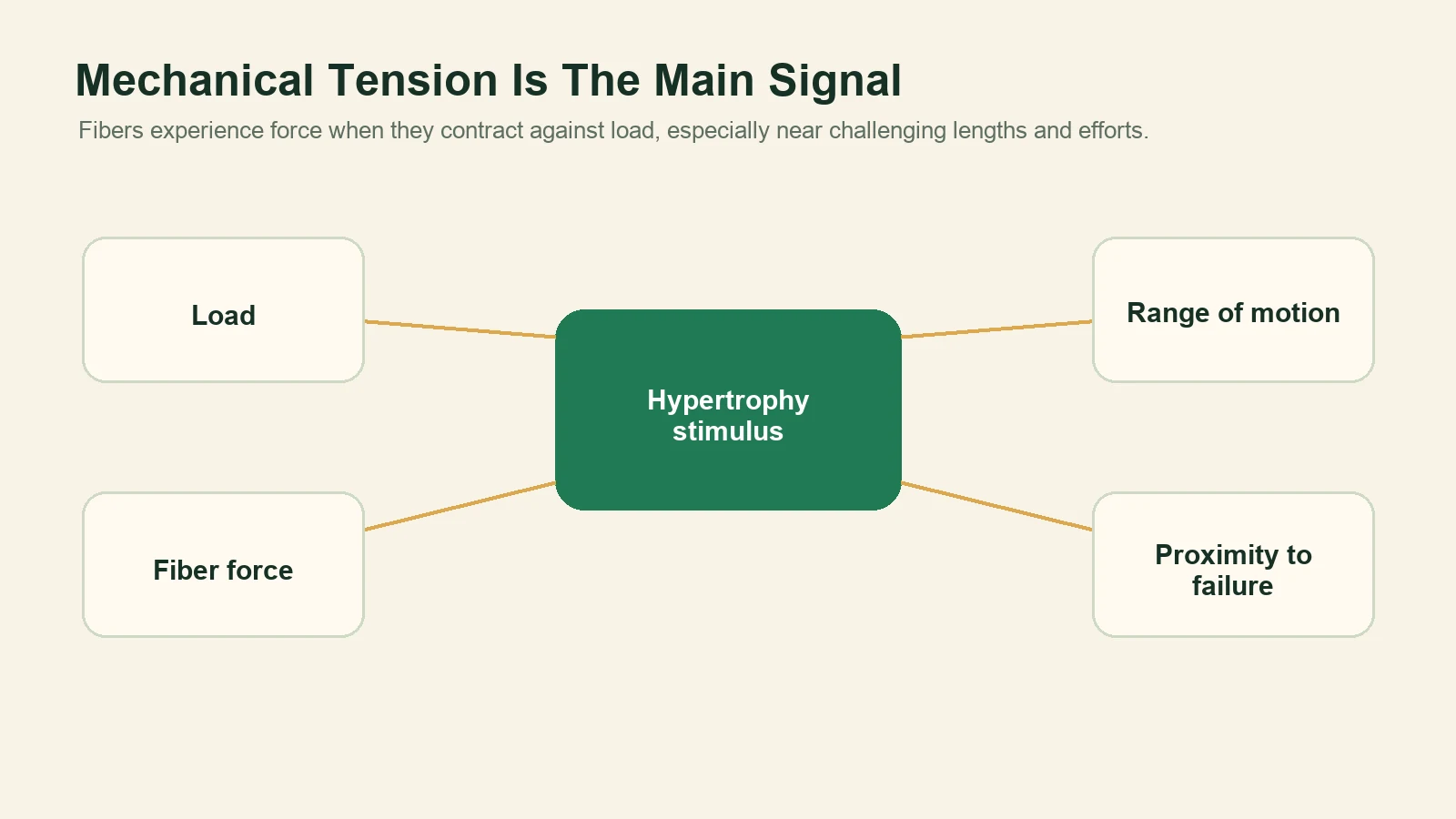
The Schoenfeld review on mechanisms of hypertrophy discusses mechanical tension as a primary proposed mechanism, alongside muscle damage and metabolic stress. The field has evolved since that paper, but tension remains the clearest practical target because resistance training is, at its core, force training.
If the weight is too easy and the set stops far from meaningful effort, few high-threshold fibers may be challenged. If the exercise does not load the target muscle well, another muscle or joint position may take over. If the program never progresses, the same tension signal may eventually become too familiar to keep driving change.
Mechanical tension is therefore not a vibe. It is the reason progressive resistance training works.
Tension must reach the fibers you care about
Mechanical tension is sometimes discussed as if the whole muscle receives the same signal. In practice, exercises can bias regions, ranges, and muscles differently. A movement may be hard overall while the target muscle is not the main limiter.
This is why exercise setup matters. A bench press can train the chest well, but if a lifter’s technique turns the movement into mostly front delts and triceps, the pec stimulus may be lower than expected. A row can train the upper back well, but if momentum moves the weight, the target muscles may receive less sustained tension.
The useful question is not only "Is this heavy?" It is "Which tissue is producing force, through what range, and can I repeat and progress that demand?"
Heavy loads create tension early
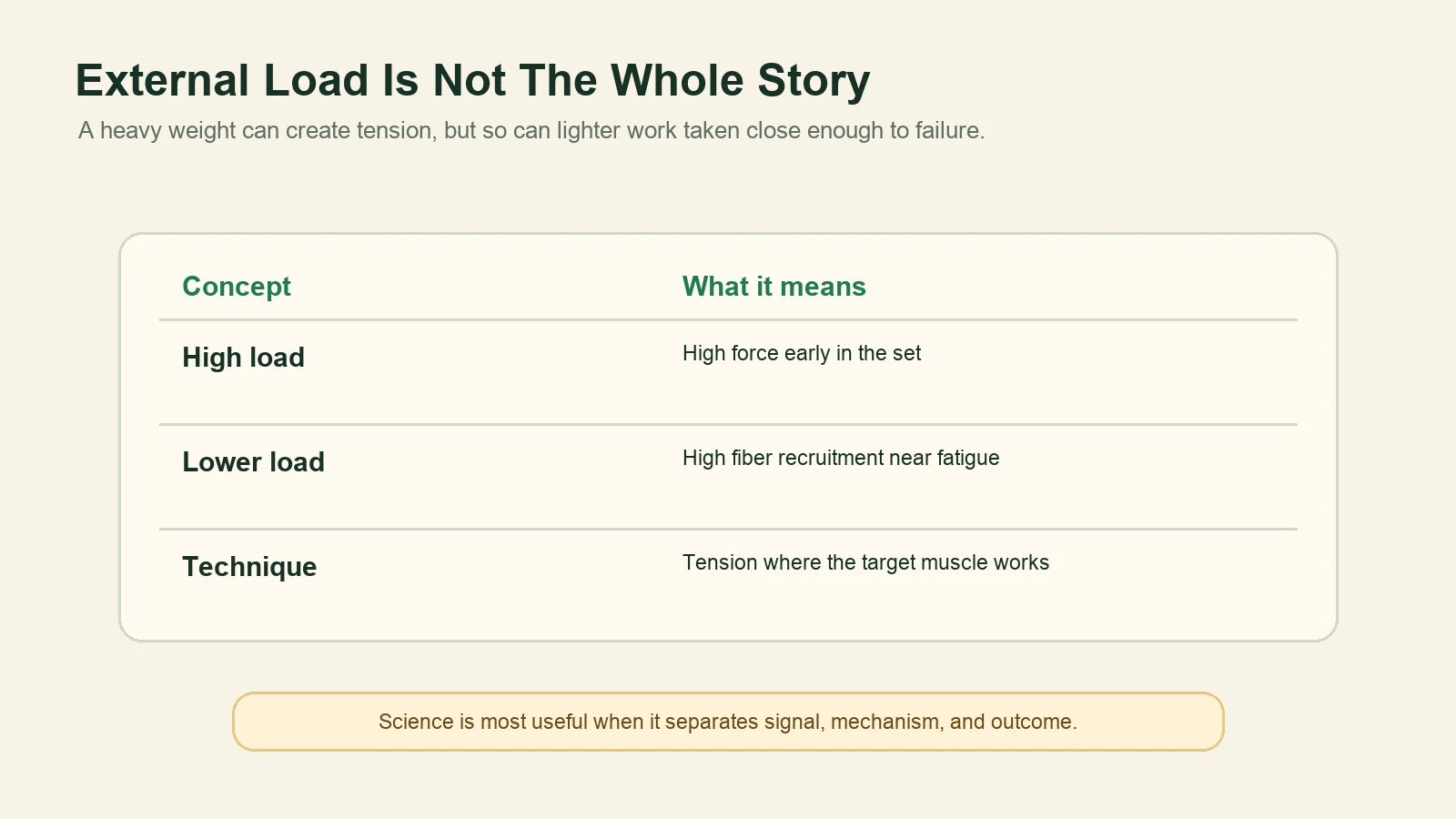
Heavy loads are an obvious way to create high tension. When a load is heavy, the body has to recruit a lot of force early in the set. This is one reason heavy compound lifts are so effective for strength and can contribute to hypertrophy.
But heavy loading has trade-offs. Very heavy work can be more fatiguing, require more skill, and limit total volume. It may also shift attention toward completing the lift rather than keeping tension on a specific muscle.
For hypertrophy, heavy work can be useful, but it does not need to dominate every exercise. Some muscles and movements are easier to train productively with moderate loads, controlled reps, and enough proximity to failure.
Lighter loads can create tension near fatigue
Lighter loads can also stimulate growth when sets are taken close enough to failure. As easier fibers fatigue, the body recruits more fibers to keep producing force. This is why higher-rep sets can be hypertrophic if they are hard enough.
The Lopez network meta-analysis found that hypertrophy can be broadly similar across low, moderate, and high loads when sets are taken to volitional failure, while strength gains tend to favor heavier loading. That fits the practical model: for growth, several loading zones can work; for maximal strength, heavier loading is more specific.
This does not mean every light set is useful. A set of 30 reps that stops with 15 reps in reserve is mostly warm-up or endurance work. A light set near failure can be hard enough to recruit fibers and create a growth stimulus.
Range of motion changes where tension happens
Mechanical tension is also affected by joint angle and muscle length. Some exercises challenge a muscle more in a lengthened position. Others peak in the shortened position. Some have fairly even resistance. This is one reason exercise selection matters.
For example, a dumbbell fly may load the pecs differently near the stretched position than a cable press. A squat challenges the quads and adductors through a different pattern than a leg extension. A Romanian deadlift loads the hamstrings at long muscle lengths more than many lying leg curl setups.
The point is not that one range is always magical. The point is that the target muscle should be challenged through a useful range that matches the goal and the lifter’s tolerance. If shortening the range lets you use more load but removes the hard part for the target muscle, tension may be less useful than it looks.
Lengthened positions deserve attention, not mythology
Recent training discussion often emphasizes long muscle lengths. There are good reasons to pay attention to loaded stretch positions: some exercises may create strong tension where the muscle is lengthened, and some research suggests that training at longer muscle lengths can be hypertrophic in certain contexts.
But this should not become another absolute rule. A lengthened position is useful only if the lifter can control it, tolerate it, and progress it. Forcing deep ranges that irritate joints or turn the target muscle off is not better science. It is just another way to chase a concept without checking the execution.
Use long ranges where they are safe and productive. Keep them honest. Add them gradually if they are new.
Technique determines who does the work
Technique is not only about safety or aesthetics. It determines where tension goes. A row can become mostly arms and momentum. A squat can shift away from the quads. A lateral raise can become a trap swing. A curl can become a hip hinge with elbows attached.
This does not mean every rep must be slow or perfect in a theatrical way. It means the execution should keep the target muscle meaningfully involved. If you cannot tell what muscle is doing the work, the exercise may need lighter load, better setup, or a different variation.
For hypertrophy, the best technique is the one that lets you apply progressive tension to the target muscle safely and repeatedly.
External load is what you lift. Mechanical tension is what the target fibers experience while producing force.
Progression keeps tension meaningful
A set that is challenging today may be easy in two months. That is adaptation doing its job. To keep growing, the program usually needs some form of progression.
Progression can mean:
- more load with similar reps and form;
- more reps with the same load;
- more total hard sets;
- better control through the same range;
- a harder variation;
- shorter rest only when it serves the goal.
Not all progression has to happen every week. In fact, forcing progression too aggressively can create fatigue and technique breakdown. But over a block of training, the demand should trend upward or become more refined.
Tension still needs enough dose
One perfect hard rep is not a hypertrophy program. Mechanical tension has to be delivered in a sufficient dose. That dose comes from hard sets, weekly volume, exercise frequency, and the ability to repeat the stimulus.
This is where lifters sometimes make opposite mistakes. One person uses heavy loads but too little total work to grow well. Another person does huge volume but with poor tension and no progression. Better programming sits between those extremes: enough hard work, enough target-muscle tension, enough recovery, and enough time.
How to apply this in training
Choose exercises that load the target muscle well. Use a range of motion you can control. Work hard enough that the set becomes challenging near the end. Keep technique honest. Progress gradually. Recover well enough to repeat quality work.
For many lifters, the sweet spot is not constant maximal loading. It is moderate-to-heavy work done with control, close enough to failure, across enough weekly volume. Heavy work can stay in the program, especially for strength. But hypertrophy does not require turning every set into a maximal lift.
Continue with a related guide
For the next practical step, read Metabolic Stress and Hypertrophy: Does It Matter?. For a second perspective from the same topic cluster, continue with Strength vs Muscle Size: What’s the Relationship?.
Conclusion
Mechanical tension is the main practical signal for muscle growth, but it is not just "heavy weight." It is meaningful force experienced by muscle fibers during repeated training. Load, effort, range of motion, technique, and progression all shape that signal.
If you want to use the concept well, keep it simple: make the target muscle do hard work through a useful range, repeat that work, progress it over time, and recover enough to adapt.
FAQ
Is mechanical tension more important than the pump?
For hypertrophy, mechanical tension is the primary practical signal. The pump may contribute or indicate hard work, but it cannot replace meaningful tension.
Do I need heavy weights for mechanical tension?
Heavy weights are one way to create tension, but lighter loads can also be effective when sets are taken close enough to failure and the target muscle is doing the work.