
Starting strength training can feel like opening a cockpit full of controls. There are programs, exercise variations, rep ranges, machines, free weights, apps, and confident people telling you that their method is essential. In the first 100 days, most of that complexity is optional. Your job is not to prove how hard you can train. It is to build a training practice you can repeat long enough to learn from.
This guide is for healthy adults who are new to structured resistance training. It assumes basic access to dumbbells, machines, or a barbell setup, but the principles work across all three. The priority is a small number of movements, a conservative starting dose, and a log that shows whether your plan is becoming easier to repeat. If you have sharp pain, new neurological symptoms, recent surgery, or a condition that changes how you should exercise, get individual advice from a qualified clinician or coach before trying to push through it.
The ACSM progression models position stand remains a useful starting reference because it frames resistance training as a process of manipulating exercise choice, load, volume, rest, and progression rather than chasing one universal routine. The newer network meta-analysis of resistance-training prescriptions reaches a compatible practical conclusion: several prescriptions can improve strength in healthy adults. For a beginner, the best one is usually the plan you can perform well and repeat.
- What the first 100 days are really for
- How to choose movements and a weekly schedule
- How hard to train without turning every set into a test
- How to progress and what to record
- When to adjust, pause, or ask for help
The first goal is skill, not a dramatic number
Strength is specific. You get better at the patterns you practice, with the setup, range of motion, load, and tempo you repeat. Early gains often come from learning how to coordinate a movement and apply force more efficiently, not from an overnight physical transformation. That is why a calm, repeatable first phase can be more productive than changing exercises every session.
Our guide to how muscle gets stronger explains why strength is more than muscle size: motor learning and repeated exposure matter, especially early on. In practical terms, this means you should give yourself enough repetitions with the same broad patterns to learn where your feet go, how you set up, how much range of motion you tolerate, and what a controlled final repetition looks like.
The first 100 days are roughly fourteen weeks. That is long enough to establish a real rhythm, but short enough to keep the plan deliberately simple. You do not need a dramatic “transformation phase.” You need a stable base.
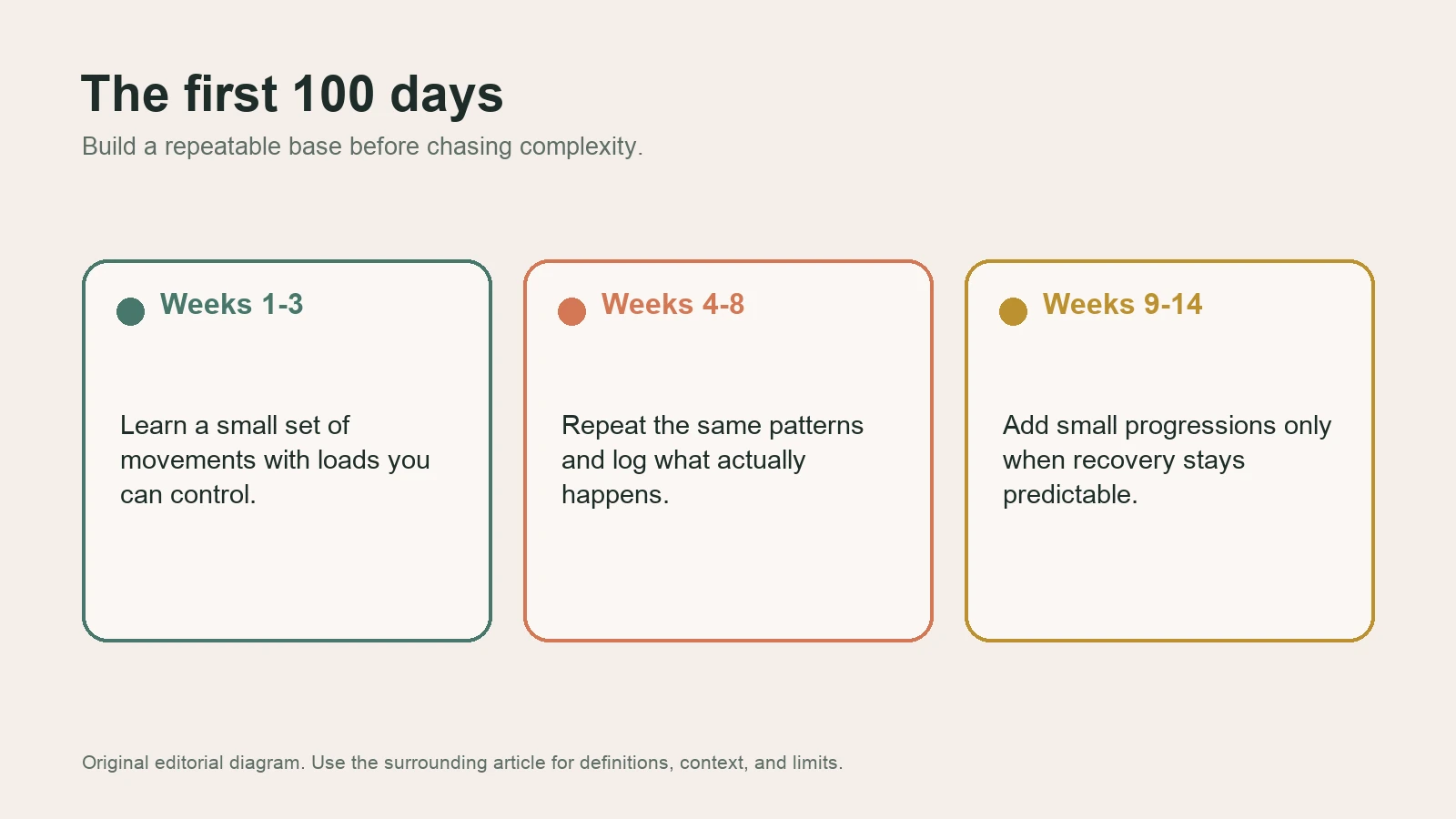
Days 1-21: learn the room and the movements
Your first few weeks should feel almost underwhelming. Choose movements that you can set up safely, understand, and repeat. For many people, that means a squat or leg-press pattern, a hip hinge or bridge, a press, a row or pulldown, and possibly a carry or simple trunk exercise. A barbell is not mandatory. Dumbbells, cables, machines, and bodyweight variations are valid tools if they let you practice the movement with control.
Start with a load that leaves clear room before your form changes dramatically. A useful beginner cue is to stop a set while you believe you could still perform roughly two to four controlled repetitions. This is not a laboratory measurement. It is a practical way to avoid turning every working set into an all-out test while you are still learning the pattern.
Use the same setup notes every time. Record the machine seat position, bench angle, dumbbell weight, bar height, or foot placement that made the movement feel stable. Those ordinary details make the next session easier to reproduce.
Days 22-56: repeat before you add
The middle phase is where many beginners become impatient. The initial novelty fades, soreness may become less dramatic, and social media offers a new exercise for every possible angle. Resist the urge to rebuild the plan just because it no longer feels novel.
Repeat the same main movements and look for small signs of improvement: a rep performed with cleaner control, the same load feeling less chaotic, or a session that leaves you less exhausted afterward. This is also the phase where you learn what fits your actual week. If a three-day plan repeatedly becomes two days, adjust the plan to two reliable sessions rather than carrying guilt into the following week.
The useful question is whether the weekly dose is large enough to practice and small enough to repeat. The Volume Sweet Spot gives that decision a practical framework.
Research on frequency is useful here because it removes some false urgency. A systematic review and meta-analysis on resistance-training frequency found that apparent benefits of higher frequency for strength were largely explained by higher total volume; when volume was equated, frequency alone did not show a significant advantage. A beginner does not need more days merely because more days sound serious. Use the number of sessions that lets you perform useful work and recover.
Days 57-100: earn small progression
After several weeks of reliable practice, add progression in small, observable steps. The easiest progression is often “double progression”: keep a sensible repetition range, such as six to ten or eight to twelve, and add repetitions with the same load before adding a small amount of weight. For example, if you complete three sets of eight with clean control this week, you might aim for three sets of nine next time. Once the top of the range is consistently controlled, a small load increase may make sense.
Do not increase load merely because a calendar says it is week eight. Add it when the last few sessions show stable technique, completed work, and recoverable fatigue. If the new load makes the movement look and feel completely different, it was probably too large a jump.
Build a session around movement patterns
A good first program is not a list of every exercise you have seen. It is a handful of movement slots. Each slot can be filled with an option that matches your equipment, skill, and comfort.
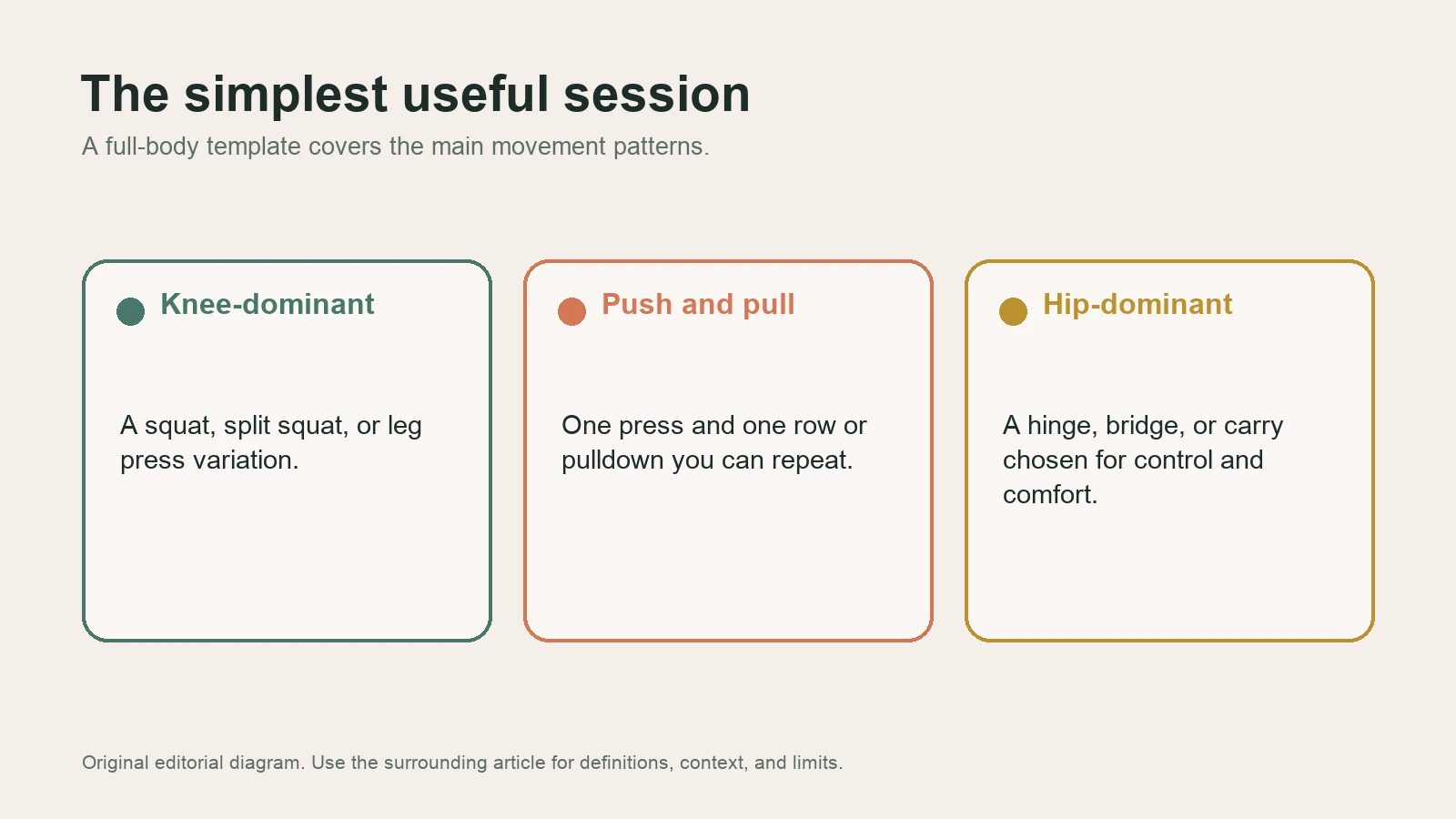
Here is a useful full-body template for two or three weekly sessions:
| Movement slot | Examples | First target |
| — | — | — |
| Knee-dominant lower body | goblet squat, leg press, split squat | 2-3 controlled sets |
| Push | dumbbell bench press, machine chest press, push-up variation | 2-3 controlled sets |
| Pull | cable row, chest-supported row, pulldown | 2-3 controlled sets |
| Hip-dominant lower body | Romanian deadlift, hip bridge, cable pull-through | 2-3 controlled sets |
| Optional support work | carry, calf raise, simple trunk work | 1-2 controlled sets |
You do not have to use every slot in every session forever. The point is to avoid a program that is all pressing, all leg work, or all novelty. If one movement is uncomfortable, change the variation or reduce the range of motion rather than assuming there is a single perfect exercise you must force.
Train hard enough to learn, not hard enough to collapse
Beginners often ask how sore they should be. Soreness is not a reliable scorecard. A new movement can create soreness, but it does not prove that the session was productive. Likewise, a session with little soreness can still be useful if you practiced, applied an appropriate dose, and can return to train again.
Use a simple session structure: warm up with lighter versions of the first movement, perform your planned working sets with ordinary rest, and finish before technique becomes a negotiation. Rest long enough that the next set can be performed with comparable intent. There is no prize for cutting every rest period short when the result is a visibly worse repetition.
The first month is also not the time to test a one-repetition maximum. You can become stronger without proving your maximum. Learn to perform moderate sets consistently, then let heavier work enter later if it serves your goal and you can set it up safely.
Keep a log that answers useful questions
A training log can be a notebook, spreadsheet, or phone note. It should answer five questions after every session:
- What exercise did I perform?
- What load, sets, and repetitions did I complete?
- Did the setup or range of motion change?
- Did any pain, unusual symptom, or equipment problem appear?
- What is the smallest reasonable next step?
Your log is not a diary of motivation. It is a record that lets you separate a true trend from one unusually good or bad day. If you cannot tell whether you improved, simplify the record rather than adding more metrics.
Common first-100-days mistakes
The most common error is trying to progress every variable at once: more exercises, more days, more load, more sets, less rest, and a stricter diet. That makes it difficult to know what helped and difficult to recover from the whole plan.
Other avoidable mistakes include:
- changing the whole program after one disappointing session;
- treating sharp pain, numbness, dizziness, or worsening symptoms as “normal training discomfort”;
- copying loads or exercise choices from someone with a different history and body;
- skipping basic setup notes, then guessing again next session;
- using exhaustion as the only measure of whether the workout counted.
If a movement produces sharp or escalating pain, stop that movement and seek appropriate assessment rather than trying to diagnose yourself from a program template. For ordinary uncertainty about technique, a qualified coach can help you find a variation, setup, or range of motion you can practice confidently.
The first 100 days, in one sentence
The winning beginner plan is rarely the most impressive-looking plan. It is the one that gives you enough high-quality practice to learn the movements, enough recovery to come back, and enough simple data to make the next adjustment calmly. Treat the first 100 days as an apprenticeship in consistency. Once you can repeat the basics, the advanced choices become much easier to evaluate.
Continue with a related guide
For the complete programming framework, read The Anatomy of a Great Strength Program. For a repeatable first template, continue with Your First Strength Program Should Be Boring — That’s Why It Works.