The squat, bench press, and deadlift have a special place in strength culture. They are the competition lifts of powerlifting, the center of countless beginner programs, and the source of more arguments than almost any other exercises. Their reputation can create two equally unhelpful ideas: that every serious lifter must perform all three with a barbell, or that the lifts are old-fashioned relics with nothing useful to offer outside a competition platform.
Neither idea is right. The big three remain valuable because they make several important things visible at once: you can practice a multi-joint movement under load, use the same setup repeatedly, and track gradual change. They are not magic. They are also not the only route to strength. A dumbbell, machine, or bodyweight variation can train the same broad movement family when it better fits your equipment, experience, or tolerance.
This article explains why the lifts still matter and how to decide whether the exact barbell versions belong in your program. It is not a substitute for individual coaching, medical assessment, or pain diagnosis. Stop a movement that produces sharp pain, numbness, dizziness, or symptoms that worsen, and get appropriate help rather than trying to “fix” it through a generic checklist.
- What the big three represent
- Why they are useful for strength development
- How to choose a variation that fits you now
- What beginners should prioritize before heavy testing
- When a different exercise is the better choice
The big three are movement tools, not a membership test
At a broad level, the three lifts represent three useful movement families:
- the squat is a knee- and hip-bending lower-body pattern;
- the bench press is a horizontal pressing pattern;
- the deadlift is a hip-hinge pattern that starts from the floor or a raised position.
Each movement asks several joints and muscle groups to contribute while the lifter manages position, balance, and force. That makes the lifts efficient tools for practicing strength, but efficiency is not the same as universal suitability.
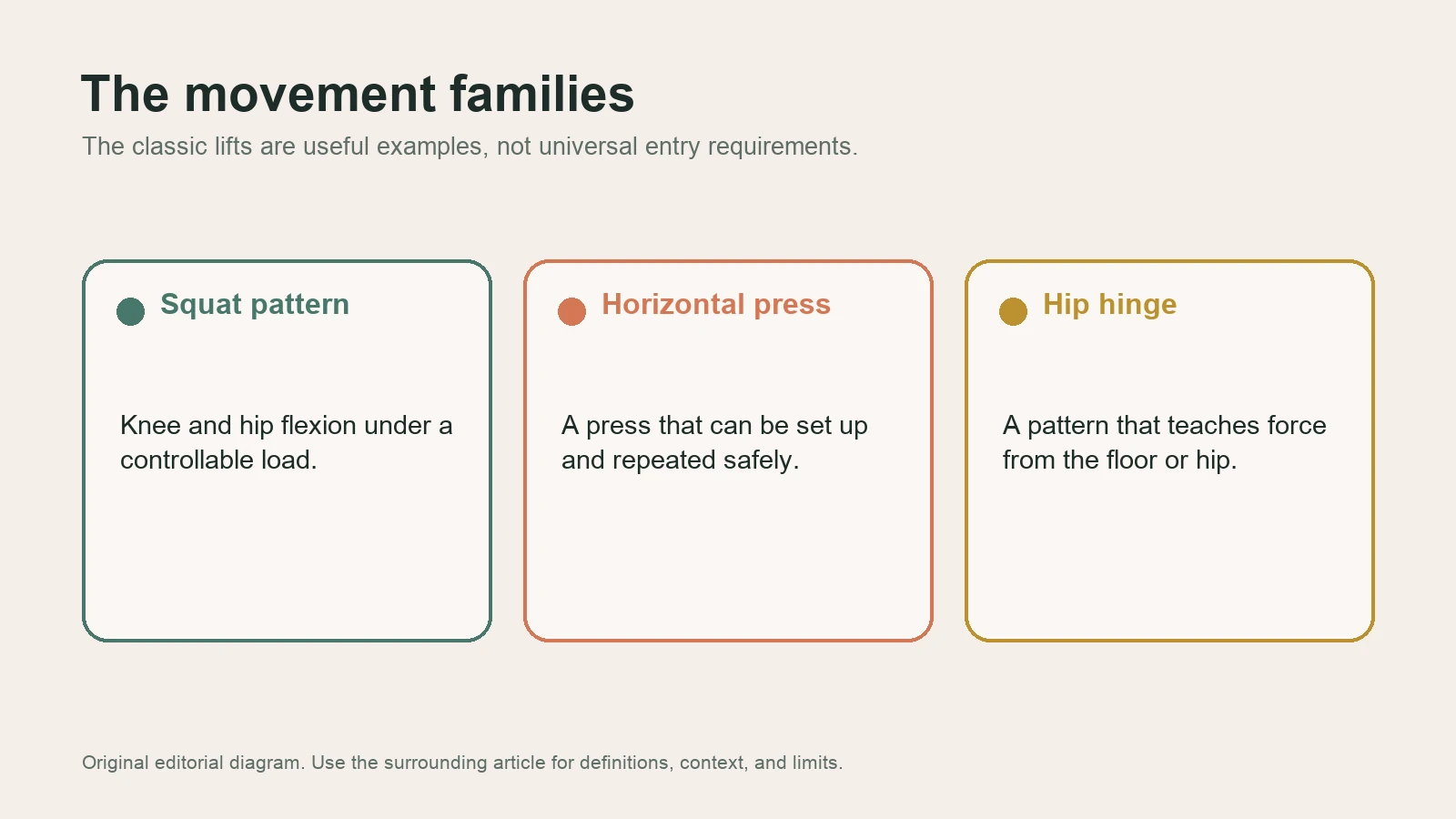
The ACSM progression models position stand recommends resistance-training exercise choices that reflect the training goal and the trainee’s experience. That principle matters more than the name of the implement. A goblet squat can be a sensible first squat pattern. A machine chest press can be a sensible first horizontal press. A Romanian deadlift, hip thrust, or cable pull-through can be a sensible way to learn hip extension before a conventional deadlift from the floor.
The classic lifts simply make the categories easy to see. They give training a common language and offer a stable target for people who enjoy practicing them.
Why these lifts remain useful
The big three reward repeated practice. You can set a bar height, choose a range of motion, add small plates, and compare this week’s performance with the last several sessions. That does not mean the numbers are the only outcome that matters. It means the movements provide feedback that is concrete enough to guide a program.
They also expose the difference between strength and a single muscle group. A squat depends on lower-body force, bracing, balance, depth control, and coordination. A bench press depends on pressing strength, shoulder position, a stable base on the bench, and the ability to reproduce the bar path. A deadlift depends on a controlled setup, a hip hinge, grip, and the ability to keep the bar close while force is applied.
That complexity is why the lifts are interesting, but it is also why beginners should not treat the first session as a performance test. Our guide to how strength develops explains that movement-specific skill and neural coordination contribute to strength, especially early in training. You learn the lift by performing versions you can control, not by repeatedly demonstrating the heaviest load you can survive.
The review of sticking points in the squat, bench press, and deadlift is a useful reminder that each lift has positions where the mechanical demand changes. There is no single cue that solves every difficulty for every body. A controlled setup and a reproducible range of motion give you a much better chance of identifying what actually needs practice.
Start with the variation that makes learning possible
“Start with a barbell” is not universal beginner advice. The right starting variation is the one you can set up reliably, perform without sharp pain, and repeat frequently enough to learn. Equipment, coaching access, mobility, body proportions, and confidence all change that decision.
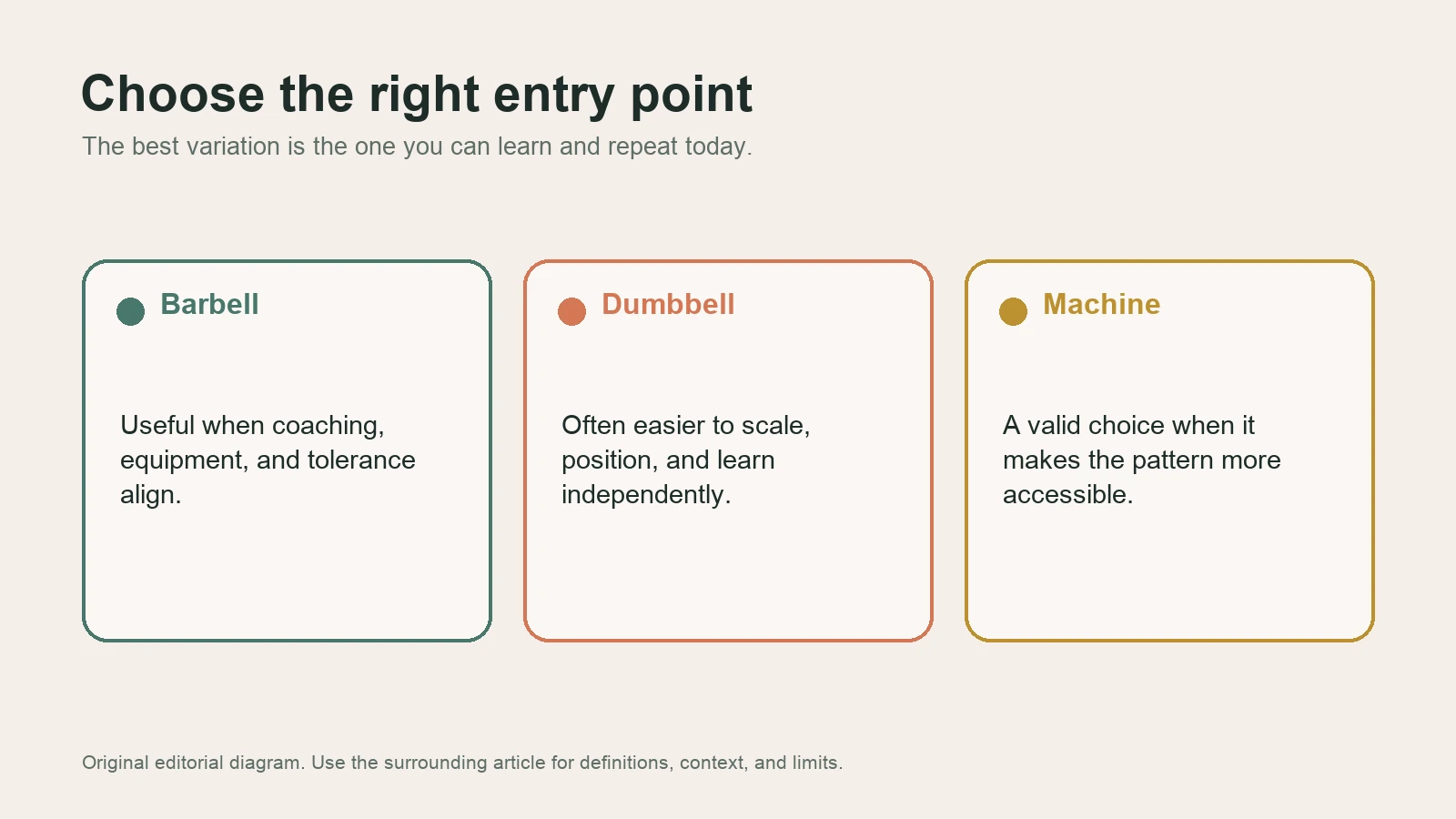
The Delphi study on exercise selection for novices supports a similar practical approach: novice exercise choice should account for technical demands and available progression options. It is expert consensus rather than a guarantee about an individual body, but it reinforces a sensible rule: choose an entry point that lets you build skill safely instead of making every session a technical rescue.
| Movement family | Barbell option | Accessible alternatives |
| — | — | — |
| Squat pattern | back squat, front squat | goblet squat, split squat, leg press, box squat |
| Horizontal press | barbell bench press | dumbbell bench press, machine press, elevated push-up |
| Hip hinge | conventional deadlift | Romanian deadlift, trap-bar deadlift, hip bridge, cable pull-through |
Alternatives are not lesser versions. They are tools. A machine can let someone train a pressing pattern with a stable setup. Dumbbells can allow a comfortable hand path and smaller load jumps. A raised bar or trap bar can change the starting position of a hinge. If an alternative is measurable and repeatable, it can support meaningful progression.
Coaching and environment are part of the choice as well. A standard bench press is easier to learn when you have a stable bench, sensible rack height, and a spotter or safety setup appropriate to the load. A barbell squat may be practical in a well-equipped gym but awkward in a crowded room with no safe rack. A deadlift variation from blocks may be easier to set up consistently than a floor pull when plates, platform height, or confidence are limited. Choosing the variation that makes practice possible is good programming, not a compromise in standards.
What to focus on before lifting heavy
Before worrying about a personal record, make the setup repeatable. For each lift or variation, you should know:
- where you place your hands and feet;
- what range of motion you are using today;
- how you begin the repetition;
- what a controlled last repetition looks like;
- what symptom or loss of position tells you to stop the set.
Use loads that allow a deliberate setup and avoid rushing to failure. You do not need to max out to become stronger. The 2023 prescription network meta-analysis found that several resistance-training prescriptions improve strength in healthy adults. Higher loads tended to maximize strength gains, but that does not erase the role of gradual exposure. A load only helps if you can use it with a setup you understand and recover from the training it creates.
For a beginner, two or three work sets in a moderate repetition range can provide plenty of practice. Rest long enough to repeat the next set with a similar quality of movement. If the first set looks controlled and the third becomes a different movement entirely, adjust the load, repetitions, or rest before adding more complexity.
Use a practical filter, not a purity test
The best lift for your program should pass three tests: it is tolerated, repeatable, and measurable.
Tolerated means it does not create sharp pain or worsening symptoms during the exercise. Repeatable means you can recreate the setup, range of motion, and basic execution next week. Measurable means you can record a load, repetition range, or quality marker and see whether the work is improving.
If a barbell back squat fails that test right now, use another squat pattern. If benching without a spotter is not practical, use dumbbells, a machine, or push-up variations. If conventional deadlifts are difficult to set up or do not feel right, use a raised start, a trap bar, or another hip-dominant exercise. There is no virtue in choosing the most demanding variation before you have the conditions to practice it well.
The squat, bench, and deadlift still rule strength training because they are clear, durable examples of loaded movement practice. Their real value is not that they make someone look like a serious lifter. Their value is that, when chosen appropriately, they give a program structure, feedback, and a skill worth developing. Start with the movement family. Let the exact tool earn its place through comfort, consistency, and useful progress.
That final point matters over the long term. Some lifters will eventually enjoy testing the classic three with a barbell, and others will build impressive strength through close variations. Both can be legitimate outcomes. The program should serve the person and the goal, rather than asking the person to serve the mythology of a lift. Keep the standard high, but keep the tool appropriate.
Continue with a related guide
For the practical equipment layer, read The Powerlifter’s Gear Guide. If competition is the goal, continue with Your First Powerlifting Meet: The Gear That Actually Belongs in Your Bag.