

Training hard is not the same as trying to prove something every time you enter the gym. Both can involve effort, heavy weights, uncomfortable sets, and a serious attitude. The difference is the job the session is meant to do.
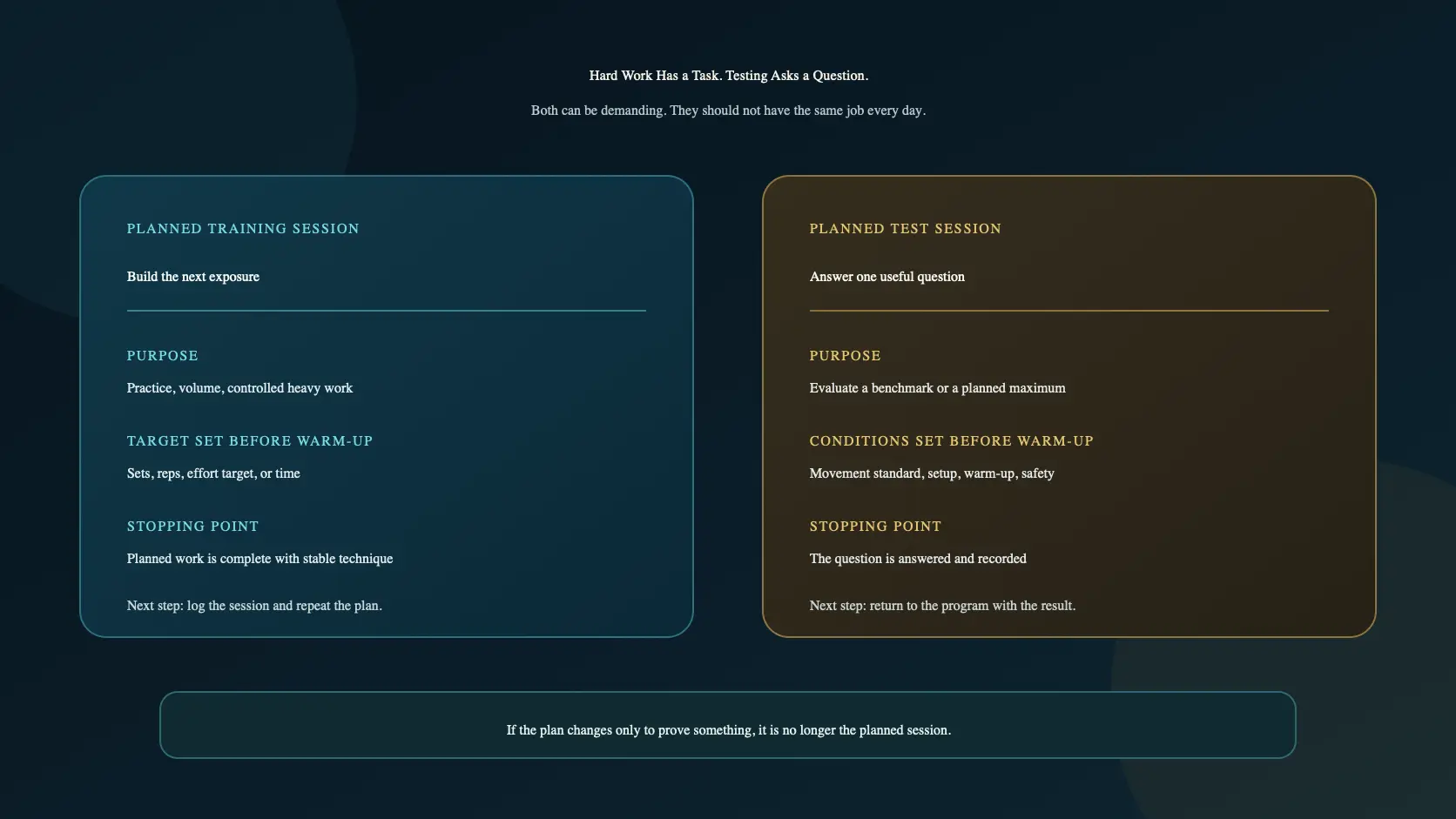
A hard session can build strength, practice a movement, accumulate useful volume, or improve work capacity. It has a target that was chosen before the warm-up and an endpoint that lets you return to the plan. A test is different. It asks a specific question: can I lift this weight today, beat this repetition record, or perform this benchmark under comparable conditions?
Tests have a place. They can make progress visible and help you decide what to do next. The problem starts when every working set becomes an unplanned audition. Then normal training feels inadequate unless it ends in a grinder, a personal record, or exhaustion. That makes the program harder to repeat and the feedback harder to trust.
- Define the two jobs clearly
- Recognize when a session has become proof-seeking
- Write the stopping point before you start
- Use tests at planned moments
- Return to the program without compensation
Hard work has a task, not just a feeling
The word “hard” describes effort, but effort alone does not explain whether a session was useful. Three demanding sets of squats can be hard because you are practicing strong, controlled repetitions at the load your program calls for. The same three sets can become a poor test if you add weight simply because the warm-up felt good and then grind every repetition to see what happens.
This is why a well-built program needs more than a list of exercises. The Anatomy of a Great Strength Program explains how exercise selection, progression, volume, and recovery work together. A session only makes sense inside that larger job. If a day is meant to build repetitions, it does not become better because you turn it into an impromptu maximum.
Hard training can include high effort. It can include a difficult final set, heavy singles that are not maximal, or a demanding conditioning interval. The useful distinction is whether the effort was selected in advance and whether it leaves the rest of the week intact.
A test needs an explicit question
A real test has a question, a standard, and conditions you can repeat. “Can I make a clean single at this load after a sensible warm-up?” is a question. “Can I beat last month’s five-repetition set using the same variation and range of motion?” is another. Decide what counts before the attempt: depth, pause, range, setup, equipment, and the point where technique changes enough that the answer is no longer useful.
Signs that the session has become proof-seeking
It usually happens in small moves: an extra plate because someone else is lifting nearby, a last set taken far past the target, or a new exercise added because the planned one suddenly feels too ordinary.
Watch for a few common signals:
- You change the load target without a programming reason.
- Every last set has to be a grinder to feel complete.
- You add “make-up” sets after finishing the written work.
- You change exercises mid-session to chase a better number.
- A merely solid session feels disappointing because there was no record.
These choices replace a useful question with an emotional one: “Was I tough enough today?” That question does not help you adjust next week’s loading or keep a consistent log.
The comparison problem can make this worse. A hard set may stop feeling like enough after seeing a larger lift online or across the room. The practical response is not to become less ambitious. It is to keep the current session tied to its original purpose. Your PR Is Someone Else’s Warm-Up – So What? makes the same point from another angle: a result is only useful when it is compared with your own conditions, not used as a ranking contest.
Write the end condition before the warm-up
The simplest protection against accidental testing is to write the target before you start: three sets of five at a planned load, two sets with two repetitions in reserve, or twenty minutes at a repeatable pace. Decide what “enough” looks like while your judgment is calm.
For strength work, an end condition might be, “Complete three clean work sets; do not add load if technique changes materially.” For a heavier exposure, it might be, “Take one confident single, then do the back-off work.” You can work seriously without negotiating after every set about whether there is more to prove.
A 2022 systematic review and meta-analysis on training to repetition failure found greater acute fatigue markers after failure work than after non-failure work in the included comparisons. That does not make failure training forbidden, and it does not mean every hard set needs a large buffer. It does support a practical idea: more effort has a cost, so it should serve a purpose rather than become the default ending for every exercise.
Schedule tests so they can answer something
Testing is most useful when the answer can change the plan: at the end of a block, before a competition, after technique practice, or when you need a training maximum. It does not need to happen weekly for progress to be real.
Warm up in a repeatable way, choose the movement standard in advance, use appropriate safeties, and record the result before chasing another attempt. If the test is especially demanding, arrange the surrounding work accordingly. Maximal effort is not free.
Adjust the day without turning it into a verdict
Some days do not match the plan. If the warm-up is unusually heavy or technique is less stable, use a proportionate adjustment: reduce a set, lower the load modestly, or choose the minimum useful version. How to Train When You Don’t Feel Like Training can help when readiness is uncertain. If fatigue is building across several sessions, review the block rather than force a benchmark; see When Your Program Is Asking for a Deload.
Do not use this framework to ignore pain, illness, dizziness, or an unsafe movement. General training advice cannot diagnose a symptom.
Do not compensate after a normal session
Do not treat an ordinary day as a debt. If you reduced one set because recovery was poor, do not try to make it up tomorrow. Log the planned target, actual work, and reason for any change, then return to the next scheduled session. Ordinary exposures build the trend that makes a later test meaningful.
Conclusion
Training hard means completing demanding work that has a purpose and an endpoint. Making every session a test means asking your body for proof before it has had time to build the next answer. The first approach creates usable data and repeatable practice. The second can make effort feel exciting while making progress harder to evaluate.
Write the target before the warm-up. Decide what ends the session. Test when you have a question worth answering under conditions you can repeat. Then let the next ordinary workout do the quiet work that testing cannot replace.
FAQ
Is it bad to train to failure?
No. Training to failure can be a deliberate tool in some exercises and phases. The important point is that it should have a role in the program, not be required for every set to feel worthwhile.
How often should I test a personal record?
There is no universal schedule. Test when the result would answer a clear programming question and when you can control the movement standard and surrounding recovery. Many blocks need more practice than testing.
Can a hard session still feel easy mentally?
Yes. A clear plan can make difficult work feel calmer because you are not constantly deciding whether to add more. Mental drama is not a reliable measure of training quality.
Continue with a related guide
For a practical way to set productive training targets, read The Anatomy of a Great Strength Program. For a second perspective on using records without letting them control the process, continue with Your PR Is Someone Else’s Warm-Up – So What?.