Most bench press plateaus are not solved by a new cue, a dramatic accessory, or a weekly max. They are solved by making the lift easier to recognize from one session to the next. If the bench, grip, range of motion, pause, loading and effort target change every time, the number on the bar is not telling one clear story.
A practical bench press blueprint has four parts: define the version of the lift you are improving, practice it often enough to learn it, progress one variable at a time, and review the work before adding more. The aim is not a perfect-looking bench press. It is a repeatable task you can train hard enough to improve and safely enough to practice again.
This guide is for healthy adults training a barbell bench press for general strength or powerlifting. It cannot diagnose shoulder, elbow, wrist, chest or neck symptoms. Stop if a repetition brings sharp or escalating pain, new numbness, dizziness, weakness or symptoms that worsen, and seek individual assessment rather than trying to force a generic program through the problem.
- Define the lift you are trying to improve
- Build a setup you can repeat
- Use two purposeful weekly exposures
- Progress the main lift before adding noise
- Use accessories to support a specific job
Define one comparable bench press
“Bench press” can describe several different tasks. A paused rep, touch-and-go rep, close-grip press, feet-up variation and machine press may all be useful, but they should not be treated as the same performance test. Before you chase a number, write down the version you mean to improve: barbell and bench, grip width, touch point, range of motion, whether you pause, and whether you use a spotter or safety arms.
This is not needless precision. The review of sticking points in the squat, bench press and deadlift shows why the difficult portion of a lift is not one universal location with one universal cue. A stable version of the movement gives you a better chance of noticing whether the issue is setup, control, exposure to the lift, or simply a load that is not ready to move yet.
If you train alone without a reliable spotter or adjustable safety arms, do not turn bench press into a risk-management test. Use a load you can control, set the safeties appropriately when your equipment allows it, or choose dumbbells, a machine press, push-ups or another horizontal press for that day. The Big Three guide explains why the movement pattern matters more than forcing one implement in every situation.
Make the setup repeatable before making it heavier
The setup is the first rep. Use a bench and rack height that let you unrack without losing position. Put your feet in a place you can recreate. Choose a grip that feels stable and record it. Bring the bar down under control to the same general touch point, then press along a path you can repeat.
The goal is not to copy another lifter’s arch, grip width or bar path. Bodies, mobility, equipment and competition rules differ. The goal is to make your own setup clear enough that a change in the log means something. If one week uses a long pause, another bounces the bar, and the next changes grip by several fingers, the comparison is already broken.
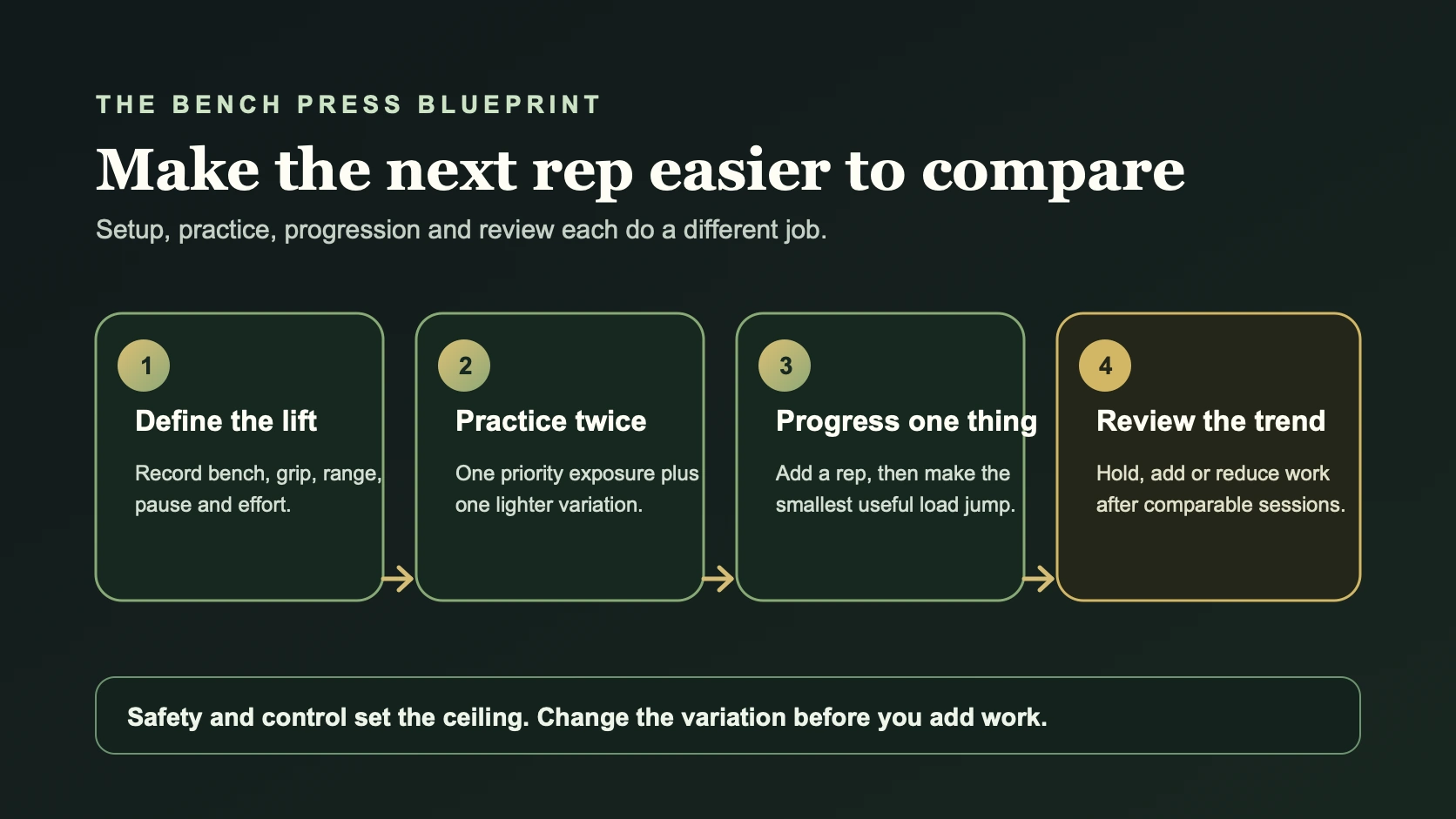
Record only details that change the task: the barbell version, load, repetitions, sets, pause or no pause, and an honest estimate of repetitions in reserve. Our guide to RPE and RIR explains why this is more useful than writing one vague number for an entire session.
Practice it twice before adding a third day
For many beginner and intermediate lifters, two bench-focused exposures per week are a useful starting framework: one day that makes the main lift the priority, and another that repeats the pattern at a lighter load, a different repetition range, or a close variation. It is an example, not a requirement. One good session can be enough for a constrained schedule; three may work when the total dose and recovery are carefully managed.
Here is a simple starting structure for someone who can bench safely with an appropriate setup:
| Day | Main work | Purpose |
| — | — | — |
| A | 3 sets of 5-8 controlled barbell reps | Practice the primary bench press with attention and useful load |
| B | 2-3 sets of 8-10 controlled reps, using a lighter bench or close variation | Add practice without turning every exposure into a test |
Keep several repetitions in reserve at first. The purpose is to learn what a stable work set feels like, not to make each session a survival event. The ACSM progression models position stand treats load, volume, frequency and exercise order as connected training variables. More bench days are not automatically better if they make the primary work rushed or poorly recovered.
The evidence also does not require a fixed number of weekly visits. In a study comparing three and six resistance-training days, similar outcomes were found when the weekly volume and intensity were equated. Frequency can help distribute practice. It does not replace useful work.
Progress one variable at a time
The simplest progression is usually enough. Choose a repetition range, such as five to eight for the primary lift. When all planned sets reach the top of the range with a comparable setup and the planned effort, make the smallest practical load increase. Then rebuild through the range. If the next load jump is too large, add a controlled repetition, hold the load for another session, or use smaller plates when available.
Do not add weight, sets, a new variation and a harder effort target all at once. When the outcome changes, you will not know why. A repeat week can be useful evidence that the prior session was not a one-off. It is not a failure of discipline.
The 2023 network meta-analysis of resistance-training prescriptions found that higher-load approaches tended to produce the largest strength gains in its estimates. That supports keeping some specific, reasonably heavy practice in a strength plan. It does not mean every set must be heavy, every accessory must mimic the main lift, or every lifter should use the same loading plan.
Give support work a clear job
Rows, pulldowns, triceps work, pressing variations and shoulder work can all belong around a bench press goal. They are support work, not substitutes for bench practice. Add them because they solve a clear programming need: more upper-back pulling volume, extra triceps work that you tolerate well, or a pressing variation that adds controlled practice without duplicating the exact fatigue of the main lift.
Start by protecting the main work. Put bench practice early in the session when it matters most. Add a modest amount of pulling and a small number of accessories you can recover from. If the main sets become less controlled after adding more exercises, remove the least useful addition before assuming you need a more complicated plan.
The strength-training volume guide is useful here: count direct bench work first, then assess whether the supporting work helps you return to the next quality session. A large upper-body workout is not automatically a good bench press program.
Review the trend, not one emotional session
After three or four comparable exposures, review the log. Are the same loads producing more controlled repetitions? Has the load increased without changing the task? Are the final sets still recognizable as bench press? Are you arriving able to practice rather than negotiating each rep?
Hold the plan if the trend is positive. Add one small change if the work is stable but no longer challenging. Reduce or redistribute work if control and recovery decline together. If the problem is persistent pain, repeated loss of position, or uncertainty about the setup, a qualified coach or clinician can assess the individual situation in a way a generic article cannot.
A bigger bench is usually built from ordinary sessions made comparable and repeatable. Define the lift, practice it with a clear purpose, make the smallest useful progression, and keep the rest of the program in service of the work that actually moves the number.
Continue with a related guide
For programming the rest of the week, read The Anatomy of a Great Strength Program. For a focused equipment decision, continue with When Does Bench Press Actually Justify Wrist Wraps?.